


The Madlanga Commission on Tuesday heard details of an alleged business relationship between Joe Sibanyoni and Tengane Ntuli.
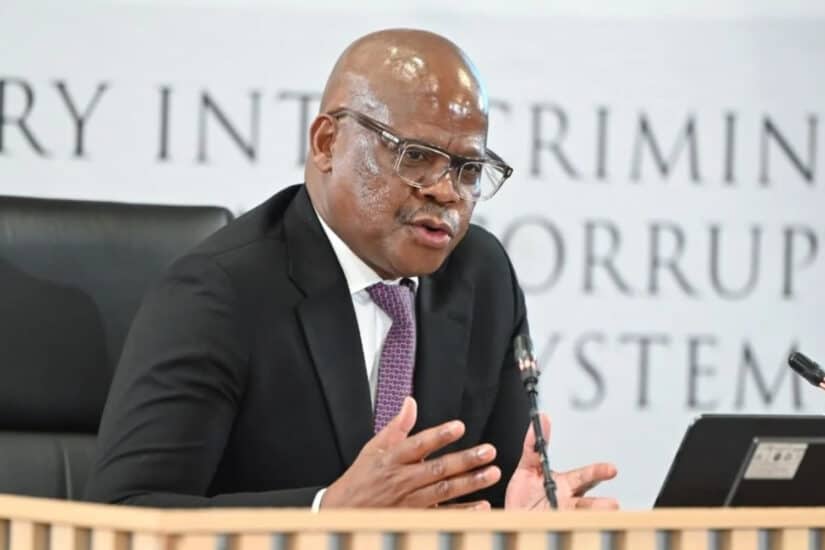
Johannes ‘Joe Ferrari’ Sibanyoni appearing before Madlanga Commission. Picture: Gallo Images / Frennie Shivambu


Kwaggafontein taxi boss Joe ‘Ferrari’ Sibonyoni has admitted that he formed a partnership with a mining businessman in order to profit from tender regulations.
Sibonyoni was again before the Madlanga Commission of Inquiry on Tuesday, where he faced questions on his business dealings as a taxi operator.
The commission was yesterday shown a WhatsApp message that evidence leaders argued was proof of a protection racket, with Tuesday’s questions centring around a tender to upgrade the R572 Moloto Road through Ekukhanyeni.
Evidence leader Matthew Chaskalson read the statement of businessman Tengane Ntuli, who alleged that Sibanyoni and accomplice Bafana Sindane forced him to pay protection fees to secure a contract related to the tender.
Sibanyoni denied any wrongdoing, claiming his involvement was part of a legitimate deal to help Ntuli secure the contract.
‘Started doing business’
Chaskalson confirmed whether Sibanyoni was from Pretoria or Kwaggafontein, with the witness stating he had been a “Kwaggafontein person” since the age of five.
Sibanyoni explained that Ntuli had mining rights at a quarry, and that they met to discuss the possibility of what the former called “local content”.
Tender regulations stipulate that 30% of contract work needs to go to local businesses, which was a stumbling block for Ntuli, who is based in Middelburg.
Sibanyoni said he and Ntuli came to an agreement, with the taxi boss claiming he paid R900 000 as an investment into the partnership.
Chaskalson began to probe the payments, and Sibanyoni became agitated, noting he was facing extortion charges related to accusations made by Ntuli.
“Chair, where I am seated with the matter of Mr Ntuli, it’s a matter that is sub judice.
“For us unpacking it bit by bit, it’s a matter that does not make me feel comfortable, because it is a very serious offence. It’s a very serious case that sits in Delmas.
“If Mr Chaskalson is pushing this matter, that it must be heard here, it prejudices my rights. Why do we do that?”, he asked.
“He must just go straight to the matter. Like I have said: I know Mr Ntuli; he came to my house, and we started doing business. As to the merits, can we allow the Delmas court to do that?”
No knowledge of taxi violence
After brief interjection by commission chair Mbuyiseli Madlanga, Chaskalson asked Sibanyoni about a text message containing five names: Mandla, Norman, Mshinga, Trinity, and Suprice.
The taxi boss said he knew two: one was his nephew, and the other was the son of a taxi associate.
The names belonged to the victims of a shooting, with Chaskalson inquiring as to whether Sibanyoni had any knowledge of construction mafia or taxi-related violence.
Sibonyoni denied that he knew of such things, with the evidence leader and commissioners expressing their doubt over his answer.
The brief distraction allowed Chaskalson to return to the line of questioning about Sibonyoni’s relationship with Ntuli.
Sibonyoni asserted that he and Ntuli had initially agreed a 50-50 split of the profits, before Sibonyoni accepted a 60-40 split on the basis that Ntuli had greater industry experience.
“The understanding was him and me; we were of a different age – 60 plus – therefore, when we are talking to each other, it’s not a matter of us bluffing or fooling each other.
“It’s a matter that adults are talking, adults are agreeing on the matter,” the taxi boss said.
‘Based on my involvement’
Pressed on how the deal was structured and whether the main contractor was aware, Sibanyoni said the Project Liaison Officer (PLO) facilitated communications, and he and Ntuli would share the proceeds.
“From there, Mr Ntuli will be to supply materials from the quarry based on my involvement for him to get the local content.
“As he does that business, we go to profits. On the profits, because he is the one who is running that quarry, we ended up saying he gets 60% because you are directly involved running the quarry, give me 40% of that,” he said.
The commissioners wanted clarity on how the 30% was comprised, with Sibanyoni stating the figure was limited to the local share, not the main contractor’s 70%.
“As you have mentioned, Mr Ntuli supplying the quarry; it’s 100% standing. Then I partner him just in that space.
Sibanyoni said other local contractors supplying equipment and labour made up portions of the 30%, but their agreement was only based on quarry materials.
“All those things combined, they form that 30%. So, Ntuli and I come with the supply of that precious stone,” Sibanyoni said.



