Lamola recalled how former president Thabo Mbeki described the 2001 Durban gathering as heralding a 'new internationalism'.
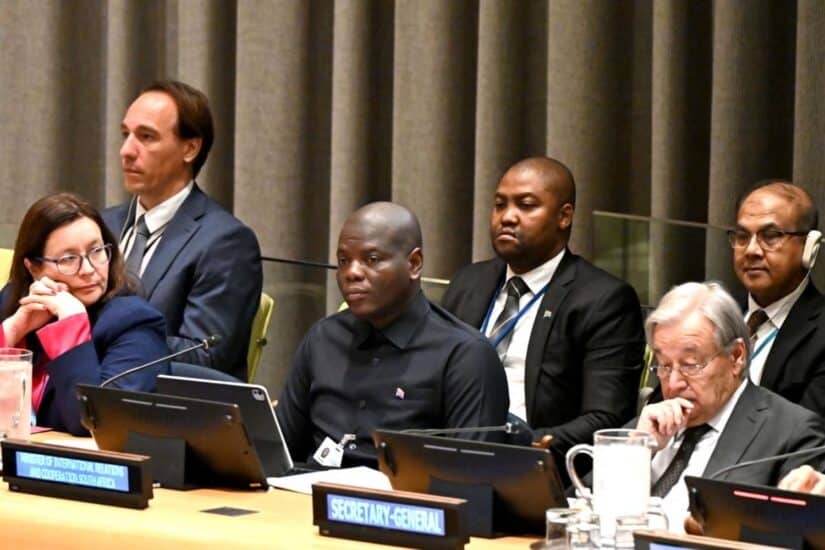
International Relations and Cooperation Minister, Mr Ronald Lamola attended the opening session of the High-level Meeting to Commemorate the 25th Anniversary of the Adoption of the Durban Declaration and Programme of Action. Picture: Dirco.


International Relations Minister Ronald Lamola has called on the world to renew its fight against racism and intolerance, warning that the legacies of slavery, colonialism, and apartheid remain deeply embedded in global systems.
Lamola delivered the remarks at the UN General Assembly’s high‑level meeting on Tuesday, 28 September 2026, marking the 25th anniversary of the Durban Declaration and Programme of Action (DDPA), a 153‑page framework adopted in 2001 to confront racism, xenophobia and the oppression of Indigenous peoples.
Durban Declaration
Lamola recalled how former president Thabo Mbeki described the 2001 Durban gathering as heralding a “new internationalism” aimed at repairing the damage of the past.
“The Durban Declaration and Programme of Action marked a pivotal moment in the international community’s commitment to build a world rooted in equality, dignity, and justice. But racism and related intolerance will not be defeated through state action alone. Civil society, communities, and ordinary people have a vital role in changing reality.”
Racism
Lamola warned that racism, xenophobia, and gender inequality are resurging, fuelled by online hate speech and backlash against redress measures.
“Contemporary racism against Africans and people of African descent is still embedded in the institutions, systems, and practices that govern human affairs. This is why we must strengthen our collective efforts,” he said.
Inequality
He linked inequality and insecurity to rising hostility towards migrants, cautioning that scapegoating fuels division.
“Failure to cooperate leaves the door wide open for actors whose conduct runs counter to the principles of equality, dignity, and human solidarity.”
Progress
Despite the challenges, Lamola pointed to progress, including Ghana’s leadership in securing UN recognition of the transatlantic slave trade as a “gravest crime against humanity” and Togo’s push to correct distortions in global maps that have long diminished Africa’s size.
Lamola urged reparations, truth‑telling, formal apologies, and the return of cultural artefacts, stressing that the envisaged UN Declaration on the Human Rights of People of African Descent must put into practice efforts to redress past injustices.
“Twenty‑five years ago, we recognised that Durban marked the beginning, not the end. The task of building a world free of racism, righting the wrongs of the past, and restoring the human dignity of all is as much ours today as it was then.”
Past wrongs will not right themselves.
– DIRCO South Africa (@DIRCO_ZA) September 28, 2026
Historical distortions do not correct themselves.
And progress is always a product of struggle.
We need to remain resilient to move forward in building society free of racism, xenophobia and related intolerances.#DurbanDeclaration pic.twitter.com/IQrcDbWmh0
US and Israel
The 2001 declaration was adopted by consensus, though the United States and Israel withdrew over clauses relating to Israel and Palestine – including the recognition of refugees’ right of return, a provision Palestinians link to the Nakba of 1948.