Mayor Dada Morero outlined his administration's achievements while calling for a wider discussion on Johannesburg's future.
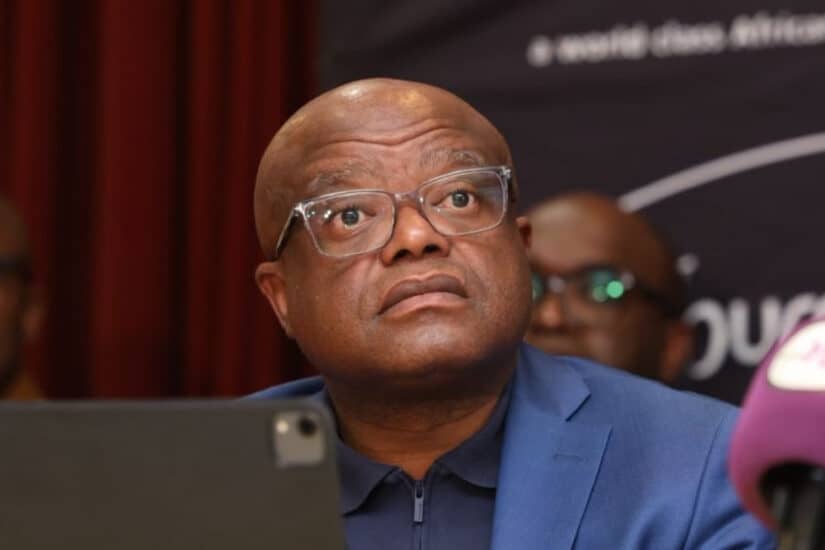
Johannesburg Mayor Dada Morero. Picture: Supplied / City of Johannesburg


Johannesburg Mayor Dada Morero still believes that the best way to achieve results in the municipality is through persistent dialogue.
Morero was at the Soweto Theatre on Sunday, where he gave his Mayoral Lecture under the theme: Joburg, our first love.
The mayor said development was hollow if it wasn’t accompanied by dialogue, as open discussions allowed for directional adjustments when necessary.
“As we implement, we must never forget to talk. Sometimes you may think you are on the right path; later you realise you are on the wrong path.
“We are in your homes, shops, cemeteries, clinics, clubs and on the road. Please invite us to your spaces so that we can talk and shape the future of Johannesburg,” said Morero.
Greater access to services
In what could be his last such lecture, Morero highlighted several successes of this administration, including under his mayorship and those of his predecessors
He claimed that since 2021-22, 7 700 households had gained access to basic water, 7 000 households gained access to basic sanitation and 21 000 dwellings were connected to the electricity grid.
Morero said Johannesburg’s “good air quality days” rose from 181 in 2023 to 240 in 2025, and that health service patient surveys recorded satisfaction scores of between 80% and 84% across his mayorship.
Among the successes listed, Morero cited a 9 000-unit housing development in the south of Johannesburg currently under construction, improved emergency services fleet capacity and “31.6 million fatality-free kilometres” achieved by Metrobus.
Morero claimed a 2025 plan that “reimagined” the city was beginning to bear fruit, evident in public-private partnerships, digital transformations, inclusive economic growth, renewable energy and civil society and community-led initiatives.
The mayor said infrastructural challenges stemmed from an increase in households from 1.4 million in 2013 to an estimated 2.29 million currently.
“We must also talk about the service delivery pressures it has created. This pressure is most visible in informal settlements, backyard accommodation, subdivided properties and lower-cost parts of the inner city,” Morero said.
Municipal shortcomings
While the mayor’s figures were welcomed, residents pointed to the municipality’s multiple shortcomings.
Johannesburg has been under a financial cloud for over a year, with Eskom repeatedly threatening to cut the city’s supply, with the debt only settled in August.
Pikitup has experienced collection delays throughout 2026; the city’s roads remain potholed and unpainted; unplanned power outages are frequent; and the billing department perpetually leaves residents fuming, among other issues.
Freedom Front Plus’ Johannesburg mayoral candidate Franco de Lange said the city’s infrastructural problems were rooted in a gross lack of maintenance.
He added that the questionable appointment of contractors amplified the problems, as projects often missed deadlines, ran over budget, or went incomplete.
“The problem lies in supply chain management where there are unscrupulous contractors who have been handling these service delivery projects.
‘The systems are broken, the systems are not properly maintained, and I think that is one of the mayor’s biggest failures is to secure the existing infrastructure,” De Lange told The Citizen.
He added that his party was calling for the scrapping of all black economic empowerment (BEE) regulations, especially in instances related to government contracts.
“There must be open opportunity for all and the best company with the best experience and the best quote must get these contracts,” said De Lange.
‘Let us keep talking’
The FF+ candidate noted the high volumes of lost billable services – roughly 48% of water lost due to leaks and 28% of billable electricity lost to illegal connections – as greatly disadvantaging ratepaying residents.
“You have to protect your tax base and the people who pay the rates and taxes in the city. The mayor can speak about many new projects and things that were implemented, but where does the real problem lie? It lies in the maintenance of existing infrastructure
“Unfortunately, if it comes to general maintenance – road, water, electricity, street lights, traffic lights, underground piping – that has all been neglected,” said De Lange.
Morero said on Sunday that “we need to talk about the difficult things” that were plaguing Johannesburg.
“Some of you may be positive or negative. At the end of the day, we must talk and talking must form part of our culture because the Constitution demands we talk and plan together.
“In the African culture, we talk during good and bad times. Through talking we solve problems,” said Morero.
Admitting the city could not budget its way out of the R220 billion infrastructure backlog, Morero said key aspects of the city needed discussion.
These included urban renewal as a vehicle for economic and spatial transformation, infrastructure development as a job creator, developing Johannesburg as a Smart City, and turning public transport corridors into investment hubs.
“In support of the national dialogue, which is a citizen-led process initiated by President Cyril Ramaphosa to address critical national challenges and shape a shared 30-year vision for the country, let us keep talking,” Morero concluded.