Expert warns that although poverty rates are declining, the tax base that enables government spending is being squeezed.

Picture: iStock


Poverty is decreasing, and while even some South Africans living below the poverty line don’t consider themselves poor, those powering the economic machine are feeling the strain.
A recent report on subjective poverty showed that roughly one in four households considered themselves poor, despite almost 40% of households falling below the lower poverty line.
Both numbers had improved in the last decade, and StatsSA boasts improved monthly percentages for key industries, but experts warn against a “fragmenting” of society.
Poverty self-perceptions
StatsSA on Monday reiterated that households self-identifying as poor had dropped from 34.4% in 2015 to 25.7% in a survey released in 2026.
However, 37.9% of South Africans still fell below the lower bound poverty line (LBPL) – down from 46.7% in 2015.
“Subjective poverty refers to individuals’ or households’ own perceptions of what constitutes a socially acceptable standard of living and, based on these perceptions, whether they consider themselves to be poor.
“People’s experiences of poverty are shaped by a range of factors beyond income, making subjective measures an important complement to traditional poverty indicators,” StatsSA stated.
The social perceived wealth question (SPWQ) asked those heading households to rate their household’s financial position out of six, from wealthy to very poor.
Options six and five were “very poor” or poor”, with option four of “just getting by” being the first of the neutral or positive answers.
KwaZulu-Natal had the highest LBPL rate at 49.6, with a SPWQ of 28%. The Western Cape had the lowest LBPL with 21.4% and a closer SPWQ with 16.%.
Buffalo City and Nelson Mandela Bay were the municipalities with the highest LBPL with 39.6% and 36.2%, yet their SPWQ’s differed at 35.4% and 21.4%, respectively.
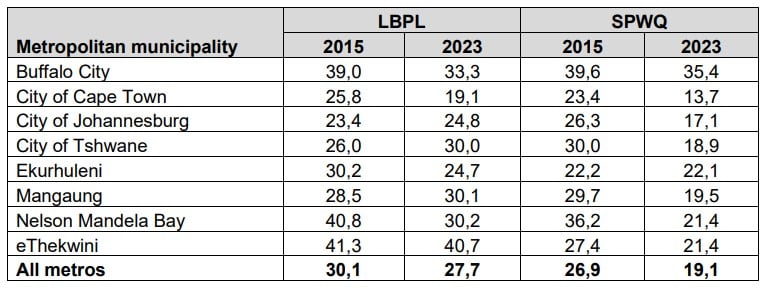
Above: The LBPL and SPWQ trends in metropolitan municipalities since 2015. Source: StatsSA
‘Aggregates mask the underneath’
Chris Hattingh, Executive Director at the Centre for Risk Analysis, explained that stats on the poverty line can be misleading.
He added that questions over wealth self-perceptions were “relative and adaptive” as they were measured against peers and fellow communities.
“A falling headcount rate doesn’t mean falling absolute numbers if population growth is uneven, and it says nothing about the depth of poverty for those still below the line.
“People recalibrate what ‘poor’ means to their own reference group over time. A national subjective poverty rate falling from 34.4% to 25.7% can partly reflect shifting expectations rather than improved material conditions,” Hattingh told The Citizen.
StatsSA stated that mining, tourism accommodation, as well as wholesale and retail motor trade had increased, but Hattingh elaborated on the underlying factors of the numbers.
He explained tourism numbers were the result of foreign and higher-income group expenditures, while motor and mining numbers were the result of fuel and mineral sales, but not an increase in production or higher economic volumes.
“Price windfalls in a handful of commodities don’t translate into broad-based hiring. They often fund capital projects or shareholder returns rather than headcount, and coal-dependent regions and mines are still shedding jobs.
“Sectoral aggregates mask the underneath: a few large, price-boosted or foreign exchange-exposed dealers dominate an aggregate while independent operators file for liquidation,” Hattingh said.
Stressed tax base
In mid-2014, South Africa had roughly 16 million people receiving social grants, with that number having increased to roughly 28 million by 2025 when including those receiving the Social Relief of Distress grant.
National Treasury earlier this year allocated R292.8 billion for the social assistance grants for the 2026/2027 financial year.
Hattingh stressed that there were increasing pressures on the middle class that severely hindered investment, consumption, and formal job creation.
These included municipal service delivery failures and the interest rate hikes that increase the cost of servicing bond payments, vehicle finance and credit cards.
“The middle- and upper-income groups are the tax base and the consumer demand base that finance both the state’s redistribution capacity and the retail and services jobs that absorb entry-level and informal workers.
“Squeeze that group through unemployment, high real borrowing costs and failing municipal services, and you constrain the very mechanism that would pull people out of poverty faster than cyclical commodity windfalls can.
“Unemployment at 32.7% and rising liquidations are the more direct measures of what’s happening to firms and workers,” said Hattingh.
Weighing up the positives and negatives, Hattingh added that “both pictures are true”, as poverty data was a long-term trend and industry data could be tracked monthly.
“Our assessment is that South Africa is fragmenting: pockets of genuine improvement sit alongside deepening distress without either fully offsetting the other,” Hattingh concluded.