Government plans to buy 4 600MW of battery storage to protect South Africa's electricity supply.
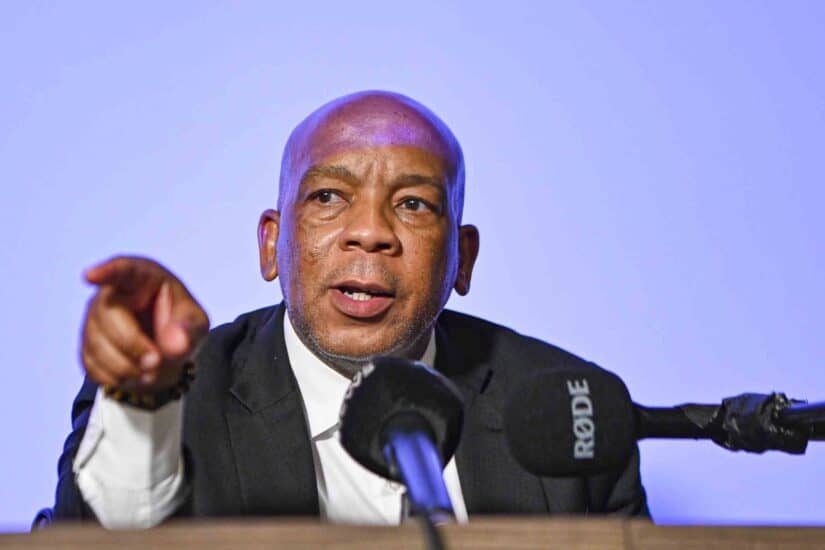
Minister of Electricity and Energy Dr Kgosientsho Ramokgopa warns municipal debt could balloon significantly if decisive interventions are not implemented, however, he makes mention of measures that have been in place for a while and have yielded limited success. Picture: Gallo Images/Volksblad/Mlungisi Louw


Energy Minister Kgosientsho Ramokgopa said on Wednesday that South Africa had more electricity than it needed, while some households remained in the dark.
Speaking to the media at a briefing held in Hatfield, Pretoria, Ramokgopa said many homes “have no electricity, because they just can’t afford to buy the units”.
He also announced 4 600MW of battery storage and a new gas programme for South Africa.
Electricity affordability and load reduction
Ramokgopa said excess power did not guarantee households access to electricity.
According to Ramokgopa, electricity supply and access were different.
He said Eskom did not set prices. The National Energy Regulator of South Africa (Nersa) decided tariffs based a policy last introduced in 2008. Ramokgopa said the gap needed to be closed. “We want to resolve it, going forward,” he said.
He said the electricity pricing policy was meant to address the issue.
“Electricity can be available on the grid, but in many instances, it’s not accessible. By that, I mean, people can’t afford the price of electricity.
“We are generating excess electricity, but their households now, as I speak to you, have no electricity, because they just can’t afford to buy the units,” he said.
Outages and communities willing to pay
According to Ramokgopa, the public had previously been invited to comment on the new electricity pricing policy.
He said residents had told him they wanted to be billed properly.
“We are prepared to pay,” he said they told officials, asking municipalities “to please formalise us”. He said new transformers cost about R500 000 each, so the fix needed major funding.
Ramokgopa said officials were also studying how to use surplus daytime power to benefit households and industry, subject to regulator approval.
He cautioned that policy development took time. It “addresses both the moment and tomorrow”, he said, adding that there was no answer yet on prices and that he would “come back” with details.
Load reduction
Ramokgopa linked load reduction to illegal connections, growing informal settlements and weak municipal planning.
According to the minister, overloaded local networks, driven by illegal connections, informal settlements and weak municipal planning, are the main causes of load reduction.
“We accept that if you don’t roll out that programme, you are going to continue to have a situation where people don’t have access to electricity,” he said.
He added that load reduction had ended in seven of nine provinces. “I’ve made the point that we have kept up to our promise to the country,” he said.
Why battery storage was fast-tracked
The government will procure all 4 600MW of battery storage allocated under the Integrated Resource Plan (IRP) 2025 to ease pressure on the grid, Ramokgopa announced.
The IRP had expected about 2 200MW of storage to be procured by 2030.
Ramokgopa said the allocation was more than doubled because excess electricity generation was already straining the system.
“We don’t wait for the future; the problem is now,” he said.
According to the minister, the system operator could manage for now, but renewable projects coming online would worsen the situation.
He warned of the cost of delay. “So if you don’t address it now, we are likely going to revert back to a situation of crisis,” he said. “We have to get the megawatts onto the grid and relieve the pressure from the system operator. If we don’t make this intervention, we are going to see the big problem.”
Gas and power parks plans
An official at the briefing said bids for the first gas-to-power round had closed on 29 May 2026 and were in final evaluation.
A further 5GW was set aside for a second round.
“We know the importance of gas; it provides dispatchable power, which will answer some of the problems that we are currently trying to resolve,” the official said.
Ramokgopa said the next power parks round would be announced before the end of the calendar year.
The independent power producer (IPP) office would run procurement before the end of the financial year.
He said the state would prepare land approvals, studies and bulk services to cut upfront costs for developers.
“The state will carry that responsibility,” he said. Eskom would compete on equal terms with other generators, he added.