

Bluebottles: Mysterious ocean dwellers
Learn more about these little blue bubbles and what to do when stung by one.
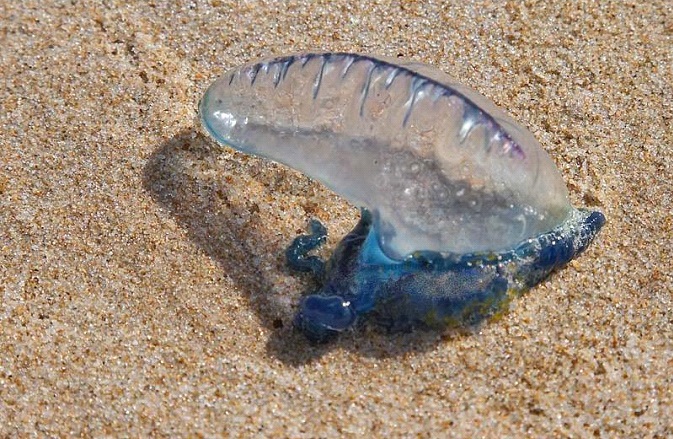
Bluebottles can be a curse to sea-loving residents of coastal towns.
The bubble-looking animals wash up on beaches and at some point, everyone has experienced the fiery sting, but few know more about the mystical creatures they really are.
Bluebottles are siphonophores, an odd group of colonial jellyfish. Rather than being a single organism like the jellyfish, these are actually made up of several colony members called persons.
These members include feeding persons, reproductive persons and stinging persons.
Like the bluebottle, some siphonophores also have a gas-filled bladder, this is the ‘bubble’ we recognise bluebottles by.
Together this colony contains male and female parts so are able to reproduce asexually, meaning the bluebottle makes clones of itself.
Siphonophores are the most poorly studied of all jellyfish, which are in turn among the most poorly studied of all invertebrates. In fact, evolutionary biologists have been mystified by the ocean dwellers. It has been debated as to whether they are an individual or a colony.
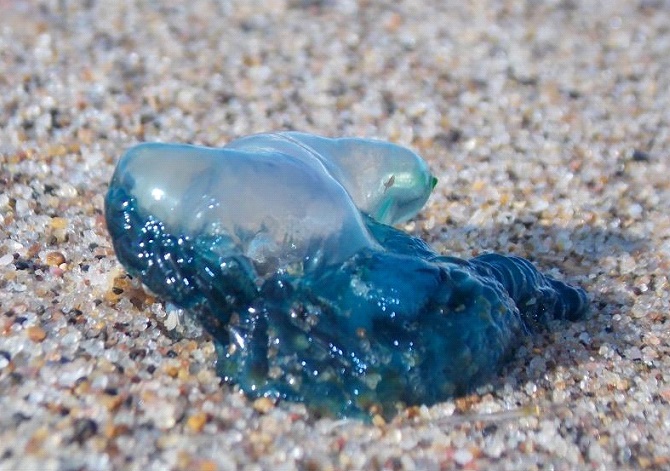
Photo: Marius Calitz
Like a colony, they share resources, but like an individual they cannot survive if separated. The collective noun for the creatures, is a ‘flotilla’ of bluebottles.
Bluebottles are not ambidextrous, this means that some are left-handed and others are right-handed. These creatures are drifting along on the wind, but their direction is not determined by wind alone.
A left-sided bluebottle drifts rightward from the direction the wind blows and a right-sided one drifts leftward. This explains the even distribution of these animals throughout the oceans.
“Blue bottles do not seek out humans as prey but if we happen to be in the water at the same time as them and we come into contact with one of their tentacles, it will trigger a reflex release of nematocysts (stinging cells),” explains marine biologist, Ann Kunz, of the South African Association for Marine Biological Research.
If a bluebottle feels threatened, it is able to deflate its ‘bubble’ and go into a submarine mode for a while. Their sting is different to that of a jellyfish, so while a jelly’s sting can be treated with vinegar, this is not ideal for a bluebottle’s and it can actually cause more discomfort.
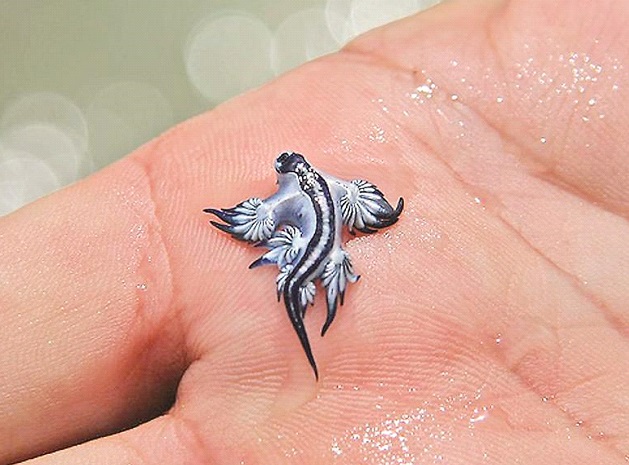
Photo: Earl Baillache
Another mystical-looking sea creature, the blue sea slug actually feeds off the stinging part of a bluebottle. This dragon-looking animal then stores the stinging proteins and uses the substance to protect itself against predators.
What to do when stung by a blue bottle
When suffering from the whip-like sting, try these remedies:
- Carefully remove all tentacles with the tips of your fingers as only a harmless prickling can be felt. As itchy as it may be, do not scratch the area or rub sea sand on it.
- Rinse the remaining tentacles off with seawater, as freshwater could irritate the affected area.
- Place the stung area in hot water, as hot as can be tolerated. If the area is unrelieved by the heat or if hot water is not available, apply cold packs or wrapped ice.
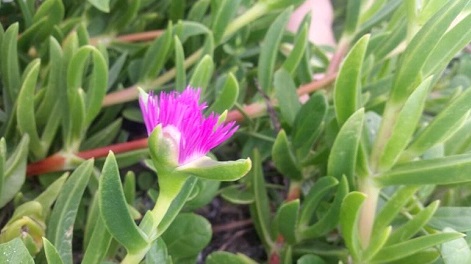
- The most soothing remedy occurs right in the dunes, from a fleshy succulent with pink flowers. Once breaking open the leaves, apply the aloe-like gel to the stung area. One will experience almost immediate relief.
- If the symtoms persist or for stings that cover a particularly large area or across the throat and face, seek medical assistance.
>> Ready to say ‘I Do’ on the Dolphin Coast? Meet the team ready to advise, help and deliver on your big day.
>> Visit our Education feature for a collection of all the best schools, tutoring systems, and even some colleges and training facilities on the North Coast.

Do you want to receive news alerts via WhatsApp? Send us a WhatsApp message (not an sms) with your name and surname to 061 718 4438.
Please read our WhatsApp broadcast list disclaimer.
Join us on BBM at 59015786
Join the conversation on Facebook, Twitter and Instagram
Stay in the loop with The North Coast Courier on Facebook, X, Instagram & YouTube for the latest news.
Mobile users can join our WhatsApp Broadcast Service here, or if you’re on desktop, scan the QR code below.