
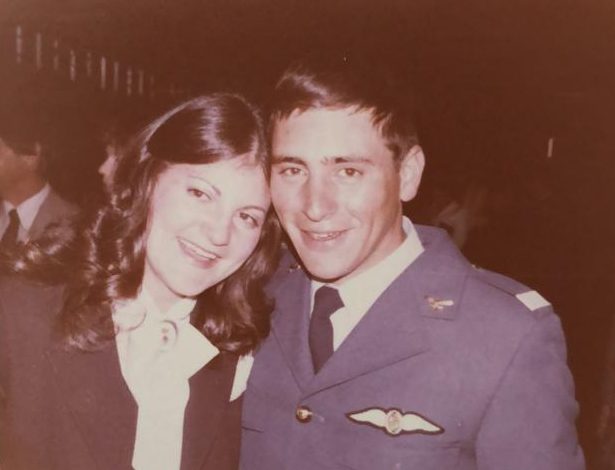
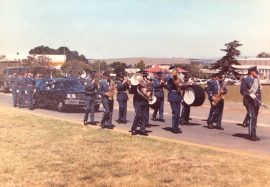
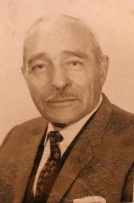
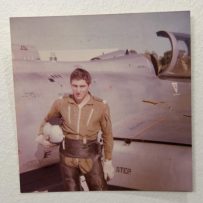
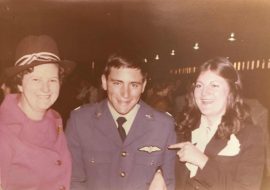
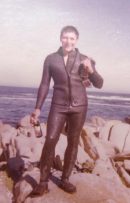
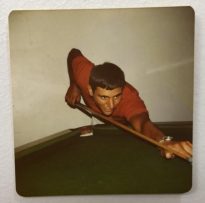
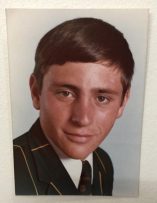
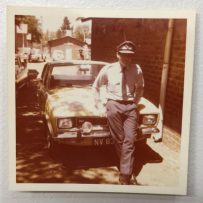
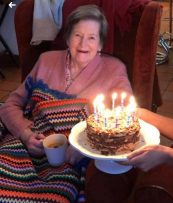
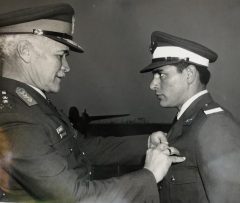
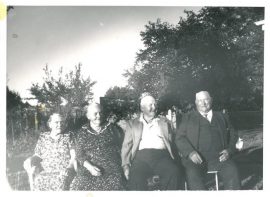
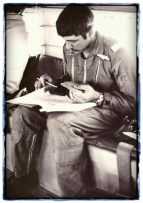
Researched and submitted by André van Ellinckhuyzen “Loyalty was Johan’s strongest personality trait,” wrote Engela Leeuw about her brother, whom she fondly named “Boet”. His first and sadly only motorcar was a yellow second-hand Hillman Vogue with the old black and white NV registration plates, but his most prized possession was his motorcycle. When he was still only a small boy, it was clear that he already loved airplanes. His bedroom walls were littered with posters of all types of aircraft, and the hobby that occupied most of his free hours was building scale model airplanes. Engela continued: “Johan had a really big heart and for him, family took precedence over all else. Johan was a bit of a poet and like most of his school mates, he loved the music of their time. His death came as a huge shock to us… and to this day, a bottomless pit remains in our hearts.” The Vryheid Gazette, April 4, 1980: “Leeuw. Die begrafnis van Johan Heinrich van Vryheid het plaasgevind op 31-3-1980 om 11h00 vanuit die NG Kerk (Moeder). Begrafnisreëlings AVBOB, Utrechtstraat 169, Tel. 2691 Vryheid.” Johan Heinrich “Boet” Leeuw was born on Tuesday, November 19, 1957, in Potgietersrus (Mokopane) in the Limpopo Province. His father was a Free State farmer, Dirk Cornelius Leeuw, who was born in Harrismith in 1914 and died at Vrede in 1977. Johan’s mother was Johanna Aletta Christina Botha, formerly Leeuw, who was born Griesel in 1932 and fondly known to her family, children and close friends as “Baby”. Dirk and “Baby” were married in 1951 at Cottesloe near Johannesburg and they were divorced in later years. During her years in Vryheid, Baby was employed as a bookkeeper at one of the local motor dealerships, Ritchie Ford. In her twilight years until her death in September 2019, she lived with Johan’s only sibling, Engela Maria Leeuw Bloch (ex Jansen van Vuuren), in Durban. Johan Heinrich was named after his grandfather, Johan Heinrich Leeuw, who was a farmer on the Vaalspruit and Mieliebult farms at Vrede in the Free State. Johan started his schooling career as a six-year-old at Nuwe Republiek School or “NRS” in Vryheid. When his family moved to Bloemfontein, he was enrolled at Laerskool Sentraal, where he completed his junior school years. Later, the family moved back to Vryheid, and Johan matriculated from Vryheid High School at the end of 1975. Johan excelled at target shooting and gained his provincial colours in that sport. He displayed leadership qualities from a young age and it was therefore no surprise to his family when he was elected as a school prefect at the end of 1974 for his matric year in 1975. After the completion of his three months of basic military training, Johan started out his military career at No.1 Parachute Battalion in Bloemfontein, before receiving approval to qualify as an air force pilot. His boyhood dream was fulfilled the day he received his pilot’s wings at the Dunnottar Air Force Base near Nigel in Gauteng, flying the famous North American Harvard trainer aircraft. From Dunnottar, Johan transferred to the South African Air Force Base at Langebaanweg in the Cape Province, where he trained in and qualified on the Italian built Aermacchi “Impala” Fighter Jet. It was also there, in true “Cape West Coast culture style”, that Johan distinguished himself in “the art of shoreline snorkeling and lobster braais”. It was always Johan’s dream to one day be a commercial aircraft pilot for a company such as the South African Airways and therefore, when he was given the opportunity, he chose to operationally fly the Douglas C-47 “Skytrain” or “Dakota” troop carrier aircraft after he had completed all of the required training phases. For that purpose, the SAAF transferred Lieutenant Johan Leeuw to the South African Air Force 44 Squadron that, at the time, was based at Grootfontein in the north east of Namibia. On the morning of March 25, 1980, SAAF Douglas C-47 Dakota with serial number 6851 was assigned on a routine return flight from Grootfontein to Tsumeb, which is situated about 30 nautical miles north-west from there. The 22-year-old Lieutenant Johan Heinrich Leeuw and the 21-year-old native from Port Shepstone on the Natal South Coast, Lieutenant Cornelis Johannes Wessels, were assigned to pilot and co-pilot the aircraft. At the same time, there was an instruction for them to take on board a single Pax in the form of the 23-year-old Pretoria native, Candidate Officer Elna Susan Swart of the Air Traffic Control at Grootfontein Air Force Base. Halfway into the flight, Dakota 6851 nosedived and crashed into the ground, instantly killing all three on board. His remains arrived back in Vryheid late on the Friday afternoon, and on Monday morning, March 31, 1980, at 11am, Lieutenant Johan Heinrich Leeuw was buried with full military honours from the Dutch Reformed Church (Klipkerk) in Vryheid. A military band walked at the front of the cavalcade from the church and all the way down High Street to the cemetery, where he was laid to rest. A single bugler sounded ‘The Last Post’ as his coffin was lowered into the grave. A few years later, Lieutenant Leeuw’s name was inscribed on the War Memorial at the St Peter’s Anglican Church in Vryheid, as well as on the SAAF Memorial at Bayshill at Swartkop, outside Pretoria. Per Aspera ad Astra (Through Hardships to the Stars)
ALSO READ: Soldier boy Heine Jonck didn’t give up without a fight
Make sure you follow us on our social media platforms for regular updates