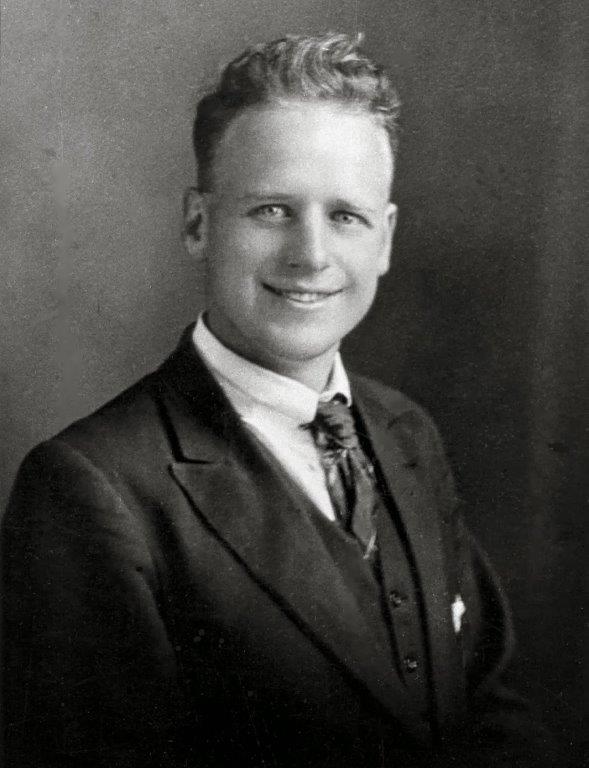
He was a lad of just 12 years old when the well-known writer, Herman Charles Bosman, came to Potchefstroom in 1917, a century ago this year.
Bosman later became one of South Africa’s most famous writers and is well-known for his humorous short stories with signature twist endings. He was the son of Elisa Malan and Jakoos Bosman and was born in Kuilsrivier near Cape Town on 3 February 1905.
Bosman’s mom, Elisa Malan was a Potch girl. Her father, Pietie Malan, came to Potchefstroom from Porterville, bought land and a house in town and settled down. Elisa was the eldest of six children and her brother, two years younger, was Charles Malan.
Elisa taught at the old South School, currently the ML Fick Primary School. She was described as ‘a sharp-nosed, myopic woman, her unremarkable looks concealed a remarkably incisive brain and an equally incisive tongue’.
She was 28 years old when she suddenly left Potchefstroom and, on 26 April 1904, married Jakoos Bosman, a mine worker in Kuilsrivier.
By 1916, they were living in Krugersdorp and, in February 1917, Elisa, Herman and his younger brother, Pierre, were back in Potchefstroom. Jakoos was still looking for work on the Rand and Herman Charles was enrolled at the Potchefstroom College, currently the Potchefstroom High School for Boys. According to the school register, Bosman only enrolled on 25 July 1917, as pupil No. 689. He resided in Kruger Street (currently Beyers Naudé).
Although other sources say Pierre was also enrolled at Boys High, the school register does not reflect this.
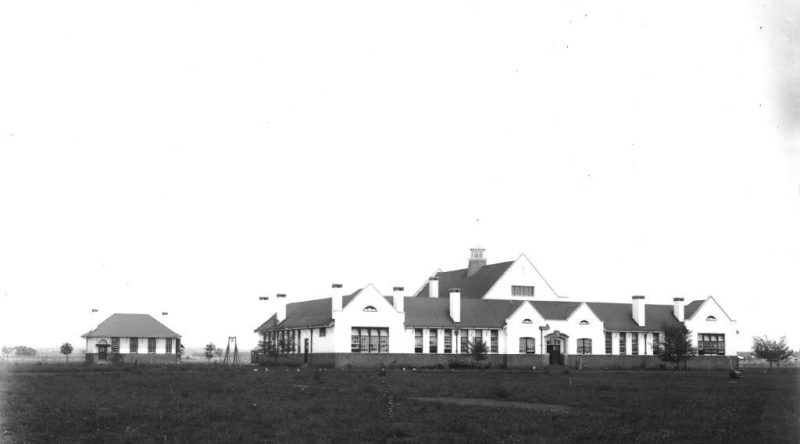
Boys High (then known as Potchefstroom College) opened its doors on 31 January 1905 as one of the elite Milner schools, built after the Anglo-Boer War.
A biographer of Bosman reports on his sojourn at Boys High: ‘The year at Potchefstroom College must have been the happiest of Herman’s childhood. The intellectual stimulation he received was manifest in his school marks: for the humanities, he scored close on an A aggregate, a mark he was never again to reach within the accepted disciplines.’
From the school register, however, it appears that Bosman left the College in December 1917, thus only being a student there for about six months.
Bosman and the Herald
Herman’s uncle, Charles, after whom he received his second name, was a prominent figure in Potchefstroom and also provides Herman’s tenuous association with the Potchefstroom Herald.
Charles Malan was much more of a father figure to Herman than his own dad. He was a brilliant student and the first to achieve 85% in his final law exam at the Victoria College, later the Stellenbosch University. He then went into legal practice.
The founder and first editor of the Potchefstroom Herald was CV Bate. With the purpose of strengthening the position of the South African Party, which was pro-British, in the Western Transvaal, CV Bate started an Afrikaans newspaper. De Westelike Stem debuted on 12 August 1915 with Charles Malan as its first editor.
Herman and his family relocated to Johannesburg and he started school at Jeppe Central on 3 June 1918. It was in this school’s paper that Bosman’s first literary work was published.
He studied at the Johannesburg College of Education and was posted to teach at a farm school in the Groot Marico district in 1926. It was there that he saw and met the prototypes of many of the characters in his entertaining short stories. One of his biographers suggested that Christoffel Lombard, a pioneer Voortrekker of Potchefstroom, might have been the prototype of Bosman’s character, Oupa Bekker.
While on holiday in Johannesburg during the school holidays of that year, he shot and killed his step-brother. Bosman was sentenced to be hanged and spent nine days in the death cell at the Pretoria Central Prison. This sentence was reprieved and changed to 10 years’ hard labour, but he was released in 1930.
His semi-autobiographical work, Cold Stone Jug, recounts his memories from his stay in prison. Doris Lessing called this ‘the saddest of all prison books’.
Bosman was married three times. In 1934, he went to London accompanied by Ella, his second wife. They were repatriated to SA in 1940. During his time in London, one of his most famous short stories, ‘Mafeking Road’, was published in South Africa. A book of short stories, with the same title, was first published in 1947 and has never been out of print since then.
Of all the books he wrote, only three were published in his lifetime. Although he grew up in an Afrikaans-speaking family, he preferred writing in English and is regarded as one of a few writers who were equally at home in both English and Afrikaans culture. He died of cardiac arrest in his house in Johannesburg on 14 October 1951, at the age of 46.
In 2012, the English Department of NWU honoured Bosman with a lecture series. The first lecture, titled ‘The first literary genius that South Africa has produced’.was delivered by Prof. Annette Combrink.