
No South African athletics fan or Potchefstroomer will forget the glorious day of 31 July 1996 when one of their athletes, Hezekiel Sepeng, took a brilliant silver in the 800-metre final at the 1996 Olympic Games in Atlanta.
Sepeng’s victory was a massive boost for the nation since their reintroduction into international sport in 1992 and showcased that South Africans and a Boys’ High alumnus could make waves on the global stage.
Twenty-four years later and Sepeng still looks back at this momentous achievement with great appreciation and pride. He is still involved in athletics and now gives back to the sport with his Hezekiel Sepeng Foundation, street athletics and as excellence manager at Athletics South Africa.
“It was fantastic to become the first black South African to win an Olympic medal at that 1996 event. That feeling of being on the podium and saying to yourself that, ‘I’ve done it, I have a medal for my country’ is memorable,” remembers Sepeng.
He ran a time of 1:42.74 in the final, which was a top-10 time in the rankings. Vobjorn Rodal won the race in 1:42.58, just in front of Sepeng, with Kenya’s Fred Onyancha in third, in a time of 1:42.79.
Sepeng’s come-from-behind last 100-metre dash to second place was one of the highlights of Atlanta 1996.
See the race here:
https://www.youtube.com/watch?v=duQ-Wg0SzvU
“The only thing I would change about that race would be my mindset before the final. I needed a stronger belief that I could win the final as I was in great shape. I planned to wait until the 2000 Olympics for a medal and it did not happen. It made me realise that you must use your opportunity now and not to wait for tomorrow,” he states.
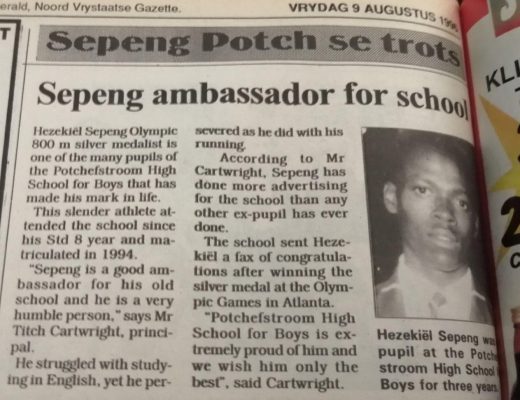
Sepeng’s welcoming after getting a medal was covered in full in the Potchefstroom Herald, which met and spoke to his family and his former teachers at Boys’ High.
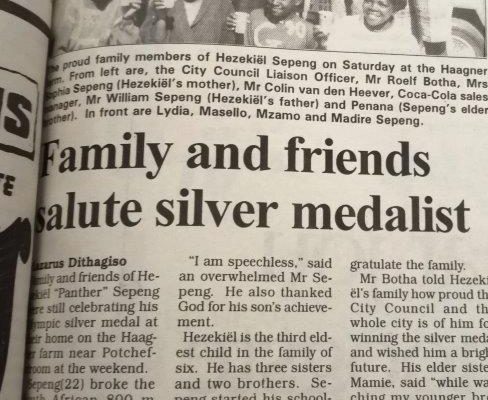
“The most memorable moment on my return was to see how workers at the Haagner Farm in Boskop were given a day off to celebrate my achievement. During our parade, we also met the former president, Nelson Mandela,” he mentions.
“Being at Potch Boys’ High was a motivation for me, as I was given a scholarship for athletics and academics, so I was under pressure to perform. My mentors were the coach, JP van der Merwe, and Mr John Blake, the principal of the school. I really appreciated all the teachers at Potch Boys and my hostel, Granton House. The school made it possible for me; they believed in me – from the teachers to the scholars,” adds Sepeng.
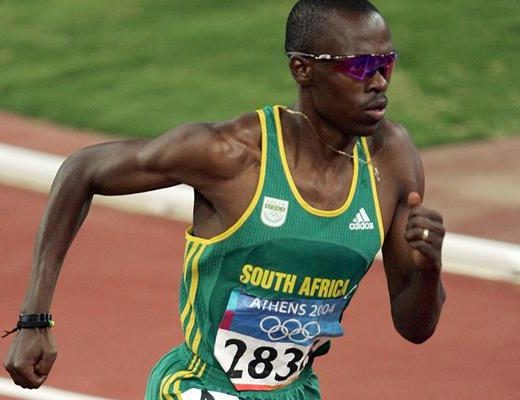
Since retiring from athletics, Sepeng has invested his time in creating new champions and identifying talent with street competitions.
“We identified athletes in 2014 and started training them to prepare for the 2020 Olympics. We have two athletes with the potential to qualify for the Olympic Games. We also organised a successful Hezekiel Sepeng 10 km Legacy Run at the McArthur Stadium last year. Due to the coronavirus, we have cancelled the 2020 race, but we will be back again in 2021 for our second edition,” emphasises Sepeng.
A career in athletics has several high and low points as well as some humorous and extraordinary situ-ations – something Hezekiel is all too aware of. He ends the interview with such an experience in Holland.
“André Olivier – my training partner – and I were at the train station in Holland and I was waiting for André inside the train with our luggage. The train was about to go and André was not on board, so I tried calling him outside the train. Just after I went out, the train started! Not knowing what to do, I tried pulling the train back because our bags were inside. I later realised what I was doing – trying to pull that massive train!”