
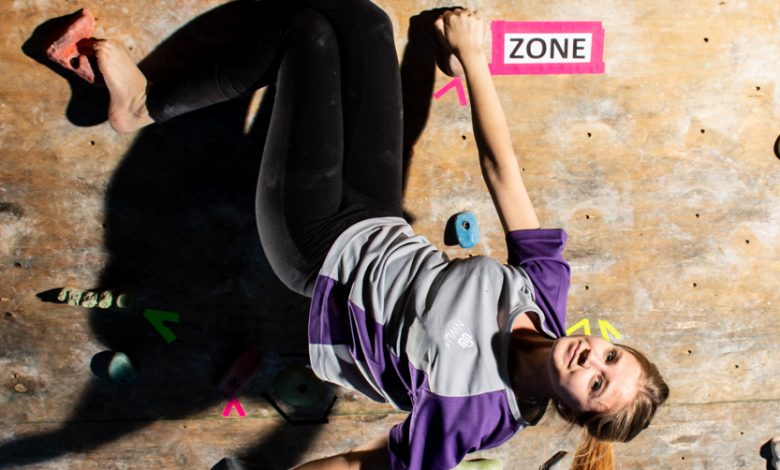
If you want to feel the adrenalin pumping through your veins as you step towards and reach your next target, then North-West Uni- versity has the perfect recreational sport for you.
Rock climbing might not be the top sport in terms of participation on the campus. Still, it provides an opportunity to become part of a tight-knit group of avid supportive climbers who enjoy new challenges, indoors and out.
NWU’s rock-climbing aficionado, Abigail Mitchell, was one of those students who was intro- duced to the sport and has never looked back – hooked from the first moment.
“I heard about it from a friend and joined the club in February 2018. I did not plan to dedicate myself and time to the sport; however, I found myself climbing there almost daily and developed a passion for the sport and a good relationship with the fellow- climbers. Because I was there four times a week, my technique im- proved greatly, which motivated me to stay up until now,” she states.
Mitchell is one of about 40 dedicated climbers at the NWU, who use two specialised areas on campus to climb.
“Students can climb at the boul-d-ering cave (inside the gym area on campus) or at “the Wall”. Bouldering is a form of climbing that is used to practise technique and train. No equipment is used as the area is three metres high and safety mats are used. Climbing routes are set here weekly. “The bouldering cave always has at least 10 courses to choose from, so if you’re not coming right on the one, you just move on to the next.
The wall, situated at building G16, is used for top rope and lead climbing. Here, 12 routes are set, the difficulty ranging from beginner routes to advanced climbing. The club provides the necessary equipment (ropes, harnesses, belay devices and quick draws) as well as training and supervision to ensure that students know how to use the equipment properly and safely,” explains Mitchell.
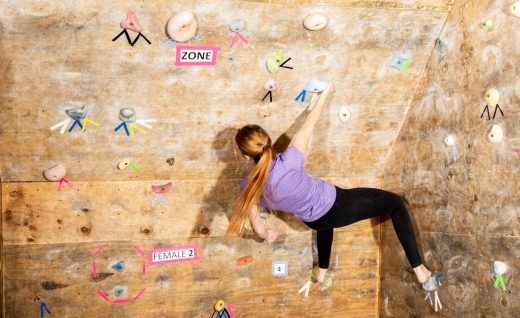
The bouldering cave is open from Mondays to Thursdays (15:30–19:00), and the wall is open between 16:00–18:00 from Mondays to Thursdays (also depends on the weather). Students may attend in their own time.
According to Mitchell, no fees are involved when joining the club, as it is a recreational sport. Friendly competitions between fellow climbers are organised to measure progress and encourage proper training. If students wish to compete in national competitions, they must enter themselves personally.
“The club also makes frequent trips (usually one Saturday per month) to City Rock (the climbing gym in Johannesburg) to help develop technique and for leisure. They also arrange an annual trip to Waterval Boven in Mpumalanga so that students can experience climbing outdoors,” she adds.
Naturally, you need certain skills to excel at the sport.
“Balance, a great amount of finger strength, explosive power, flexibility, core strength and endurance. What’s great about climbing is that most routes require different skills.
In the club, we have the climbers who excel in routes that require a lot of balance and finger strength, others who excel in climbing long routes at the wall, or those who can use their explosive power for dynamic movements (jumping from one grip to the next).”
Mitchell’s exercise routine, as a regular climber, is one that includes an intensive warm-up and practising different routes.
“I start my training by stretching and warming up. This is extremely important to prevent injuries like ankle sprains. I usually climb two or three easy routes to warm up. Afterwards, I train my fingers. In the cave, we use a fingerboard and campus board. This is done by just hanging on two or three fingers per hand for about 10 seconds and repeating it about 10 times,” she explains.
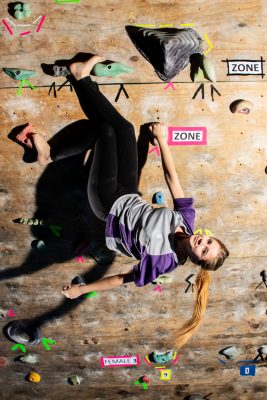
“Afterwards, I’m ready to climb, which I do for about an hour and a half. Climbing and practising different routes are the best ways to train if you want to improve your technique and strengthen the specific muscles needed. Because it’s fun, you don’t tire so easily,” she adds.
“Some days, I’ll do basic exercises like planking, pull-ups/push-ups or even jogging with the other climbers to keep fit. In my free time, I slackline (you practise walking on a five-centimetre strap off the ground that’s at least 10 metres long). This is a separate sport, but most climbers do it to improve their balance and core strength. It is extremely effective.”
According to Mitchell, rock climbing is a very personal sport where you can go at your own pace and feel a real sense of accomplishment.
“When you’re climbing a route, it’s just you and the wall; you don’t focus on anything else. When you get to the top, you feel accomplishment, especially if you have been projecting the route for a while. Because it is not a team sport, your only competition is you.
Only you measure your progress. One week, you will struggle with a certain move and the next, you get it right at the first try. The routes are always different and unique, so you’re never stuck on the same one for too long.”
Mitchell’s top highlights as a climber are the trips to Waterval Boven and City Rock.
“Spending time in nature, doing what you love is the perfect medicine for the soul. Also, seeing a fellow climber beginning to excel is so satisfying…I don’t think that happens in any other sport,” she says.
She says rock climbing takes time to master and first-timers should not drop out after struggling at the first attempt. There will most likely be avid climbers to encourage and assist.
“If you are interested, come with people you are close to, or come alone and ask one of the climbers to assist you; they are always willing to help and are very friendly. I’d say the biggest challenge is getting the climbers to challenge themselves. While some excel after a few months, others are stuck at the same level for more than a year, not because they don’t train, but be- cause they stick to the type of routes they are comfortable with, so they don’t improve.”
For more information, contact Abigail Mitchell on 064 190 3398.