
Polokwane water crisis: Blame traded as city’s taps run dry
Polokwane’s water crisis worsens as Lepelle Northern Water and the municipality face mounting backlash over repeated shutdowns and delayed restoration.
POLOKWANE – The water crisis in Polokwane has reached breaking point as weeks of dry taps and prolonged planned maintenance shutdowns leave thousands of residents across the city and Seshego without consistent supply.
What was initially presented as a series of 48-hour shutdowns by Lepelle Northern Water (LNW) has spiralled into almost week-long outages with no end in sight.
Residents are angry, businesses are struggling and confidence in both the bulk supplier and the Polokwane Municipality is collapsing.
The latest shutdown, initially scheduled for October 15–16, once again dragged on well beyond the promised time frame, leaving reservoirs dry and residents furious.
Read more: Technical failures delay water supply from Olifantspoort Plant
Large parts of the city, including Penina Park, Flora Park, Ivy Park and other areas endured almost six days without a drop of water.
The Polokwane Review-Observer spoke exclusively to both entities for answers to the deepening water crisis.
LNW responds
LNW maintains that the interruptions form part of a long-term upgrade to the ageing Olifantspoort Scheme, which it says will “enhance the assurance of supply” once complete.
“The contractors appointed by LNW are highly qualified to execute the project works,” said LNW spokesperson Joe Makhafola.
“The quality of the work meets the highest standards of the South African Bureau of Standards, as prescribed by the Department of Water and Sanitation. Our quality control processes are rigorous, and a comprehensive quality assurance procedure must be signed off before reinstating operations after every shutdown,” he told the Observer.
But residents are not convinced.
Despite repeated shutdowns for maintenance, the same sections of pipeline, including the Specon line and pumpstations continue to fail.
When asked why a 48-hour shutdown consistently becomes a week-long crisis, Makhafola said:
“After each 48-hour shutdown, the system is normally empty. Given the high demand for water in the city, higher-lying areas typically receive water later than lower-lying areas once operations resume.”
LNW insists no negligence has been found in its projects and that there is consequence management measures in place for contractors’ work.
“The contracts with our service providers include penalty clauses for negligence or poor performance. To date, no incidents of negligence have been observed. LNW adheres to the highest quality standards, guided by the relevant regulatory prescripts mentioned above,” Makhafola said.
However, with water outages now routine, the public wants accountability, not explanations.
LNW deflected responsibility for delays, pointing to ageing infrastructure dating back to the 1970s and ongoing funding challenges.
“Both LNW and the Polokwane Municipality have approached various funding institutions, including the National Treasury and the Development Bank of Southern Africa, to secure financial support for this extensive project,” said Makhafola. “It requires over R18bn to refurbish and upgrade the systems for a more reliable and sustainable supply.”
Makhafola maintains that LNW are doing utmost to address the water challenges faced by the residents of Polokwane, given that water is a basic human right and a lack thereof affects not only day-to-day life, but schools, public health, businesses, and essential services.
When asked what concrete steps are being taken to rebuild public confidence after weeks of inconsistent water supply, Makhafola said the planned shutdowns will continue as communicated.
“These shutdowns are necessary to ensure the long-term reliability of the water supply by replacing pumps and motors that have reached the end of their useful life. Failure to complete this work would compromise the sustainability of future water services. The project is being executed by a team of highly qualified contractors and engineers, furthermore, the Premier of Limpopo established a Water Supply War Room in January 2025 to monitor progress in Polokwane. Weekly updates are provided on the challenges and progress to ensure assurance of supply,” he said.
Polokwane Municipality acknowledges frustration
Meanwhile, the municipality insists it is doing everything it can to manage the crisis.
“We acknowledge the frustration caused by the recent water supply interruption that affected several areas of the city,” said municipal spokesperson Thipa Selala.
“We are working closely with our bulk supplier, LNW, to stabilise the system and prevent future prolonged outages.”
Selala said coordination exists “at both Executive and Technical levels” and that the Municipality has a reservoir management strategy to mitigate future shutdowns.
“We have implemented a strategy that includes filling key reservoirs such as Specon, Witkop, Palmiet and Rasfontein in advance of planned maintenance. Once the Sand River Project is commissioned, the city will gain augmentation through multiple water sources, reducing vulnerability,” Selala explained.
When asked if the municipality has conducted any assessment on how these repeated outages are affecting households, schools, and businesses in Polokwane, Selala said they continuously do so.
“Our operational approach is centred on efficiency, responsiveness and sustainable service delivery that supports the growth of Polokwane as a thriving economic hub,” he told the Observer.
According to Selala, it is the municipality’s responsibility to ensure that emergency measures are activated whenever there are shutdowns.
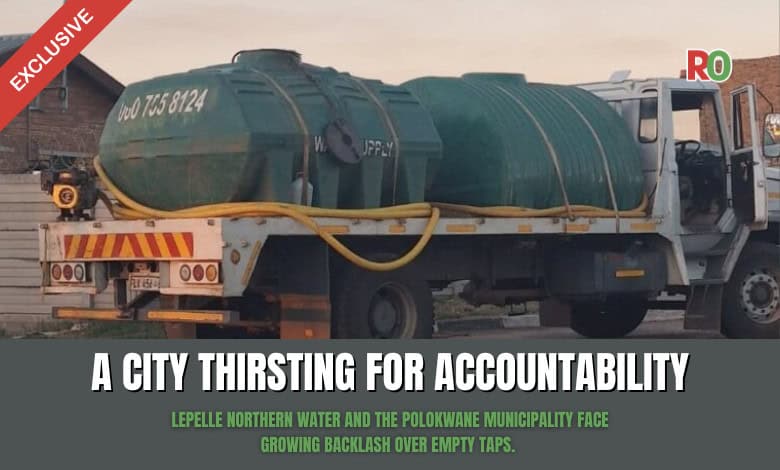
“This includes deploying water tankers and managing internal reticulation systems to minimise the impact on communities. Importantly, the municipality operates its own fleet of water tankers, instead of leasing, to save ratepayers’ money and redirect funds towards critical infrastructure upgrades that will strengthen system reliability in the long term,” he said.
The municipality currently operates 37 water tankers, distributed across seven supply clusters, but breakdowns and high demand mean not all areas receive regular relief.
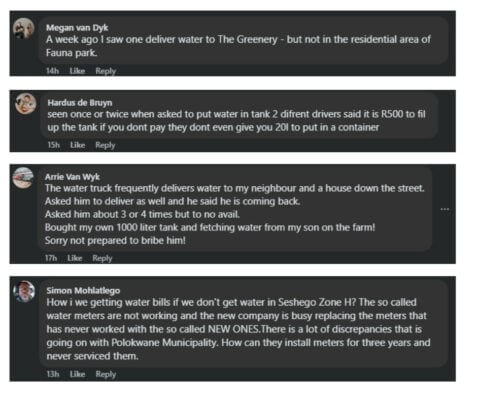
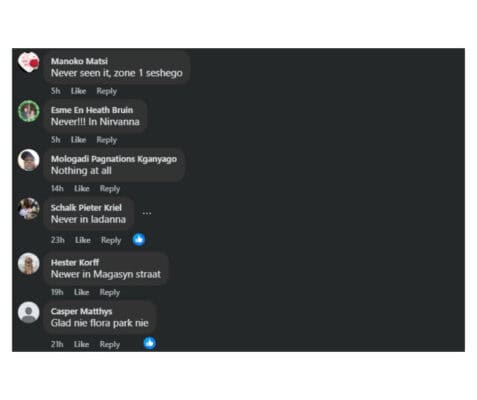
During a quick survey on our social media platforms, however, the resounding answer was that many residents have never seen a tanker in their area.
HAVE YOUR SAY! During Lepelle Northern Water's 48-hour shutdowns, how often do you see water tankers in your area?
— Polokwane Observer (@PolokwaneObserv) October 28, 2025
Selala added that the planned shutdowns, while inconvenient, are technically necessary to prevent a total system collapse.
“We have, however, raised the need to include stronger accountability mechanisms and penalty clauses during the upcoming review of the service agreement to ensure planned maintenance does not translate into prolonged outages.
Despite both entities promising progress, residents say the reality on the ground is unchanged.
Water trickles sporadically, tankers are stretched thin, and the city’s promises, like its taps, are running dry.
With more shutdowns scheduled in November and December, many fear the “upgrades” could keep Polokwane in crisis well into the festive season.
The upcoming planned shutdowns are as follows:
• October (28–29): Ebenezer Scheme
• November(12–13): Olifantspoort Scheme
• November (21–22): Olifantspoort Scheme
• December (3–4): Olifantspoort Scheme