
In response, Minister of Sport, Arts, and Culture Gayton McKenzie verbally pledged R100 million for women's sport.
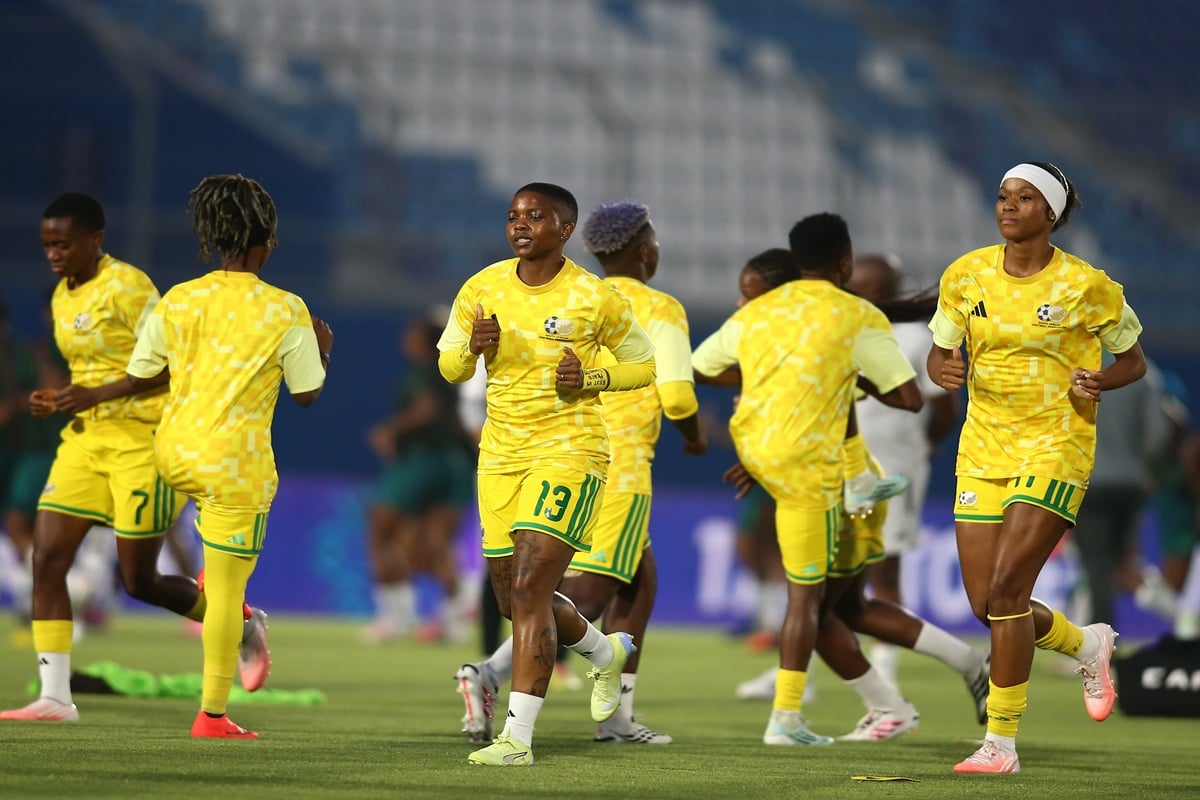
Women’s Africa Cup of Nations, FIFA World Cup Play-Off match between South Africa and Nigeria in Casablanca, Morocco. Picture: Zamani Makautsi/Gallo Images


Despite making the 2026 Women’s Africa Cup of Nations (WAFCON) quarter-finals and competing in all 13 editions to date, Banyana Banyana are still being asked to play on an uneven field at home.
A Commission for Gender Equality (CGE) report found that South Africa’s women footballers continue to deal with grievances such as unclear payments, scarce sponsorship, and shared kits.
These concerns were revisited at a sports, arts and culture portfolio meeting where Minister Gayton McKenzie verbally pledged R100 million for women’s sport in response to the critiques.
Money, secrecy and sponsorship
The 2024 report put fresh pressure on the Department of Sport, Arts and Culture (DSAC) and the South African Football Association (Safa), following a CGE presentation on its findings during the meeting.
The report identifies funding and sponsorship as the most urgent challenges facing women’s football.
Although Safa said in 2023 that Banyana Banyana players would receive the same R572 000 appearance fee as Bafana Bafana players, the women told CGE that payment arrangements remained unclear.
“About funding and sponsorship, there is secrecy around discussions, documents, finances. Nobody really knows anything; it is all speculative. No one knows the exact figures, for one player or exact figures from the sponsor for Banyana Banyana. There is a lot of secrecy,” one player said.
The report also contrasted that Banyana Banyana received R1.2 million in rewards after winning the 2022 WAFCON, while Bafana Bafana players received R520 000 each after reaching the quarter-finals of the 2019 Africa Cup of Nations (AFCON) – R120 000 more per player despite not winning the tournament.
Sasol, described in the report as Banyana Banyana’s only sponsor, said the women’s team had fewer sponsors than the men’s team.
“There’s a lot of history in terms of the support for Bafana Bafana, that’s better than Banyana Banyana. As a result, it’s still going to take hard work and time to change that history because it’s not an isolated issue,” the sponsor’s representative said.
DSAC officials, meanwhile, said about 90% of the department’s funding to sporting codes was intended to support women’s sport. However, the CGE said it was unclear what that percentage represented in monetary terms and concluded that funding remained insufficient.
Where’s the improved player welfare?
MP Eugene Mthethwa from EFF expressed frustration over the absence of clear records showing how earlier support, including a reported R5 million advance paid in 2024-25 by Safa to resolve player payment crisis, had improved player welfare.
At that meeting, the Safa representative could not provide an answer on how that money had specifically contributed to improving women’s participation.
R100m pledge raises expectations
The immediate next step after McKenzie’s “unapologetic” R100 million commitment to women’s sport is a workshop involving Safa and other sporting federations to develop a distribution plan for the funding.
The creation of a professional women’s football league is expected to take priority.
Banyana Banyana coach Desiree Ellis also told Parliament that a professional league was essential for the game’s survival because many players still work full-time jobs and train in the evenings.
“A professional league is of utmost importance. We lose players because they have to put food on the table. We lose players because they work weekends. Players work nine-to-fives. They train in the evening, and these same players are the ones that play for the national team,” Ellis said.
“Can you just imagine if they just needed to concentrate on football, where we would be in women’s football?”
Coach Ellis’ observation is supported by the 2024 report. The CGE warned that female athletes could suffer from anxiety and depression without proper support, noting that a lack of stable professional opportunities often forces players to take second jobs.
Shared kits and unequal travel support
The report says inequality also shows up in the everyday conditions under which players prepare for national duty.
One player said Banyana Banyana shared kits and tracksuits with Amajita, the men’s under-20 team, rather than having equipment reserved for the senior women’s national team.
“As far as attire (kit) is concerned, we share it with Amajita [the men’s under-20 team]. Yes. And one must consider that we are women. If I have a game today, I must take my kit with me and go wash it for the next game.
“Now imagine if I get periods while playing. Even the casual attire that we wear, like tracksuits, is not for Banyana only. The under-20 team use it as well,” the player said.
The CGE said the arrangement reflected a lack of sensitivity to players’ health, hygiene and needs. It also said the women’s team appeared to be treated as less important than Bafana Bafana, although both are senior national sides.
Local players also reported having to pay their own way to training camps and claim transport money afterwards.
“We get money for transport, but only after the tournament or camp. You travel, you claim only afterwards,” another player said.
“For locals you must get yourself to camp. You only get the money when you go back home. They do not care about the kilometres, we get R400 transport allowance,” she said.
In Parliament, Safa said it was trying to address fundamental resource shortages, including access to proper facilities, rather than merely “ticking boxes”.
Policy must move from paper to practice
MPs questioned whether existing policies had produced meaningful change.
They also acknowledged that women’s sport often lacks the high-profile promotion routinely given to men’s tournaments, with some members conceding that they themselves had not consistently attended or publicised women’s events.
The CGE said DSAC’s Women in Sport policy, gazetted in 2023, must be finalised, implemented and monitored. It urged government and SAFA to stop treating women’s football as an add-on and instead build a properly funded professional ecosystem – from school pitches to the national team.
The department said it could not directly administer sporting codes. But the CGE argued that this did not remove its responsibility to provide leadership, funding, and oversight on transformation.
“As much as there might be issues that might seem to require direct intervention of the ministry, especially given the fact that Banyana Banyana represents the country, unfortunately, the Sports and Recreation Act is very clear in terms of the Minister’s powers, and the Minister cannot get involved in the administration of any sporting codes,” a DSAC official said.
The CGE responded that improving the national women’s team could not be left entirely to Safa.