Engelbrecht to be incentivised over a 'strategic period' with special share award.

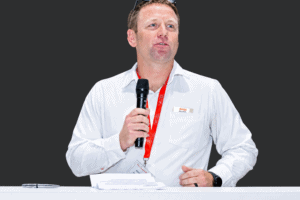
Shoprite CEO Pieter Engelbrecht. Image: Supplied


The CEO of Shoprite, Pieter Engelbrecht, received “total earned remuneration” of R117.79 million in the 2026 financial year, an increase of 35% on the prior year’s R87 million.
The sharp increase was as a direct result of the executive super stretch incentive (ESSI), under which execs were awarded share appreciation rights in October 2023.
Now, Shoprite is asking shareholders to approve a special award, the CEO Executive Share Plan (CEO-ESP), at its November AGM. This resolution requires a 50% plus one to pass.
It says this award is “designed to incentivise the successful delivery of a unique combination of strategic, transformational and succession-related outcomes and to secure his continued employment for a strategic six-year period”.
“The award addresses the delivery of a specific, time-bound set of strategic key initiatives that extend beyond the scope of the Group’s normal CEO incentive arrangements.
“The award is designed to align CEO reward directly with the successful delivery of future shareholder value.”
It adds that “the current CEO, Pieter Engelbrecht, has dedicated 29 years of continuous service to the company, including leading the group through a period of exceptional transformation, growth and shareholder value creation”.
“During this time, the company has strengthened its position as South Africa’s leading food retailer, built industry-leading digital capabilities, and delivered sustained market share gains in an increasingly competitive retail environment.
“Significant shareholder value has been created during the CEO’s tenure.”
Six-year retention plan
The plan is to issue Engelbrecht with 525 000 performance shares. At the current share price, these would be valued at R170 million.
Peter Cooper, chair of the remuneration committee (Remco), says “the CEO-ESP is designed to sustain future earnings growth, [ensure] successful delivery of strategic technology initiatives, strengthening organisational capability, developing future leadership talent and [managing] an effective and orderly succession process”.
The financial measures (each accounting for 35%) are market share growth and the internal rate of return of the total shareholders’ return (TSR).
For the first of these, the target is cumulative growth of 8.5%, while for the latter, it is cumulative growth of 12.5% per annum.
Then there are three non-financial measures (10% each): enterprise transformation (related to SAP), organisational transformation model, and group leadership transition.
Executive super stretch incentive
For the historical incentive, the ESSI, the group says the outcome for the three-year performance period is 100%. The value of Engelbrecht’s ESSI is R36.4 million, with settlement in thirds across the next three Octobers.
However, because the target was achieved in this financial year, the total is adjudged to be part of his remuneration for this period even if, in practical terms, this is not actually the case.
The ESSI works on two equally weighted measures: market share gains (with a 2.6% target) and relative TSR, versus its peer group including Pick n Pay, Woolworths, Spar, Dis-Chem, Pepkor and Clicks (with a target of 8.9%).
On the first measure, it achieved a market share gain of 3.2%, according to NielsenIQ, while its TSR for the period was 49.9% (versus 8.9% for the peer group).
Engelbrecht was granted 640 000 share appreciation units in 2023, with a strike price of R235.63. With appreciation of R56.88 (to the end of the financial year), these are worth R36.4 million.
The first R12.13 million tranche will be paid in cash this month, with the remainder deferred to October 2027 and October 2028. For those, executives may elect to have their entitlements settled in Shoprite shares.
Shareholders took issue with the ESSI in engagements with the group’s remuneration committee during the year.
The committee said it “remains satisfied that the scheme appropriately rewards exceptional long-term outperformance and remains strongly aligned to shareholder value creation through market share and relative total shareholder return performance conditions”.
It argued that “the ESSI was a once-off share appreciation rights scheme designed to retain and motivate a select group of senior executives who [were] critical to the delivery of the group’s long-term strategy”.
The group stressed that the ESSI “does not form part of the ongoing pay mix strategy”.
CFO Anton de Bruyn was awarded 250 000 share appreciation right units in the ESSI, which translates to an achieved amount of R14.2 million.
CEO total pay
Engelbrecht’s total guaranteed salary was just over R22 million for the year ended 28 June 2026, an increase of 5% on FY25. His short-term incentive was R21.3 million as his one-year target was adjudged to be achieved at 108.3% (last year, this was at 96.9%).
The amount vesting under the executive share plan (ESP) was significantly lower than the previous year (R18.2 million versus R30.5 million).
This means Engelbrecht’s total earnings before deferrals under the executive deferred incentive (EDI) and ESSI was R64.4 million, 10% below the same figure for FY25 (R71.4 million).
Group pay gap
When calculating the difference between its highest-paid employee (Engelbrecht) and its lowest-paid one, it uses a different figure.
This disclosure is required under amendments to the Companies Act, which came into effect this year.
It says that on a total remuneration basis, which is linked to cash flow, Engelbrecht’s pay was R73 million for 2026.
“The difference arises from the timing of variable pay… TER [total earned remuneration] includes variable remuneration earned in respect of the current financial year’s performance, which is only payable after year-end, whereas TR [total remuneration] reflects variable remuneration actually paid during the reporting period, regardless of the performance year to which it relates.”
Its lowest paid employees are paid R64 000 a year.
It defines this as “a general assistant earning the national prescribed minimum wage; annualised over a 40-hour contract for a 52-week year”.
The group, the largest private sector employer in the country, says its average total remuneration is R151 000 a year, with the median at R93 000.
The ratio of the top 5% of earners to the bottom 5% is 14.4 times.
This article was republished from Moneyweb. Read the original here.