National Treasury acknowledges that South Africa is not getting the full economic and social benefits of government spending.
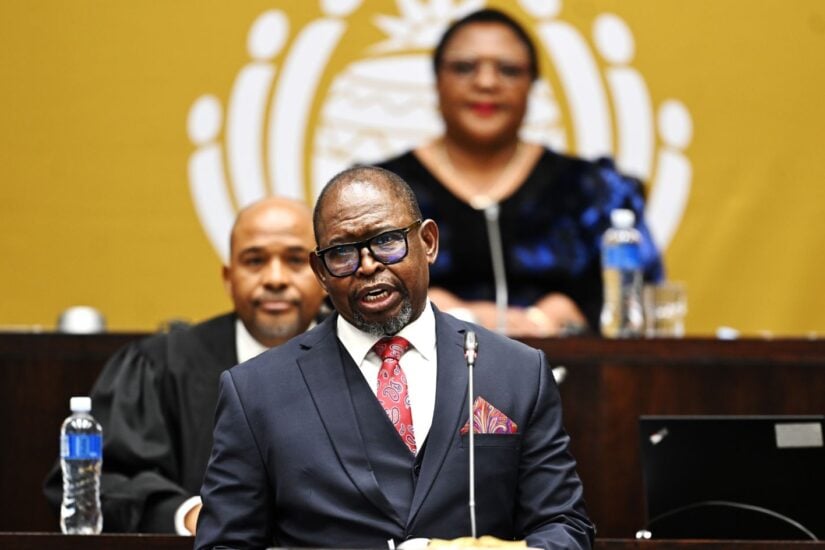
Finance Minister Enoch Godongwana delivers the medium-term budget policy statement in Cape Town on Wednesday, 21 October 2026. Picture: GCIS


Government’s consolidated spending is set to increase from R2.7 trillion to R3.02 trillion by 2029/30, growing at an average annual rate of 3.6%.
In the medium-term budget policy statement (MTBPS), National Treasury acknowledged that these allocations are large; however, South Africa is not getting the full economic and social benefits of its spending.
These allocations support frontline services, infrastructure and economic recovery. Achieving value for money in these allocations requires stronger budget discipline at all levels.
“Citizens experience the state most directly at the local level. Yet, the financial and operational performance of many municipalities remains weak,” said Finance minister Enoch Godongwana while delivering the MTBPS on Wednesday.
Improving the quality of spending
Consolidated spending is money used to run the country, including grants, interest paid on debt, social benefits, employee compensation, and goods and services.
Treasury has noted that improving spending quality requires a deliberate shift from funding activities to achieving results across all spheres of government. Budget reforms, programme reviews, and efficiency measures are underway to improve value for money, support affordability and fiscal sustainability, and protect frontline services.
“Improving the quality of spending by allocating funds to programmes that are efficient and effective is a fundamental reform to the budget process – a shift from incremental, input-driven budgeting towards strategic choices about outcomes, affordability and value,” said National Treasury.
“The fastest-growing spending category by economic classification is payments for capital assets at 5.3%, reflecting the government’s commitment to infrastructure investment.”
Where is the money going?
Over the medium-term expenditure framework (MTEF) period, R20.5 billion will be added to the provincial equitable share to compensate provinces for increased costs in health and education, and R21.8 billion will go to the local government equitable share for the increased bulk services costs for free basic water and sanitation, electricity and solid waste management.
Government will add R71.1 billion to main budget spending over the medium term to support health and education, strengthen local government, enable industrial development and infrastructure, and improve state capacity.
“As part of the government’s response to gender-based violence, R5.1 billion is allocated, mainly to employ additional social workers in provinces,” said Treasury.
Municipalities get the smallest share
According to National Treasury, over the 2027 MTEF period, national departments receive 47.4% of available non-interest expenditure, provinces 42.6%, and local government 10%.
“Provinces and municipalities face growing pressure from population growth, urbanisation and higher bulk electricity and water prices, along with the need to invest in assets such as schools, clinics, and water and sanitation infrastructure,” said Treasury.
“Government’s approach to the division of revenue aims to improve the way public funds are planned and spent in the face of these pressures. Transfers to provinces and municipalities are increasingly linked to credible plans, sound financial management and measurable improvements in service delivery.”
Treasury acknowledged that additional funding will not fix service delivery failures where planning, financial management and implementation are weak.
Municipalities to feel the pinch
Godongwana said increasing funding goes a long way towards addressing fiscal pressures in the local sphere.
“The issue can no longer be only about resources. It must also be about results. The priority now is to improve financial management, strengthen administration and eliminate waste.”
He issued a firm warning to municipalities that every rand transferred to local government must translate into visible improvements in people’s daily lives.
“Communities should have reliable water, functioning sanitation, well-maintained roads and safe, well-lit public spaces.
“With local elections approaching, citizens will judge municipalities by their performance and the quality of services they receive. The responsibility now rests with all municipalities to demonstrate that public resources are being used effectively and in the service of the people.”