Practically everything is for sale, including in-store screens, delivery trucks, till slips ...
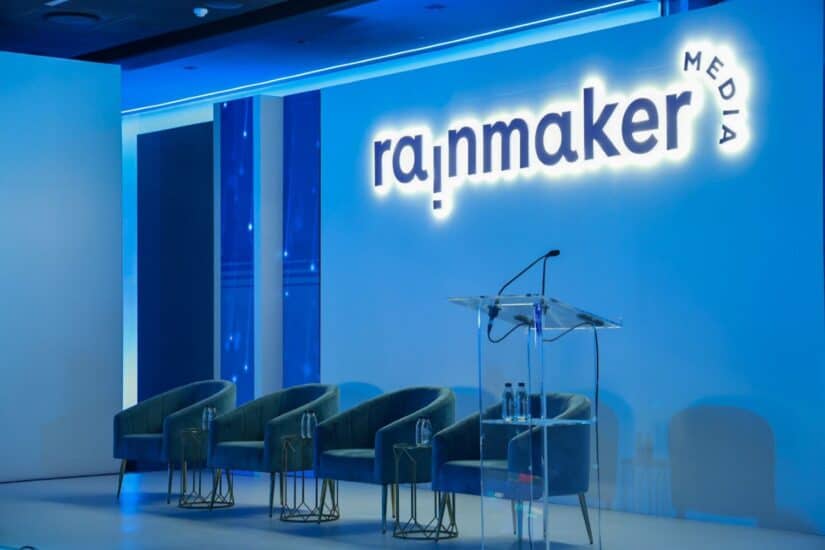
Rainmaker Media’s pitch? ‘Google knows what consumers are looking for. Facebook knows what they like. We know what they actually buy.’ Picture: LinkedIn/Rainmaker Media


The country’s largest grocery retailer, Shoprite Group, has rapidly built a marketing, media and consumer insights business that is set to generate more than R1 billion in revenue for this financial year.
At the half-year stage (26 weeks to 28 December), it reported revenue of R593 million from these activities.
Given that this segment is growing the fastest (16% in H1) among its so-called ‘alternative revenue’ streams, this will soon overtake the commissions it receives for in-store financial services (such as money transfers, payments, and the sale of insurance policies) as well as for ticket sales via Computicket.
Shoprite’s alternative revenue streams
That segment had revenue of R676 million in the first half. For comparison, fees from its OK Franchise business with 500 stores were ‘just’ R97 million in H1.
In total, the group will report between R3.5 billion and R4 billion in alternative revenue this year, which may seem minor in the bigger picture, with total revenue that will be more than R250 billion.
However, these alternative revenue streams have significantly better margins than selling cans of baked beans and maize meal (or even high-end Forage and Feast products at Checkers).
Its media sales are done through Rainmaker Media, a specialist agency that offers data-driven campaign precision to clients.
Scale, precision, zeroing in
It leverages its scale – 81 million shoppers each month and 1.1 billion grocery transactions measured annually – to offer targeting that is unmatched. This precision, it says, means “zero wastage”.
This stands in stark contrast to traditional media (both print and broadcast) that would typically always have some element of wastage, where consumers outside of an advertiser’s target audience are exposed to a campaign.
Rainmaker Media’s pitch is that: “Google knows what consumers are looking for. Facebook knows what they like. We know what they actually buy.”
It offers targeting on simple profile options (demographics, location, lifestyle) and also shopping behaviour, dietary and lifestyle preferences, categories and departments shopped as well as exposure to marketing.
It uses a blend of its own inventory as well as social media and other digital assets (app, email, USSD).
Not quite every square inch …
Inside its stores, it sells ‘on-shelf’ inventory, activation space (where brands set up sampling counters), spots on digital screens (at entrances, tills, behind Money Market counters, and in Liquorshop and Petshop Science stores), even the wraps for its security tag sensors at store entrances.
Almost everything is inventory. This extends to delivery trucks and the bottom of its till slips!
For the latter, if a shopper meets the target criteria, they will have an ad printed at the footer of their till slip (for, say, a third-party financial services product), while the next shopper in the queue who isn’t part of the target audience won’t. This is all done in real time.
The average consumer at its stores will not even realise that they’ll encounter dozens (sometimes hundreds) of paid-for messages from advertisers during their shop.
Across social media, the group uses its brands’ presence on platforms like Facebook and Instagram to push brand or product messaging organically, but it will also leverage its profiles and deliver paid-for (‘boosted’) campaigns for clients against specific target criteria.
Samples!
Based on trackable sales data from its Xtra Savings rewards programme, it is able to sell actionable detailed insights to its suppliers via its Rex platform.
Using this data, suppliers such as the large fast-moving consumer goods producers can optimise the sales of their products in the group’s stores and tweak their overall marketing strategies.
And although not specifically listed as ‘inventory’ by Rainmaker Media, one can be certain that the retailer is also selling targeted sampling for new products via Sixty60.
This is when smaller sample packs of new flavours or variants are included in deliveries for free to ‘surprise and delight’ shoppers … and get them to try the new product. These are not complimentary.
Numbers
Until this year, revenue from consumer insights was previously lumped with ‘other revenue from contracts with customers’.
Following this reclassification, one can easily derive how much money it makes from selling this data to its suppliers.
In the first six months of its 2024 financial year, it generated around R141 million in revenue from consumer insights.
For the full year, this would be above R250 million (because of Black Friday and the peak festive trading season, its first half is seasonally stronger than the second).
For comparison, the behemoth SABC reported advertising revenue of R2.8 billion in 2024/25 across seven TV channels and 18 radio stations, while the eMedia Group’s advertising revenue for the year ended 31 March 2026 was R2.2 billion.
The then-listed MultiChoice group reported advertising sales of R3.6 billion in its 2025 financial year via DStv Media Sales (the bulk of this – R3.1 billion – was from South Africa).
This article was republished from Moneyweb. Read the original here.