The economy is growing, but not enough to bring about meaningful change.
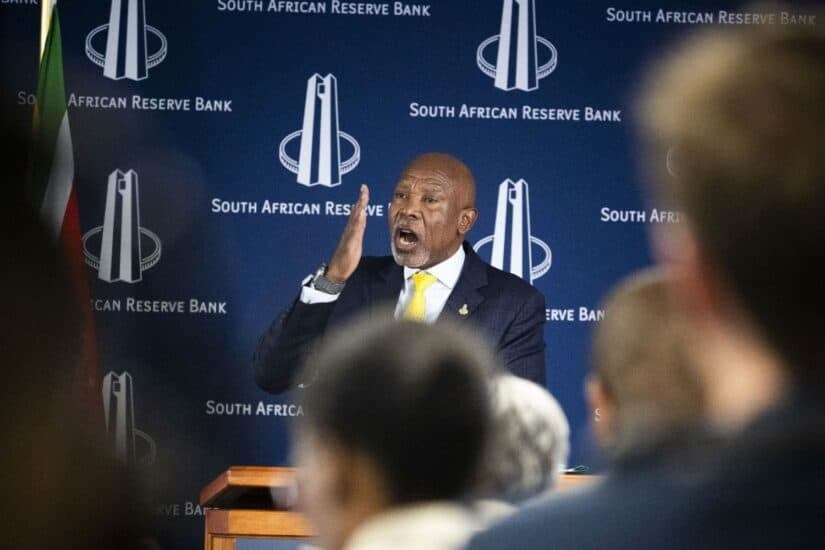
Governor of the South African Reserve Bank (Sarb), Lesetja Kganyago. Picture: Gallo Images/Alet Pretorius


South Africa’s economy has been growing slowly over the past few quarters, but many economists, including Finance Minister Enoch Godongwana have stated the pace of growth is not enough to make any meaningful change. So what is holding the economy back?
South African Reserve Bank (Sarb) Governor Lesetja Kganyago has answered the question, putting the blame on the state capture fallout, and not macro-policy.
He was speaking at the Principal and Vice-Chancellor Public Lecture and Leadership Engagement at the University of South Africa (Unisa) on Tuesday afternoon.
SA’s economic growth
The country’s real gross domestic product (GDP) grew by 1.1% last year, while National Treasury had expected a 1.4% growth. In the first quarter of 2026, the economy grew by 0.5%, which led analysts to be pessimistic about growth throughout the year.
Kganyago said the country’s economy is growing at a slow rate despite adopting the right macroeconomic policies.
“It is wrong and dangerous to argue that our growth stagnation is due to macro-policy. It is wrong because, as we’ve seen, many emerging markets adopted similar macro-frameworks, and almost everyone has grown faster than us.
“It is dangerous because it takes one of the few areas where we got things right and makes that the scapegoat for failures elsewhere.”
State capture hurts SA’s growth trajectory
He added that the real problem was “institutional destruction – a process often called ‘state capture’.” Kganyago was referring to the State Capture Commission, which was chaired by former chief justice Raymond Zondo from 2018 to 2022.
The commission concluded that the Gupta family had captured key levers of the state during former president Jacob Zuma’s administration, influencing appointments, procurement and policy decisions for their own benefit. Its findings detailed how the widespread corruption inflicted billions of rands in losses and severely weakened state-owned enterprises, including Transnet and Eskom.
“It devastated capacity in national government; it just about broke the state-owned enterprises; and it persists in the municipal failures we see around us today. The essence of state capture is that institutions are no longer run for public benefit.
“Instead, they are taken over and used to extract resources for private gain. For instance, the maintenance budget pays for a big tender which ends up buying someone three Ferraris, but there are still holes in the road.”
Private sector’s success hamstrung
Kganyago added that the private sector cannot perform to the best of its ability because state-owned enterprises are not functioning at the level they should.
“We have a large and sophisticated private sector in South Africa, and that’s the reason we are still much richer than our neighbours, even if we don’t grow. But that private sector has been in survival mode. Investment has stalled.”
He recently warned that dysfunctional municipalities are hurting the economy as they drive away businesses. Firms are not pouring their energies into growing their South African business; the ones that are here are treading water, and the others are in places where things work, like Australia, Canada, or Dubai, Kganyago said.
Since the poor performance of Eskom and Transnet, the Presidency and National Treasury established Operation Vulindlela aimed at fixing these two, and including the water challenges faced by the country.
Kganyago, however, has noted that progress is slow. “Output in the network sectors, based on measures like rail tonnage and port volumes, looks like a Nike swoosh, with a long decline and then an uptick at the end. In many areas, we are still below the 2019 levels of output.”