But this three-way tussle will be with us for some time yet ...
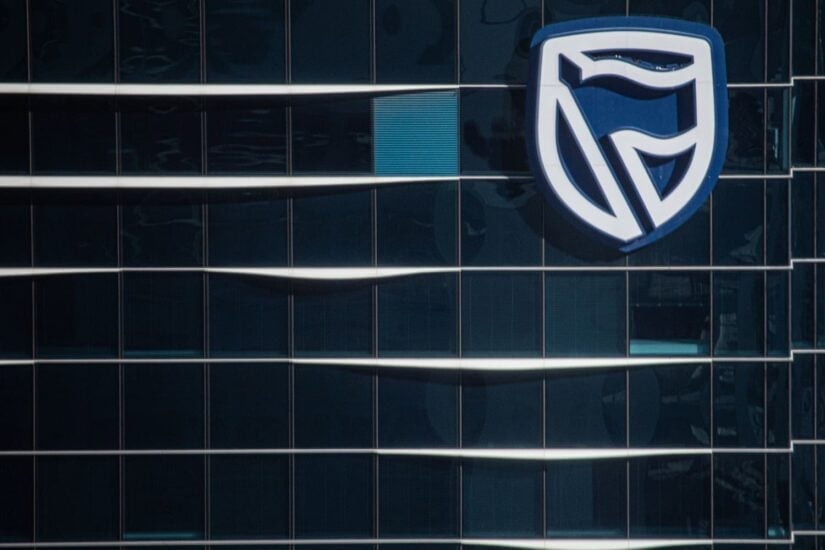
The race for the top spot intensified in the second half of last year, with Capitec briefly overtaking FirstRand in August before FirstRand reclaimed the lead. Picture: Gallo Images/Misha Jordaan


Standard Bank has firmly overtaken both Capitec Bank and FirstRand to become the South African bank with the largest market capitalisation.
At Friday’s close, all three banks were valued at more than R500 billion, with Standard Bank at R517 billion, Capitec Bank at R511 billion and FirstRand at R503 billion.
A two-way ‘tussle’ emerged in the latter half of last year, with Capitec Bank surpassing FirstRand in August to become the biggest bank in Africa by market cap. By November, FirstRand retook its lead. But now Standard Bank has the biggest market cap.
Standard Bank on top
That two-way fight was always a three-way one as, while Standard Bank Group remained behind the other two, the gap in market capitalisation between all three in the middle of November was about R25 billion (the trio were in a range between R446 billion and R472 billion).
FirstRand entered 2026 as the most valuable bank on the JSE with a market cap of R508 billion.
It was, more than likely, the first of the three to have crested that valuation. At that point (2 January), Capitec Bank was at R486 billion and Standard Bank not too much further behind at R480 billion.
(The other three major banks remained far behind at that point: Absa Group at R215 billion, Nedbank at R128 billion and Investec (both Limited and Plc together) at R123 billion.)
Middle East impact
It has been a chaotic five months, with strikes on Iran by the US and Israel on 28 February, which then turned into a full regional skirmish (or war) causing sharp drops in share prices worldwide, including of the JSE banking sector (not to mention major trade disruptions, chiefly in oil).
Since the early weeks of the conflict, the situation has moderated, although oil flows via the Strait of Hormuz remain shut.
The peak in the local banking sector this year was, effectively, on 27 February. At that point, FirstRand remained the largest (R558 billion), with Capitec Bank (R551 billion) and Standard Bank (R535 billion) both trailing.
The action then happened again in early March where, within the first week, Capitec had overtaken FirstRand (again). Those two traded positions for the first two weeks, whereafter in the middle of the month, the current new order emerged.
On 16 March, Standard Bank closed at R305.79 a share, giving it a market value of R503.5 billion. FirstRand closed at R89.15, with a market cap of R500 billion, while Capitec Bank closed at R4 200.22 (a market value of R487.7 billion).
It remained in the lead, but by 20 March, Standard had dipped below FirstRand by about R1.4 billion. The current order was restored the following trading day.
Share price impacts
A lot impacted the share prices of our banks over this period.
Capitec issued a trading statement on 11 February which impacted matters and reported annual results on 22 April.
FirstRand acquired an additional 6% of Optasia (in which it already owned 20%) on 26 March. At that point, there was only R1.6 billion in market cap difference between the three banks: R495.4 billion, R494.7 billion and R493.9 billion.
By that point, too, it was already embroiled in the matter with UK authorities regarding certain practices in its MotoNovo unit.
It announced a change in leadership at the end of March, which saw a blip in its price. It also went ex-dividend on 7 April. It appointed new FNB leadership on 30 March.
However, one can trace Standard Bank’s complete outperformance in the last two months to its Capital Markets Day on 26 March.
Since then, the stock has been on a tear. Its executives have guided to 8% to 12% in Heps growth annually for the 2026 to 2028 period, with a target range in return on equity of between 18% to 22%.
By 2 April, its value was more than R20 billion higher than the next challenger (Capitec). And by Friday, the gap was just R5.5 billion, but there was a further roughly R8.5 billion between it and FirstRand.
This article was republished from Moneyweb. Read the original here.