Though it could identify 'only' R7m in alleged personal benefits from the corruption the Bosasa whistleblower exposed, alongside R26.7m in assets.
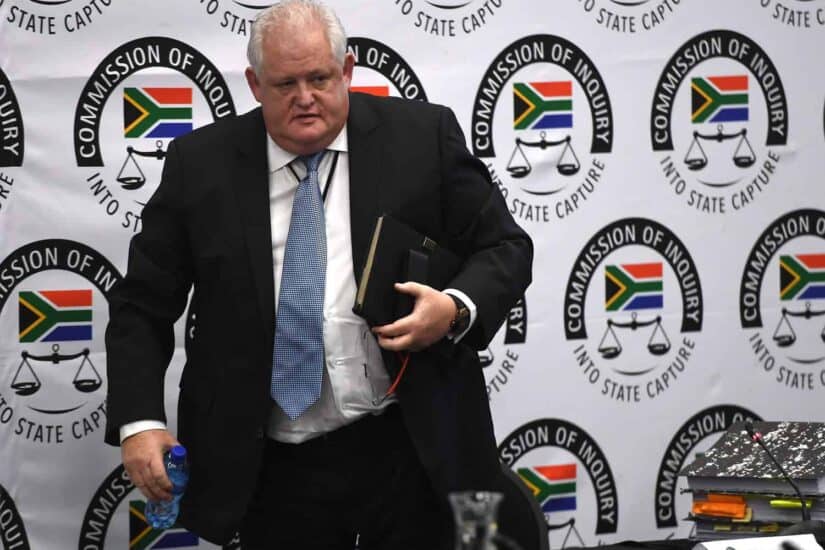
Former Bosasa COO Angelo Agrizzi testifies at the state capture inquiry on 28 January 2019 in Johannesburg. Picture: Gallo Images / Netwerk24 / Felix Dlangamandla


Bosasa whistleblower Angelo Agrizzi believes he is paying a heavy price for his role in reporting the corrupt Bosasa prison tenders and their political enablers to law enforcement authorities.
More than a decade after blowing the whistle on his former employer, Bosasa, and nine months after accepting a plea and sentence agreement for his role in corrupt activities and money laundering, Agrizzi found himself last week defending a R1.8 billion confiscation claim against him by the National Director of Public Prosecutions (NDPP).
It’s an astonishingly large figure the prosecutor was attempting to recover from Agrizzi – equivalent to four prison tenders awarded to Bosasa between 2004 and 2006 – even though the state’s own court annexures show he personally benefitted to the tune of just R7.1 million and has identifiable assets of R26.7 million.
Barely two hours into the hearing, the state had reduced its claim from R1.8 billion to just R53 million, alternatively R62 million, which it deemed “an appropriate confiscation order” reflecting his known salary payments and inducements received from corrupt practices at Bosasa.
No new evidence was introduced to account for the dramatic drop in the sum claimed.
Eight years since Agrizzi blew the whistle
Agrizzi first exposed the Bosasa empire of corruption in 2018, and in 2019 was a key witness in the Zondo Commission of Inquiry into Allegations of State Capture.
He was formerly chief operations officer at Bosasa, now trading as African Global Operations.
His testimony before the Zondo commission mapped the nexus between political operatives and Bosasa, founded by the Watson brothers, once a revered anti-apartheid family steeped in Eastern Cape rugby.
Agrizzi’s testimony detailed how former Bosasa CEO, the late Gavin Watson, was able to translate that political cachet into cash, bribing high profile connections to swing tenders their way.
Among those implicated by Agrizzi were former prisons boss Linda Mti and former Department of Correctional Services (DCS) finance chief Patrick Gillingham.
Agrizzi pleaded guilty in November 2025 to three corruption charges and one count of money laundering arising from Bosasa’s dealings with the DCS.
He was sentenced to 10 years in prison, suspended for five years, on condition that he continues assisting investigators and testifying in Bosasa-related cases.
Agrizzi, who is in poor health and has since relocated to Italy where he has property, has continued to assist authorities as required under his sentencing conditions, but now has to contend with a separate confiscation order by the NDPP under Section 18 of the Prevention of Organised Crime Act (Poca).
Agrizzi’s ‘personal benefit’
During the virtual hearing last week, Agrizzi argued that 93% of the state’s R1.8 billion calculation was the equivalent of four Bosasa tenders, yet the state can only show R7.1 million in personal benefit to him in the form of:
- Holidays (R928 000)
- Cash payments (R4.4 million)
- A bonus (R150 000)
- Two motor vehicles (R170 000 and R350 000)
- The painting of his house (R30 000), and
- An interest in a property held by Spilacraft cc (R1.05 million).
The second part of the state’s claim is based on the face value of four DCS tenders awarded to Bosasa for catering, access control, fencing and television systems. This claim is for R1.66 billion.
“It is not the State’s case that he personally received the payments flowing from the corruptly procured tenders,” submitted the state during the hearing.
In November 2025, then head of the Investigating Directorate Against Corruption (Idac), Advocate Andrea Johnson, told a parliamentary ad hoc committee that the amount that could be quantified and supported by the available evidence was about R2.7 million.
The state now appears to have distanced itself from that evidence.
Johnson resigned as head of Idac with immediate effect on 27 July, while the National Prosecuting Authority has ordered a full audit of all Idac cases as part of a six-month institutional reset.
State discrepancies vs Agrizzi discrepancies
Agrizzi pointed to discrepancies in the state’s figures, though the NDPP’s central argument remains that Agrizzi may have turned whistleblower, but he was also an admitted participant in a sustained corrupt scheme and colluded with others for corrupt ends.
The Asset Forfeiture Unit (AFU) highlights what it believes are serious discrepancies in his disclosed assets, arguing that several accounts, investments, company interests and offshore arrangements were allegedly omitted or incorrectly described.
Agrizzi says the R1.8 billion (sometimes shown by the state as R1.66 billion) rests entirely on the affidavit of Richard Chinner of the AFU.
He concedes he was the conduit for bribes to Mti and Gillingham, but alleges that Chinner has recast these payments as personally received by Agrizzi – which he denies.
He further argues that the AFU’s schedule of assets double and triple count figures, such as salaries paid as a part of transfers, and properties bought with his own salary.
He further alleges that the AFU relied on flawed evidence from a 2008 report by the Special Investigating Unit, some of it based on unverified information.
The state is also attempting to close in on overseas assets and investments purchased in 2018 as derived from the proceeds of crime, to which Agrizzi replied that the state has no evidence to support its claim, and transfers out of SA were cleared by two regulated South African banks.
“The Italian prosecuting authorities investigated precisely this question for two years, asked the South African authorities for proof of illicit origin, received none, and the Tribunal of Siena formally closed the investigation by decree of archiviazione, 6 October 2022,” Agrizzi states in a written submission to the court.
Agrizzi argued that most claims of non-disclosure by the state collapse on closer examination.
For example, he says the state conflates two transactions 11 years apart: the R180 000 routed in 2007 to buy a vehicle for a departmental official (which is the 2025 money-laundering count he pleaded guilty to), and the later transfer of funds to Italy. His plea contains no admission that the Italian funds were the proceeds of crime.
Zondo impact
The Zondo commission recommended investigation or prosecution in respect of more than 200 individuals and entities.
Three convictions have followed, one of them being Agrizzi – who provided most of the evidence underlying the commission’s Bosasa findings.
Fraud and corruption charges have been laid against former ANC MP Vincent Smith for allegedly receiving benefits from Bosasa.
Mti and Gillingham have also been charged and are awaiting trial.
The state is entitled to strip Agrizzi of the proceeds of his admitted crimes.
The unanswered question is whether those proceeds amount to R7.1 million, R53 million or R62 million.
Judgment on this matter was reserved on 30 July.
This article was republished from Moneyweb. Read the original here.