
Volumes through Richards Bay Coal Terminal are on a four-year uptrend, though not yet back to the 2017 peak.
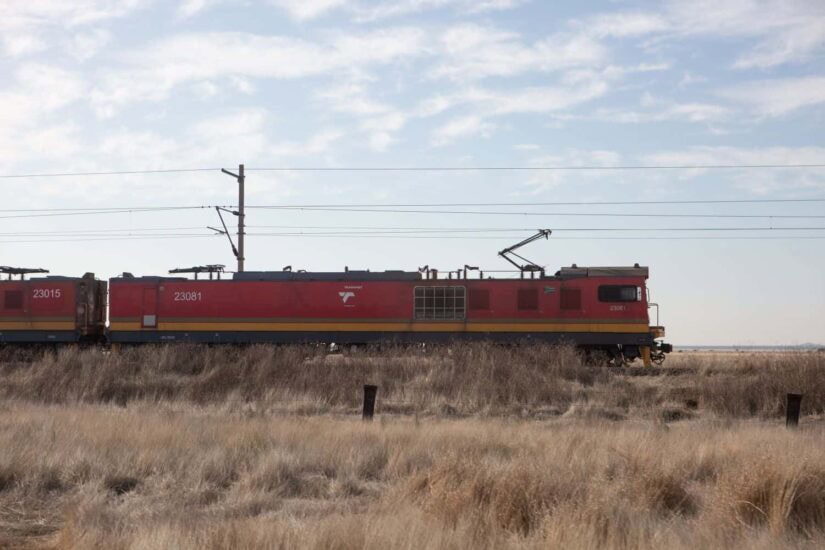
A Transnet train on 23 August 2022 in Hopetown, South Africa. Picture: Gallo Images/Misha Jordaan


Some outstanding financial results from coal producers in the last few months point to a steady improvement in Transnet Freight Rail (TFR) performance.
Thungela Resources reported a sharp improvement in earnings for the six months to June 2026. Headline earnings per share increased 150% to R4.80, while the interim dividend nearly trebled from R2 to R5.50 a share.
Net profit of R1.4 billion was boosted by a roughly R1 billion non-cash gain arising from the sale of the Kleinkopje mining right and the release of associated environmental provisions.
The results also contain some encouraging evidence that the improvement in TFR’s coal service is translating into additional export sales.
Despite flat production in the first half of the year, Thungela’s export sales, including third-party coal, increased by about 12% from 6.6 million tonnes (Mt) to 7.4Mt. Thungela was able to sell around 1.1Mt more coal than its own SA mines produced during the period.
The company says this was made possible by improved Transnet rail performance, supplemented by additional rail allocations obtained from producers unable to use their full capacity.
It also sold roughly 600 000 tonnes of third-party coal.
Transnet’s annualised performance on the coal corridor improved to 59.9Mt during the half-year, from 56.8Mt in 2025.
While still well short of historic levels, the improvement allowed Thungela to draw down stockpiles and move additional coal through Richards Bay at a time when international prices were strengthening.
The Richards Bay benchmark coal price was 15% higher than in the corresponding period, although some of this benefit was offset by the stronger rand and a lower-quality sales mix. Thungela realised an average price of $89.18 a tonne at the Richards Bay Coal Terminal, a 15.7% discount to the benchmark.
TFR ‘getting it right’
Jan Havenga, professor in logistics at Stellenbosch University, says it’s gratifying to see the improvements in rail performance showing up in company results.
“They’re getting it right under the new management. The target is to get to 75Mt a year on the coal line by 2028/29, but I think we could get there sooner than that.
“Russell Baatjies [CEO of TFR] and his team have come up with some interesting solutions around locomotives,” says Havenga.
“For example, by redistributing the locomotive fleet and making new deals with original equipment manufacturers.
“On top of that, we’ve seen manganese exports improve quite dramatically from 2Mt to 16Mt in the last few years, and I think we will hit 20Mt within a few years.
“The iron ore line is also doing well, and I expect we will hit the target of 60Mt within a few years.”
It’s a different story for the container rail lines from Durban and Cape Town to Gauteng, says Havenga. That will require more sustained investment and innovative solutions to fix.
Thungela isn’t the only company reporting better rail performance.
Exxaro is seeing much the same trend.
Its coal export sales increased 2% to 7.1Mt in 2025, an improvement the company attributes in part to improvements at TFR coupled with use of alternative export routes. It is targeting roughly 8Mt of exports in 2026, an increase of about 13%.
Glencore was forced to curtail production in 2024 due to Transnet’s limited rail capacity, but has since expressed confidence that the situation is on the mend.
Export production recovered 8% to 12.6Mt in 2025 as coal-line performance improved – sufficient to consider re-examining expansion projects previously put on ice.
These are still the early days of rehabilitation for Transnet, but coal producers are encouraged by the trend on the coal corridor as well as moves by government to open the market to private operators through the creation of an infrastructure manager to referee the process.
Richards Bay Coal Terminal
The impact of Transnet’s recovery is seen most visibly on volumes through Richards Bay Coal Terminal (RBCT), which exported 57.66Mt in 2025, an increase of 11% from 52Mt in 2024 and the highest volume in four years.
This followed exports of just 47.21Mt in 2023, the lowest level since 1992, according to Reuters.
The number of trains offloaded at the terminal increased from 6 342 in 2024 to 7 157 last year. The daily average rose from 17 to 20 trains.
It’s now clear the coal sector has turned the corner, though volumes through RBCT are still well short of its nameplate capacity of 91Mt. If current trends continue and there are no serious derailments, Richards Bay could ship 62Mt this year, with a target to hit 70Mt in the next few years.
RBCT exported 76Mt in 2017. Even if it achieves 62Mt in 2026, the terminal would still be operating at only about 68% of capacity and exports would remain 14Mt below the 2017 level.
But the trend is certainly pointing in the right direction.
This article was republished from Moneyweb. Read the original here.