
More young South Africans are rediscovering chess as Gen Z embraces real-world connections and life beyond endless scrolling.
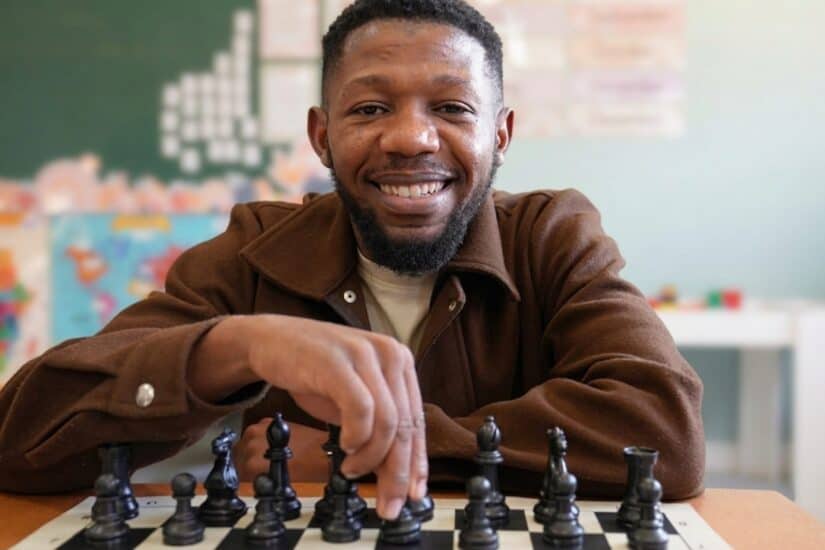
Chess is growing in popularity said coach Buthelezi.


Chess is experiencing an unexpected resurgence as more young South Africans swap endless scrolling for 64 squares in black and white. The game that was first played around 1 500 years ago has not lost an inch of its edge and, if chess coach Ncedo Buthelezi’s passion for the game is anything to go by, Gen Z has rediscovered it along with vinyl records and bricks-and-mortar shopping.
There’s just a certain something about chess, said Buthelezi, that other sports and pastimes struggle to deliver. It’s a personal and social inflexion point that serves up something that the digital universe simply does not. It gives people focus, connection and the chance to exercise their minds, to really think and solve problems, he said.
The 29 year old first discovered chess 18 years ago while growing up in KwaThema, outside Springs on the East Rand. At the time, he had no idea it would eventually turn out to be his career. Buthelezi’s original ambition was to become a mechanical engineer, but after being accepted to study town planning at university, chess gradually became more than just a hobby.
More than just a hobby
“I studied it and got a degree. Along the way, I fell in love more with chess. That’s where the coaching bug bit me and, since then, I have never looked back,” he said.
In retrospect, he said the game filled a gap that his childhood education could not. “The school that I went to didn’t offer much in terms of extracurricular activities, but with chess, I saw something that I could challenge myself with, make friends and travel a bit as well. I liked that about it,” he said.
Today he coaches players from young children through to adults, serves as an arbiter (a chess referee of sorts) at tournaments and sits on the executive of organised chess in Ekurhuleni after being elected earlier this year. Watching hundreds of players develop has convinced him that the game’s greatest value has very little to do with winning.
“I’ve heard some parents say, ‘My kid can sit longer and focus on other things.’ A lot of kids have made friends through it. They understand that in life there’s a dialogue. I speak, you listen and then it’s your turn, just like in a chess game,” he said.
Life is like a chess game
Adults, however, often take up chess with very different goals. “I think they learn it just to understand the game and be as good as they can be. They don’t necessarily want to be competitive,” Buthelezi said.

He reckons that the game’s rapid growth over the past few years was no coincidence. During Covid lockdown, he said, “A lot of people needed an escape or new skills to learn, so many turned to chess.
“Once they started learning more about it, social media streamers got a lot of people interested and they really drummed home the understanding and the notion that it is a sport that caters for everyone.” Then of course, there was the hit Netflix show The Queen’s Gambit, which added another sexier layer to the sport while unpacking its nuanced intricacies.
Unlike many organised sports, chess also remains relatively accessible, he said. “It’s a game you can learn and enjoy from all different walks of life,” Buthelezi said. He added that accessibility is only part of the reason the game has found a new audience.
Chess also offers something that many people feel has been lost in an age dominated by smartphones and social media: uninterrupted face-to-face interaction.
“I think, in a way, there is an argument that chess helps people to connect with themselves or with others, rather than through social media,” he said.
“That aspect of having to sit at the board and play with someone does give a nice escape from the digital world that we’re in.”
Teaches critical thinking
Beyond the friendships and social interaction, Buthelezi said the biggest lesson chess had taught him was how to think. Every match presents players with a series of problems that cannot be solved through instinct alone. Instead, they have to weigh up possibilities, anticipate consequences and remain calm enough to make good decisions.
“I saw how it helped me approach everything logically and think critically. I became much more of a problem solver than whining and complaining about certain things,” he said. It’s a characteristic that can permeate into every aspect of life.
“The opening moves of a game, you can memorise them if you have a good memory. But once you reach the middle stage, it’s all on you as an individual. The creativity kicks in there and it relies on how much you know, your own strategic impetus,” he said. “In chess, you can look at the board and the state of play from different lenses.”