
Malatsi said the country faces a stark contradiction.
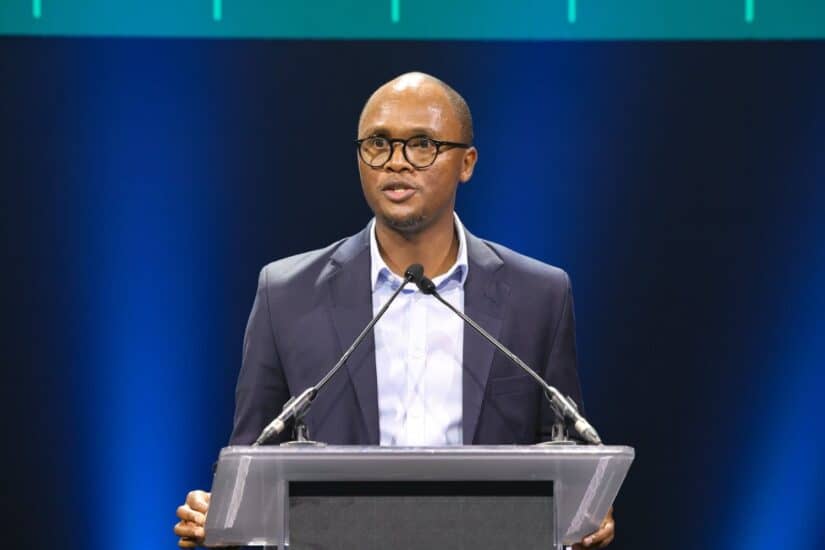
Communications and Digital Technologies Minister Solly Malatsi has challenged both government and the private sector. Picture: Communications Department.


Communications and Digital Technologies Minister Solly Malatsi has challenged both government and the private sector to stop talking about youth employment and start creating real opportunities for young people to gain the work experience needed to enter South Africa’s growing digital economy.
Addressing stakeholders on digital skills development at the Collective Xchange 2026 in Johannesburg on 15 October 2026, Malatsi said the country faces a stark contradiction.
In July, Malatsi said the government must do more to close the gap between those with access to digital connectivity and those without.
Warning
The minister warned that while tens of thousands of digital jobs remain vacant, qualified young people still struggle to secure their first opportunity.
“We all agree that young people need work experience. The reality indicates that very few of us want to be the ones giving it to them,” he said.
“That gap between agreement and action is where most of our digital skills effort goes to die.”
Digital skills
Malatsi described the situation as a “digital skills paradox”. According to research cited by Collective X, South Africa has more than 300,000 ICT jobs, with nearly 90,000 positions unfilled, while many young graduates in digital fields struggle to enter the labour market.
The minister said the recently revised Digital Economy Masterplan aims to address this mismatch by creating a framework to unlock the potential of the sector.
Masterplan
The digital economy currently contributes between 7% and 8% of South Africa’s GDP, but could exceed 15% with the right investment, policies and partnerships.
“The Masterplan estimates that the digital economy can create at least a million new jobs, both traditional and gig economy work, over the next decade,” he said.
However, Malatsi warned that infrastructure alone would not solve the problem.
“The harder problem is people. A Masterplan without a workforce is a well-designed plan with nobody to execute it,” he said.
Digital transformation
While progress is being made in areas such as fibre networks, spectrum allocation, towers and data centres, the country risks missing the benefits of digital transformation if it fails to build a workforce equipped with coding, artificial intelligence and other digital skills.
Malatsi pointed to South Africa’s worsening youth unemployment crisis, noting that Statistics South Africa reported a youth unemployment rate of 47.4%, with five million people aged 15 to 34 unable to find work.
Jobs
At the same time, he said the Masterplan estimates that South African companies have outsourced approximately 28,000 testing and application development jobs to foreign markets.
“The demand is there; the supply of eager, under-employed young talent is there in the same market. How do we equalise that equation?” he asked.
Malatsi said government must accept its share of responsibility but argued that lasting solutions require business participation.
“We must be an enabling state, not a controlling one,” he said.
The minister also criticised skills programmes that focus on enrolment and completion statistics rather than employment outcomes.
“Hope is not a pipeline,” he said, arguing that demand-led training should be shaped around employers’ needs and measured by whether participants find jobs or start businesses after completing courses.
Employers
Calling for greater recognition of micro-credentials and alternative learning pathways, Malatsi urged employers to create structured entry-level opportunities, apprenticeships and mentoring programmes.
“If a role is entry-level, why not design it for someone who has never done it,” he said.
Drawing his message to a close, Malatsi directly challenged industry leaders.
“Every executive here was once somebody’s risk. Our young people deserve the same chance,” warning that South Africa’s challenge is not a lack of talent.
“South Africa does not lack young people with ability. It lacks enough people prepared to give them a start,” Malatsi said.