
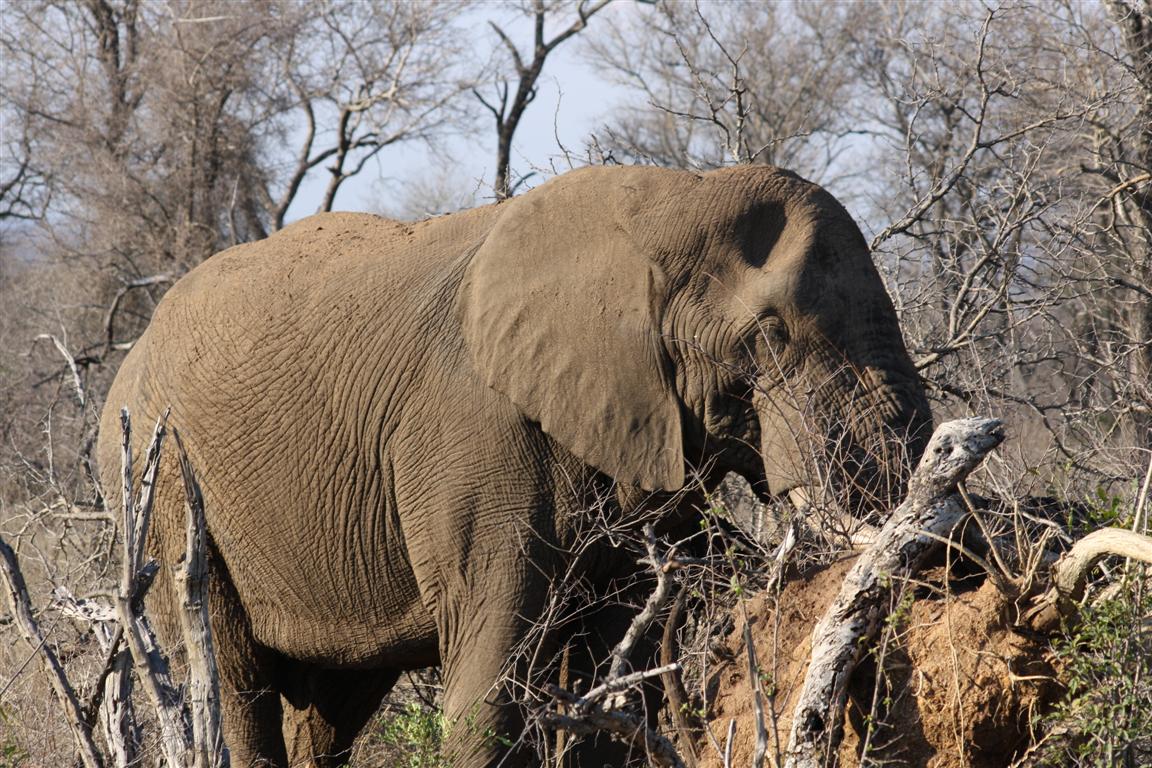
SKUKUZA – South African National Parks (SANParks) has been warned that the scourge of ivory poaching currently affecting the rest of Africa, is likely to hit the country in 2014, according to Dr Hector Magome, SANParks managing executive: conservation services.
“At the Convention on International Trade in Endangered Species of Wild Fauna and Flora held in Bangkok in March, we were warned that elephant poaching is going to hit us like an avalanche as early as January,” says Magome. “As such, at our rhino poaching strategy meeting in September, we adopted a dual strategy approach focusing on both rhino and elephant in order to properly prepare.”
The recent cyanide poisoning of elephant in Zimbabwe’s Hwange National Park has done much to alert the world of ivory poaching, which results in the death of as many as 100 elephant a day, one every 15 minutes or an estimated 32 000 per annum. Closer to home, it has placed a huge question mark over the ability of SANParks to adequately protect the elephant in its care from a similar fate, given the rhino losses it is currently experiencing.
Reeling from the onslaught of rhino-poaching syndicates, which has seen numbers decimate in its flagship property, the Kruger National Park (KNP), SANParks has beefed up its anti-poaching unit in Kruger under the leadership of Maj Gen Johan Jooste. But while the eyes and ears of the park are focused on protecting rhino, are Kruger’s elephant – among them the last remaining huge tuskers – sitting ducks for poachers?
The northern reaches of Kruger abut Zimbabwe and Mozambique, both countries where ivory poaching is out of control. From the Limpopo River down through swathes of seemingly endless mopane to the regional ranger station at the Phalaborwa Gate, there are fewer roads than in the park’s tourist-intensive south, which makes the task of patrolling all the more difficult.
Crook’s Corner is positioned at the confluence of the Limpopo and Luvuvhu rivers, where SA, Zimbabwe and Mozambique meet. It used to be a haven for gun-runners and poachers at the turn of the 20th century and it was here that legendary ivory poacher Cecil Barnard took refuge from the authorities in the 1920s. Some believe that this is where modern ivory poachers will start targeting the huge elephant herds that often congregate in this part of the park, as well as along the open border with Mozambique, which has proved so problematic in the battle against rhino poaching.
“Our Mozambican counterparts are apparently losing three elephant a day to poachers at the moment,” says Magome, acknowledging that the actual losses could be much higher. “Given what is going on in the rest of Africa, it is inevitable that South Africa will eventually be targeted.”
Magome says there is little to prevent ivory poachers from entering Kruger in search of what he describes as a “double hit” – targeting both elephant and rhino in a single foray. And should they resort to using cyanide to poison water sources and salt licks, particularly in the far north of the park, the consequences would be an ecological disaster of unparalleled proportions. The deadly chemical is not as obvious as a weapon, and may be easier to smuggle into the park as a result.
“We are planning well ahead and are prepared for what may come,” says Magome. “The last thing we want is for Kruger’s elephant to suffer the same fate as those in Hwange.”