Mbombela’s water woes far from over
See where the problems lie and how MLM plans to address them.
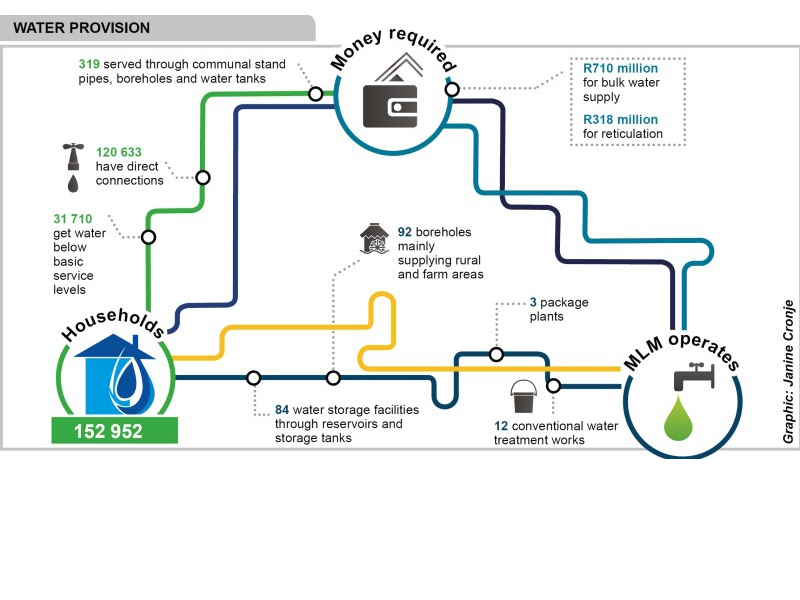
MBOMBELA – Mbombela has backlogs in providing water to such an extent that water levels in the Nsikazi areas remain at an average of 50 per cent or less. This is according to a status quo turnaround plan compiled by the municipality.
The plan to address this is outlined in the report. Mbombela Local Municipality (MLM) is the water authority responsible for water provision in the entire municipality. Sembcorb Silulumanzi acts as a service provider in a concession area which includes Mbombela (formerly Nelspruit). MLM provides water to White River.
The remaining areas used to be supplied by Bushbuckridge Water Board, which has since been usurped by Rand Water. A formal agreement between MLM and Rand Water is still in the pipeline, according to spokesman Mr Joseph Ngala. Since the infrastructure will remain after the expiry of any contract, Mbombela is to foot the bill.
The supply problems stem partially from insufficient infrastructure. “The existing bulk infrastructure is affected by enormous water losses attributed to major leakages, illegal connections and ageing infrastructure.”
Tankers which augment the supply, were initially meant as temporary intervention but are now used as a perpetual alternative.
“This does not only dehumanise Mbombela’s population but also compounds the severe strain on the availability of bulk water as these tankers also fill from the very existing infrastructure that is supposed to be used to provide piped water.”
Private water tankers also access purified water from the system at no cost to sell water to the community at a higher price than municipal tariffs, contributing to severe deficiencies in availability.
To address these challenges, MLM is focused on increasing abstraction and expanding treatment, storage, pumping and distribution. It is noted in the report that additional water-abstraction licences are required as Mbombela has reached its maximum allocation.
Nsikazi North
The Nsikazi areas are adversely affected by insufficient Eskom capacity and experience a large number of illegal connections.
Problem: A total of 42 110 households are provided with chlorinated water, abstracted from the Sabie River. Since it is only disinfected, the quality of water poses serious health risks. It is also served by package plants and boreholes and the supply is augmented by water tankers and rationed to ensure “some” access to all.
Solution: Two projects are planned to be completed at the end of 2016 to enable the provision of purified water in the entire Nsikazi. The first phase is expected to cost R177,6 million and will see two new modules supply water. Future plans include an additional two modules to ensure the provision of a 24-hour service in the entire Nsikazi North at an additional cost of
R69,4 million.
Nsikazi South
The area is predominately pre-urban and has lucrative growth opportunities that need to be supported by sound provision of services.
Problem: The existing backlog is 10 684 households. Purified water is received mainly from the KaNyamazane Water Treatment Works which abstracts from the Crocodile River. It is operating above its capacity. The scheme is augmented by the Dwaleni package plant and boreholes.
Solution: Refurbish the Dwaleni package plant and pump station; construct a new pump station and booster pump; upgrade Dwaleni rising main, install a reservoir and replace raw water pumps at
R16,2 million to ensure 24-hour water supply to the entire Dwaleni. Future plans include the construction of a new 20ML/Day Karino Regional Water Augmentation Scheme, booster pump stations, water pumps, gravity mains, pipelines and reservoirs at an estimated cost of R343 million (of which only R21,9 million is available).
Karino/Plaston
Problem: The water treatment works supplies the Karino Lifestyle Estate and Karino com-mercial zone. It is augmented by the Primkop Water Treatment Works but they have a combined capacity of only 4ML/Day. To cater to all current and future developments within the corridor to alleviate the strain on the KaNyamazane Bulk Water Supply Scheme, infrastructure needs to be developed.
Solution: The water scheme is to be located at the same site as the scheme that would supply Nsikasi South. They are to be operated in an integrated manner to ensure consistency and with supporting storage infrastructure minimise water interruptions. It will cost R56 million.
Matsulu
Problem: The Matsulu Water Treatment Works drawing water from the Crocodile River is operating above its capacity. This is augmented by water tankers, especially in high-lying areas due to low pressure. The existing supply backlog is 2 263 households receiving water below the basic level of service.
Solution: The Matsulu Bulkwater Supply scheme is under construction at a cost of R24,6 million to ensure 24-hour water supply to the entire Matsulu C. The future extension of the Matsulu Water Treatment Works will further increase bulk water supply and storage. Of the R80 million required, only R13,1 million is available.
Hazyview/Shabalala
Problem: A total of 1 847 households still receive water below the basic level of service. The water treatment works abstracting from the Sabie River operates above its designed capacity which poses serious water-quality challenges. It is augmented by boreholes which are mostly used in emergencies. The current set-up only supplies services to Hazyview and surrounding areas. Future developments will include the incorporation of Shabalala in the scheme.
Solution: Currently mechanical and electrical equipment is being installed to enable the commissioning of the new Hazyview water treatment plant with a budget of R18,2 million. Of this, only R7,8 million is available at present. The completion will ensure 24-hour water supply.
Mbombela/White River
Hazyview, Mbombela/White River and Matsulu have unacceptable levels of water losses. Future plans include the enforcement of water-conservation measures.
Problem: Nelspruit Old Water Treatment Works is operated within its capacity, but White River and White River Country Estate Water Treatment Works operate above their capacity. The current storage capacity is insufficient to balance fluctuating requirements posing a serious risk for such highly developed areas. The service backlog is 1 255 households. The institutional arrangements in the provision of bulk services caused by the common areas of operation of Mbombela, Rand Water and Sembcorp/Silulumanzi are also challenging.