MBOMBELA – To suffer from any disease, be it acute or chronic, is tough. Imagine suffering from a rare disease, with no co-sufferers in the same town or maybe even the country, to turn to for support or understanding.
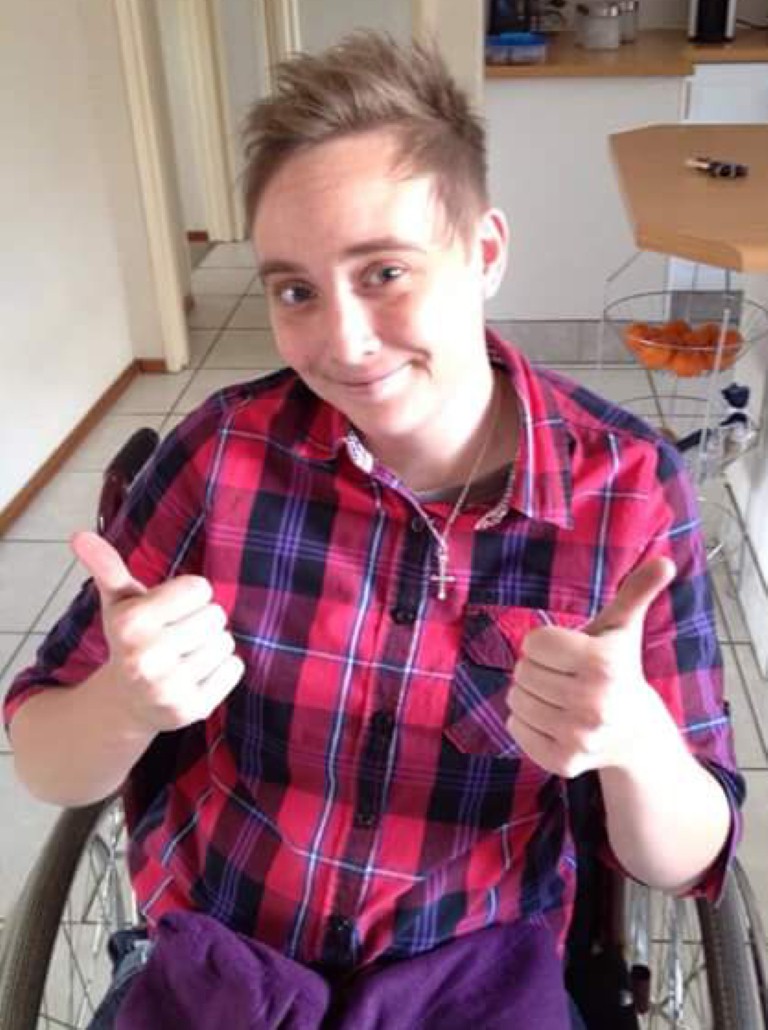
February 28 is International Rare Disease Day. Jenna Schmidt (29), a former resident of the city who now lives in Gauteng, suffers from Stiff Persons Syndrome (SPS), a very rare neurological autoimmune disorder.
She is actively creating awareness about this disease which affects about one in a million people worldwide and contacted Lowvelder with her story. As the name suggests, the disease causes periodic muscle stiffness and spasms. Jenna has a Facebook page on which she shares videos of these episodes of stiffness and it is clear that she has to endure excruciating pain.
She was admitted to hospital with bronchial pneumonia on July 14 last year. She had been in hospital for five days when she started to feel pins and needles in her hands. Her legs also became unstable and she needed assistance to get to the toilet and back in bed.
“The next day I couldn’t feel my legs from the waist down. I was transferred to the ICU where I spent six days as they had to do all kinds of tests to figure out what was wrong,” Jenna said.
She was diagnosed with Guillian Barre Syndrome and told that recovery would take anything from three months to two years. She spent another week in hospital in order to boost her immune system and received physiotherapy. “The doctor and neurologist both agreed that I should go to a rehabilitation centre. I spent a month there trying to regain my strength, trying to walk and become mobile again. I made no progress. One night a nurse was taking my blood pressure and all of a sudden both my feet and legs stiffened and went into terrible spasms. The team at the rehabilitation centre agreed that I should be referred to another neurologist.”
Jenna had to undergo another two weeks of the same tests. The neurologist also did a blood test to determine her anti-glutamic acid decarboxylase (GAD) antibodies. It was extremely high and she was finally diagnosed with SPS. Her life had changed forever. She was told that she would be permanently disabled and was medically boarded.
Jenna’s spasm attacks occur mostly in cloudy and cold conditions and when she is under emotional stress. “On cold days I can be in spasm for at least 30 minutes and it will occur randomly throughout the day. When I feel the touch of a fan or wind I can feel a spasm occurring, but will dress warm so it doesn’t go into a full-blown attack.
“During emotional stress, my spasms can last anything between three and four hours. I have been rushed to casualty twice because of a spasm in my heart. I wake up every morning with stiffness in my arms and back and now recently in my jaw. I am in pain every day but my medication relieves it. I don’t have any quality of life as I sleep most of the time.”
She was extremely active before being diagnosed with SPS. “I did athletics most of my life. After matriculating from Lowveld High in 2003, I went off to Durban to study hotel management at the International Hotel School. I had a successful career in the restaurant industry.” Today, Jenna has to rely on her wheelchair to get around.
There is a cure for SPS – a stem-cell transplant. However, there is always the risk that your body could reject it. “It is a life-threatening procedure and extremely costly,” she adds. Due to her high GAD antibody count, she is supposed to go for a polygam (immune booster) every four to six weeks. However, her medical aid only pays for three a year. “I also can’t be around people with viral infections as it is a neurological autoimmune disorder.”
Here’s the link to Jenna’s Facebook page: https://m.facebook.com/profile.php?id=1512207302395650
• The Rare Disease Society of South Africa is a community association that offers patient care and support. The initiative acknowledges the plight of rare-disease patients and their respective families whose lives have been impacted by rare disorders and encourages the public to partake in collective action by purchasing and wearing a “Jeans for Genes” ribbon to work or school on February 27.
Members of the public and rare-disease community are urged to donate R10 by purchasing the denim ribbon (details listed on www.raredisease.co.za) and wear their ribbon and favourite jeans on Friday, or SMS “Rare” to 38232 to help raise funds for individuals living with such diseases. This year’s theme is Living with a Rare Disease and advocates solidarity and togetherness.