Donga threatens Kaapsehoop Road
The provincial department of public works says it would be able to address concerns in the next financial year.
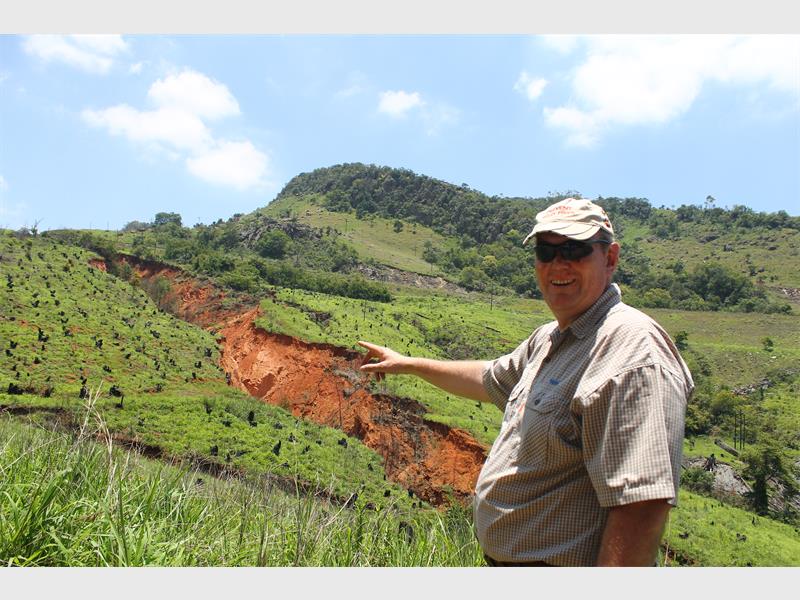
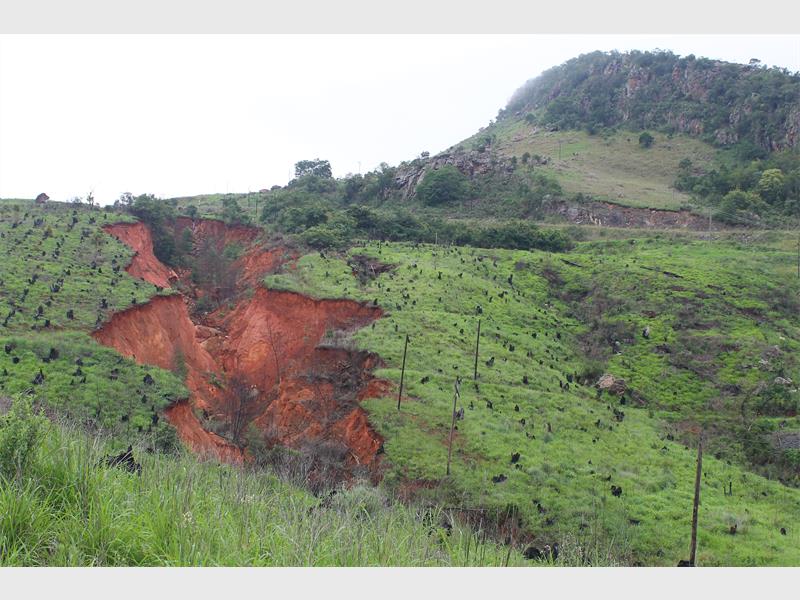
MBOMBELA – A massive donga next to the Kaapsehoop Road is beginning to threaten the safety of the important thoroughfare.
The eroded ravine has formed approximately 20 kilometres outside Mbombela on a Sappi plantation to the south of the road belonging to the Mpumalanga Department of Public Works, Roads and Transport (DPWRT).
Ms Elsabe Coetzee, regional communications manager for Sappi Limited, says their first records of the start of the cut-in dates back to January 2012.
It is believed to be caused by run-off stormwater from the road which has been diverted into a canal.
A fountain which has also been diverted to run under the road contributes to the water flow.
A few years ago the canal was blocked off after a donga had begun to form.
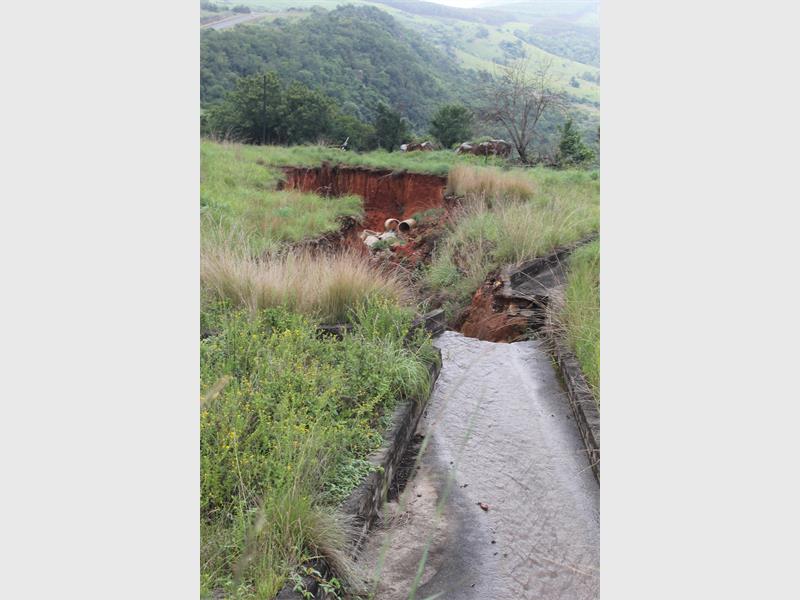
The water appears to have continued to flow to the left of the cement canal, over grasslands, causing a new donga to form closer to the road.
Coetzee says Sappi is extremely concerned about its existence and increasing size.
“The situation poses a safety risk to the road itself. We are concerned about the road caving in.
“From a firefighting point of view the situation poses a risk. The donga has very steep and unstable walls which have forced us to limit our fire protection activities in close proximity to the donga.
“We are also concerned about soil preservation as the top soil has been washed away.
“The donga is an eyesore in the local landscape. As a much loved and popular tourist route we are concerned about the loss of aesthetic value of the local area caused by the donga.”
Coetzee adds that Ngodwana Mill annually undertakes general maintenance of this road in an effort to ensure safe passage. She says they spend in excess of R20 million on road repairs and maintenance annually.
“Sappi’s maintenance efforts are totally voluntary, with no compensation from any of the other road users and or the DPWRT.”
- Read more stories related to DPWRT here.
Sappi has been able to largely mitigate effects from sediment downstream through the Oliepoort Dam serving as a silt deposit structure.
“We have observed during 2014 that the drainage structure reacted well with regrowth of grasses and reeds and the water released from there was actually very clean compared to previous years. The dam in our opinion also served a positive function by capturing most of the siltation negating further impact downstream.”
However, the root cause of the problem needs to be addressed first to make any action on Sappi’s land to arrest and reverse the soil erosion viable, she explains. Sappi has been engaging the DPWRT, the custodian of public roads, on this matter on an ongoing basis.
“Our efforts have included a site visit with departmental officials and a consulting engineer where they obtained first-hand insights into the problem.
“Sappi has also consulted and lobbied other regulatory authorities on this issue. Sappi remains willing to collaborate with the relevant government departments to be part of the solution.”
Mr David Nkambule, spokesman for the DPWRT, says the department is well aware of the matter and is hard at work to address it as all matters and concerns that jeopardise the road-user experience on provincially proclaimed roads is the department’s responsibility.
However, he attributes it to damage caused by flooding in 2012 and 2014, consequences of which have been exacerbated by recent heavy rains.
“The department has, through the support of the National Disaster Management Centre (NDMC), attempted to address the consequences of the aforementioned floods, however the damage that resulted was far too great to be addressed adequately with limited financial resources at the department’s disposal.”
According to Nkambule the 2016/17 financial year will be next applicable timeframe in which the department would be able to make available funding for side drain maintenance through its road maintenance programme.
Ms Linda Grimbeek, chief operating officer and acting executive director of business of Kruger Lowveld Chamber of Business and Tourism (KLCBT), add that it is a province-wide issue, which is not limited to run-off infrastructure, but also the surfaces of roads.
“It is a big headache for us. At the beginning of the year, the state of the provincial roads was one of the eight factors we identified as impacting on Mpumalanga’s economy the most.
“Some roads are virtually impassable. Farmers and mines can’t transport their goods.
“For tourism it is a nightmare. Try driving on them from a tourist’s perspective.”
Grimbeek adds that in some places, it falls to the private sector to maintain roads, just to be able to do business. “We owe a deep gratitude to companies like Sappi, who spend millions on roadworks.
“KLCBT addressed this problem on several occasions with the department, but it is difficult to find the correct people to deal with. We have engineers who offered their assistance at no costto show the scrapers for instance, how to scrape the roads to minimise erosion.”
KLCBT plans to make the issue a priority in the coming year and she invites all stakeholders and large companies who are currently maintaining roads at their cost, to contact her.
“Together we are going to find the right people in the department to address this in the right way,” she concludes.
Enquiries: Grimbeek on 013-755-1988.
- Read more about Kaapsehoop: Writer paints perfect picture of sleepy Kaapsehoop