MBOMBELA – There was a time when a lie could travel halfway around the world before the truth could get its boots on. Those were the good old days. In a digital era, lies fly around the globe while the truth awaits its boarding pass.
This was illustrated in a local context earlier this month when a defamatory voice note circulated among Lowvelders. The voice note featured a woman’s voice. She told her friend, whom she addressed as “Meraai” the story of a rumoured kidnapping at i’langa Mall and two other Lowveld locations. Her tale featured the victim ending up unconscious in a wheelchair, wearing a disguise. Meraai must have shared the voice note, as it spread like wildfire.
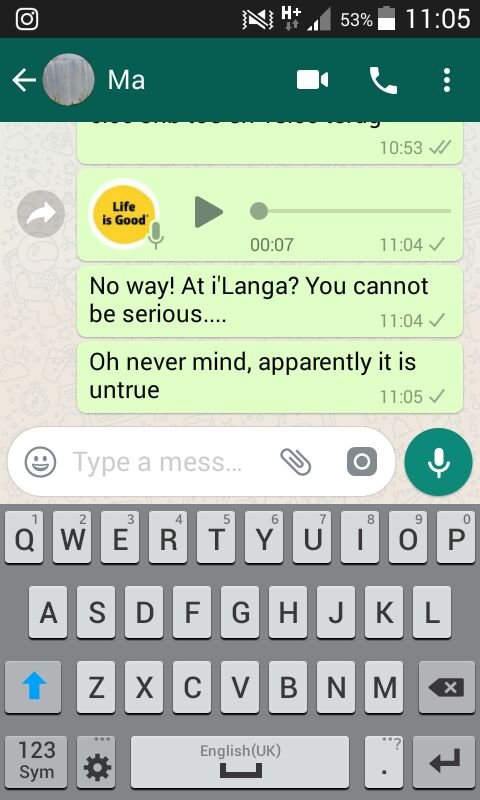
In two days, it reached countless WhatsApp subscribers across South Africa.
Its veracity was never confirmed. The police asserted that such an incident had never been reported. Investigations by the police and i’langa Mall’s security revealed nothing to substantiate its contents.
CLICK HERE TO LISTEN TO THE VOICE NOTE
It transpired that locals are ill-informed regarding the severe legal implications that any form of messaging – be it via a private, encrypted service or not – could have.
Smartphones enable users to take screen shots of private messages and distribute it widely.
Therefore, no user of WhatsApp or any other platform has the guarantee that his private correspondence will remain private.
Before you gossip or spread untruths, keep in mind that the law holds serious ramifications for those who do so. Criminal defamation is defined as the unlawful and intentional publication of a matter concerning another, which tends to seriously injure his or her reputation. It is required that the defamatory statement must have come to the notice of someone other than the victim.
In the voice-note scenario, the creator may have not expected that her message to Meraai would reach any other person’s ears. In distributing the message, Meraai had committed at least one privacy violation.
Yet the buck did not stop with her. South African courts have repeatedly stated that any person who likes or shares damaging communication is considered liable as if he had created and published it himself.
“The digital era arms Average Joes with publication abilities akin to that of media companies. Accordingly, this gives rise to an increased burden of responsibility,” said i’langa’s general manager Sandi Human.
“We hope that this experience will serve as a learning curve to local social-media users,” she said.
“After having learned how damaging the abuse of communication platforms can be, we trust that locals will refrain from doing so in future,” she added. Human confirmed that legal advice is being sought in this regard.
- Can a business institute a defamation claim?
According to legal experts only a human being, and not an entity, can institute action based on defamation. However, corporate entities are entitled to remuneration where they have suffered losses as a result of the wrongful conduct of another. These losses, he said, must be quantified.