Join in on the world’s largest role-playing game!
Dungeons & Dragons, or D&D, has many meanings for many people. It is a tabletop role-playing game (RPG).
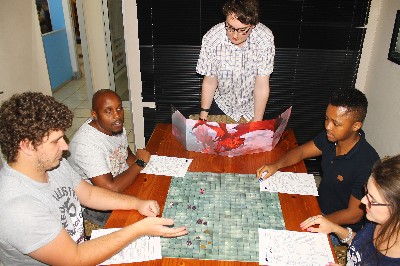
MBOMBELA – Dungeons & Dragons, or D&D, has many meanings for many people. It is a tabletop role-playing game (RPG).
It is the grandfather of the modern RPG, influencing everything from movies to video games. It is a transport to a world of magic and monsters, adventure and heroism. It is a game for friends and families.
With a set of dice and the rules provided, those sitting around the table create a story together. The players’ characters are the protagonists, while the Dungeon Master plays opponents and allies along with adjudicating the rules.
There have been over five different editions – each perhaps a game in its own right – of D&D. The first was published in 1974, the rules solidifying into a single game under the authorship of Gary Gygax and Dave Arneson. This was the original, now called OD&D. Although it required familiarity with the concept of wargaming (a game where players control armies instead of individuals), it sold 1 000 copies in its first year.
This split around 1977/78 into the Basic and Advanced (AD&D) versions. Basic had a lower barrier to entry and streamlined rules, while AD&D was a larger, more defined set. This separation continued into the 1980s, when second edition AD&D was announced. Expert, Companion, Master and Immortals rules followed.
The game also became the centre of a moral panic, accusing the game of Satanism for its use of devils and demons as monsters. AD&D attempted to placate these fears by renaming demons as “tanar’ri” and devils “baatezu”, among others. Although this was reversed in Third Edition.
AD&D also introduced new game worlds. Previously, D&D was steeped in the sword and sorcery genre, with the world of Greyhawk being its primary setting. Seeking a wider audience, D&D developed new settings for the game – the romantic fantasy Forgotten Realms and Dragonlance settings, the gothic-horror domain of Ravenloft, the space-fantasy universe of Spelljammer and the post-apocalyptic world of Dark Sun most prominent among them. These settings created enthusiastic fan bases that continue today.
However, this rapid expansion of settings almost resulted in D&D’s parent company going bankrupt. In 1997 the game was bought by its current owners, Wizards of the Coast (Wizards for short). Three years later, a new edition rose, creatively known as 3rd Edition, or “3e”. This edition expanded gameplay with feats and skills.
Unfortunately, its rules were also as balanced as a unicycle on a canoe, so led to a revised edition, “3.5e”, in 2003. This edition also brought my personal favourite setting into the game: Eberron, a world that deeply explores the effects of magic on society. However, 3.5e didn’t last much longer than its predecessor. It retained a lot of balance issues, and soon Wizards started work on a fourth edition.
It is worth noting that this was the point where one of D&D’s chief competitors and rivals was born. The game known as Pathfinder is a direct descendant of 3.5e, and kept a lot of the feel of D&D even without using Wizards’ intellectual property. This would be important when the newest official edition rolled around.
In 2008 the fourth edition of D&D was released. It radically overhauled the entire game, bringing unprecedented gameplay balance, and, at the outset, an attempt to give D&D an overarching narrative. This also brought D&D into the digital age, with online tools becoming a major part of the experience. While it could still be played around a tabletop, as it always had been, the fourth edition of D&D had a lot of online support, including character creators and monster builders.
On the other hand, Fourth Edition drew a lot of criticism. Many thought it felt more lifeless and generic. Its interesting and useful gameplay ideas were disregarded in view of the perceived rules similarity of character archetypes and a looser story that many thought took a backseat to the rules. Despite great sales, many players either stayed with 3.5e or started playing Pathfinder, which became affectionately known as “3.75e”.
In 2012 Wizards took a major step and opened up a new edition of D&D to public playtesting. With the feedback, they refined the formula: Fourth Edition’s mechanics were given a fresh lick of paint, and 3.5e’s feel was returned. The resulting, and modern, Fifth Edition (5e) debuted in 2013, and has been going strong since.
Read More: Meet Mpumalanga No.1 chess player
This edition is unlike its predecessors in two ways. Firstly, there’s a slow release cycle. Five years on, and Wizards has a mountain of content to use along with the new material they develop and include. Secondly, the community is involved. With semi-regular releases of free playtest content, 5e is connected to its community like never before.
And the community has responded. Podcasts, live-streamed games, and online communities have experienced a surge of growth. Entire games can be played over the Internet with tools like Roll20, Fantasy Grounds and D&D Beyond, supported with official material by Wizards thems. The Dungeon Masters’ Guild is an online marketplace for community-created content, and fans have more than seized the opportunity.
If you’ve read the preceding 856 words, perhaps you’d be interested in giving D&D a try for yourself. Don’t worry. Not only does Wizards offer a basic rules document for the price of absolutely free on its website, the current edition is easier than ever to learn, even if you’ve never played it before.
Join the millions of people playing D&D, who include celebrities like Stephen Colbert, actors like Dwayne “The Rock” Johnson, Iron Man and Friends director Jon Favreau, Simpsons and Futurama creator Matt Groening, and even Elon Musk, along with friend groups all across the world who’ve found a home in the game. There’s a world of fantasy and joy just a few minutes and a group of friends away that will leave you with stories you’ll tell over and over again.