Hot new wheels to combat protests
Phoenix Security recently launched its first self-designed maiden-type armoured vehicle. Such a security vehicle has never been assembled or manufactured in South Africa before.
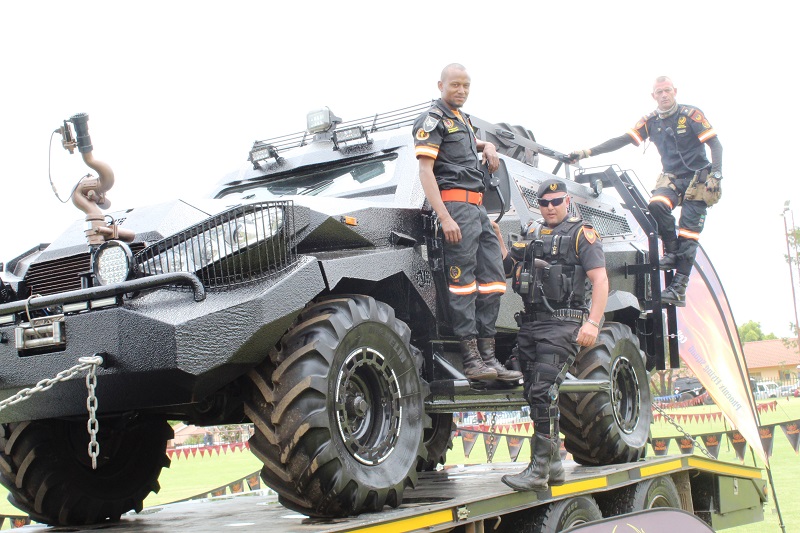
It will be utilised for commercial riot purposes and this prodigious machine’s resale value is estimated at R1,5 million.
Steelburger/Lydenburg News had the opportunity to talk to Jandre Stander of Phoenix Security about the new addition. Phoenix is a commercial security company specialising in riot control and asset protection.
Stander told the newspaper that what makes this vehicle unique is the several adjusted features which put it in a class of its own.
READ: Mob justice ends alleged thief’s death
“It took us around 18 months to complete this project. We brought one of our previously used Unimogs back from Swaziland and had it completely stripped. After that, the chassis went to Brits in Northwest, where it was fitted a V8 engine. It was then transferred to Wohler Manufacturing in Pretoria North, fitted with water pumps and a specialised water cannon from ANCO Manufacturing in Piet Retief. Extra modifications were done at Edan Trucks near Lanseria and most of the final work, detail and rectifications at Protect-a-Burn in Secunda.” Enter the Phoenix Mark 3.
Stander said the Mark 3 prototype is an all-round 4X4 with diff lock, four gears forward in low and high range and four gears in reverse, high and low range. Low range is much safer for reverse, preventing the vehicle from being too fast and dangerous.
The vehicle has built-in Wi-Fi router, cameras all-round and voice communication linking it directly to the Phoenix control room. It also has one K9 kennel on each side, a 1 000-litre water tank fitted with two 25-litre foam and chilli pepper concentrates. “The reason we use concentrates with water is because 1 000 litres of water can then actually produce around 3 000 litres of foam,” Stander explained.
Also Read: Mob justice ends in alleged thief’s death
The Mark 3 also has an extra 30-metre water hose with a nozzle, permitting hydrant fitting for quick refills which means that it can also be utilised as a fire truck. The Mark 3 and water cannon work with different engines, gasoline and batteries, enabling the separate operating systems to assist each other if necessary.
It can also carry a staggering 5 tons at 120 km/h with sirens and a public address (PA) system to aid with blasting and other emergencies.”
Although this is our prototype, all our armoured vehicles are controlled and regulated by ARMSCOR. This means that each armoured vehicle is issued with permits under section 13 of the Conventional Arms Control Act No 41 of 2002. All riot control equipment, communications, command and control systems also need to be registered and permitted under the same act,” Stander said.
This is Phoenix’s third armoured vehicle. Both its predecessors are still in use. All Phoenix’s vehicles are serviced in Lydenburg.
The Unimog is often (and rightly so) identified with being a military vehicle. This was, however, never the real intent for its use.
According to www.unimogmeister.com › Unimog-history, the first model was designed by Albert Friedrich and Heinrich Rößler shortly after World War II to be used in agriculture as a self-propelled machine, providing a power take-off to operate saws in forests or harvesting machines on fields. Unimog production started in 1948 at Boehringer in Göppingen. Daimler-Benz took over manufacture of it in 1951 for mass production.
Unimogs became famous for their use in the South African military in the early 1970s. These huge and powerful vehicles did duty as ambulances and special field vehicles. Later, the Unimog chassis was used by the SA Military to produce the famous Buffel.
Some 7000 Unimog chassis and power trains were imported to South Africa for military use, most of them rebodied with Buffel bodywork.