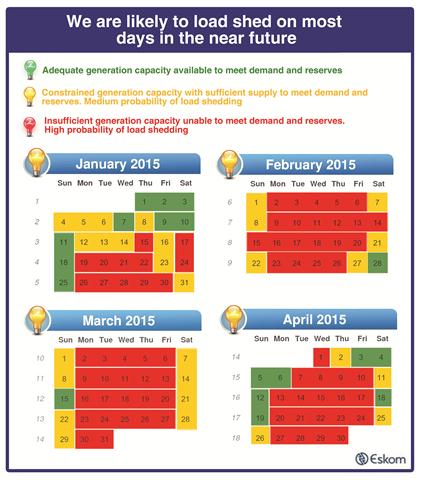
MBOMBELA – Will South Africa’s lights stay on? Only time will tell. Even Eskom seems unsure. The one minute they warn that load-shedding will be implemented, the next it is announced that reserves are stable and that it is unlikely that we will be left in the dark.
Eskom’s CEO, Mr Tshediso Matona, said they had seen a significant increase in unplanned maintenance and breakdowns on its plants that has had a compounding negative effect on the power system’s reliability. Still they were able to avoid load-shedding over the festive season. Many businesses reopened on January 5 which demanded an electricity increase which led to it being implemented a few days later in other parts of the country. The power system remains vulnerable, meaning that any extra load or faults in the system may necessitate load-shedding.
Summer is maintenance season at Eskom. “We do planned maintenance in the summer, when demand is lower, so that maximum capacity will be available in the colder seasons,” said Mantona. Maintenance season is usually from September to mid-May.
On the financial side, the liquidity situation is under pressure not just because of the high price of diesel, but also lower sales, building new capacity and the lack of cost-reflective tariffs this year. Eskom’s philosophy of “keeping the lights on at all costs” superseded the maintenance philosophy and has put them in a very difficult position. The “keeping the lights on” programme has avoided load-shedding in the past seven years against all the odds managing an extremely low-operating margin.
According to Matona there is a severe maintenance backlog leading to unplanned outages which accelerates the problem of not being able to recover. Some of Eskom’s running plants have partial load losses, because parts are worn out, and it does not have a time window to replace or fix it. There is a risk of enduring load losses on the remaining units. The “keep the lights on” philosophy has created a culture where proactive maintenance is less important. “We have arrived at a point that does not allow us to ignore the health of our plants. Our reserve margin is so thin, that every incident creates a major system issue and could also have safety implications for the plants. The massive usage of diesel helps to bridge the problem somewhat, but the systemic healing and a shortage of capacity over the next three years appear to be unavoidable,” he said.
The good news is that Eskom is preparing to minimise the effects of load-shedding. It will create a mechanism to transfer the capabilities of its best in-class operators to the rest of the fleet. It will use Koeberg and Matimba as a blueprint to develop the required skills at a station level and bring the suppliers on board to deliver the required maintenance at the best possible quality.
Matona added that Eskom would create transparency on what additional spending on diesel would do to the country and create a load-shedding schedule that supports the people and economy to the best of its ability. Eskom will prepare its customers and its interfaces to deal with load-shedding. Although it is painful, it is a necessary decision to protect the electricity power system from a total blackout, which would have significant consequences on the South African economy. Eskom is committed to provide an early warning, however, at times the system status changes rapidly. The power system will remain severely constrained and will only begin to ease once new generating capacity comes online and other levels materialise.
The system will remain tight in the summer season. Risks of extreme weather-related outages such as wet coal, unplanned outage extensions and unavailability of primary energy may worsen the situation. The country needs to be prepared for load-shedding. It remains important for
all customers to maintain or achieve
10 per cent electricity savings especially in the commercial, industrial and residential sectors, Matona warned.