
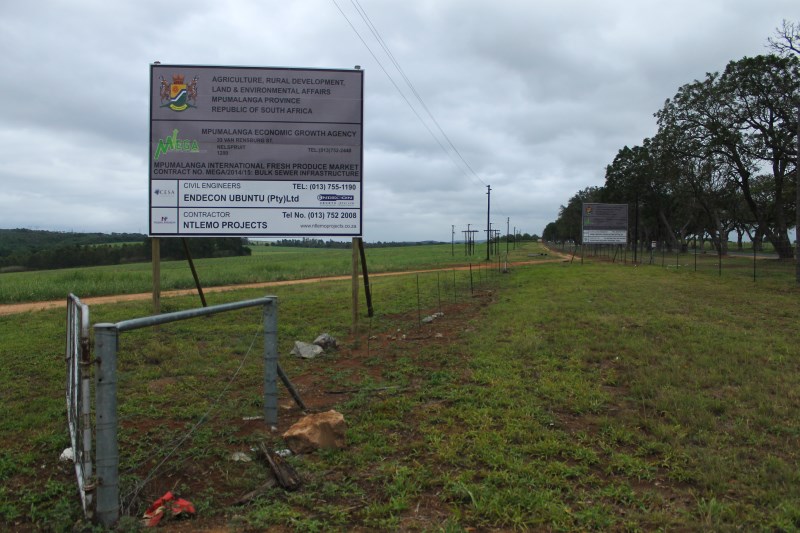
MBOMBELA – The cost of establishing the international fresh-produce market is far exceeding initial estimates that were announced two years ago.
The Department of Agriculture, Rural Development, Land and Environmental Affairs (Dardlea) estimated in 2013 that the market would cost R1 billion over five years. The implementing agent, the Mpumalanga Economic Growth Agency (MEGA) now says a total of R2 billion is required to bring the three phases of the project to completion.
MEGA CEO Mr Xola Sithole says construction is supposed to start in April 2016. He explains that the market is not only viable, but necessary.
“It is a catalytic infrastructure investment which is meant to anchor investment in the province, in the supply and infrastructure surrounding the market,” he told Lowvelder.
“The philosophy is that you need something that makes you a player. Fundamentally you need to attract capital and expertise to a credible project. It has to be sustainable in the long run.”
Dardlea has made R51 million available for infrastructure development on the site in its annual performance plan for 2015/16.
Department spokesman Mr Bhekumuzi Nyathikazi says it will provide funding to a level where all bulk services are constructed.
MEGA will source funding from the private sector for the top structures.
Sithole adds that the implementation is occurring at the pace at which it is possible. All bulk water, bulk sewer and bulk electricity have been installed on the property located about three kilometres outside Mbombela on the R37 to Lydenburg.
The environmental-impact, traffic, wetland, and geotechnical studies have also been completed, according to Dardlea, which has acquired 248 hectares at a cost of R45 million for the project.
Of this, 190 hectares lie to the left of the R37 and are earmarked for the location of the market, reservoir and new sewerage pump station. Sithole adds that there are a number of options on the table to finalise the commercial model, and deciding with whom they will partner is urgent.
MEGA is also managing the planned agri-hubs in Mkhuhlu in Bushbuckridge, Piet Retief, eThandukukhanya in Mkhondo and Kameelrivier A in Dr JS Moroka municipalities.
MEC for agriculture, Mr Andries Gamede has recently put a number to the estimated costs of these – R45 million.
According to Sithole, the sites have been chosen for strategic locations, and are meant to act as depots for surrounding producers to provide their produce to a central point, from where it will be moved to the R37 location for agro-processing and sale.
Nyathikazi explains, “The department is facilitating the organisation of emerging farmers into cooperatives (primary and secondary cooperatives) in order to enhance the business capacity and acumen of the farmers so that they will be able to organise themselves to supply the market.
“There will be some agro-processing and value addition taking place, especially where the local retailers, wholesalers and other clients are to be supplied. Not all the produce will directly be taken to the main market, the local market will be prioritised.”
DA MPL, Mr Bosman Grobler, says MEGA being entrusted to source funding is a recipe for disaster.
“The DA still maintains that this parastatal should be disbanded. How can government entrust this to an entity that can’t even keep proper records of its investment property?”
“It took the department two years (since announcement) to install this bulk infrastructure. How much longer will it take to actually build and establish the market? If we look at the enormous potential of this project, it should be fast-tracked to ensure that it happens,” he concludes.
Sithole counters that initiatives of this magnitude need government support.
“MEGA currently uses money allocated to the project by government. This will continue until the private sector and investors gain confidence from the commitment shown by government to its implementation. We believe that once potential investors see government’s commitment to the project, they will be persuaded to invest.”