Land claims, tree improvement and conservation of wetlands all in a day’s work
Sustainability, land claims and the search for the perfect tree are buzzwords in the forestry industry. Dr. Terry Stanger, managing director of Sappi Forests, took some time out to discuss these topics in his "office" amongst three millions trees.
BARBERTON- Dr Terry Stanger, managing director of Sappi Forests, has an air of humility about him. No wonder because he believes “trees keep you humble”.
After taking over the reins three years ago, it is one of the qualities that has made this ex-forester ideal for the responsibility of managing more than 11 000 contractors and employees, and millions of trees.
Lowvelder recently joined Stanger for a walk among more than three million seedlings in Sappi’s escarpment nursery in the Glenthorpe area near Barberton.
His forester’s gaze remained on the plantations. “That’s the office out there.”
It is not quite such a comfortable office at present, there are many challenges and changes coming his way.
As one of the largest owners of land in South Africa, Sappi manages 395 000 hectares. More than 135 000 hectares have never been commercially farmed with trees. This mostly consists of roads, buffer zones and reserves. Land claims have been lodged on some of these properties.

For Stanger it is important that the validity of these claims be proved, reasonable settlements be reached and a legitimate process be followed. In this process the outlook concentrates on accepting partners into the tree-growing fraternity. Sappi is open to providing the necessary technical support.
“The last thing we want is fragmentation of ownership of property. That is why we would rather join hands with stakeholders,” he said.
“Partner” is a word that you often hear the amiable Stanger use. The other is “sustainability”.
“It is the focus of our global strategy and we in Sappi Forests play our role in growing a renewable resource. As foresters we are custodians of much and we must preserve what we’ve got,” he said.
He is proud that the authoritative conservation body South African National Bidiversity Institute found, after research into our country’s grasslands, that some of the most pristine ones are located on land owned by the forestry industry.
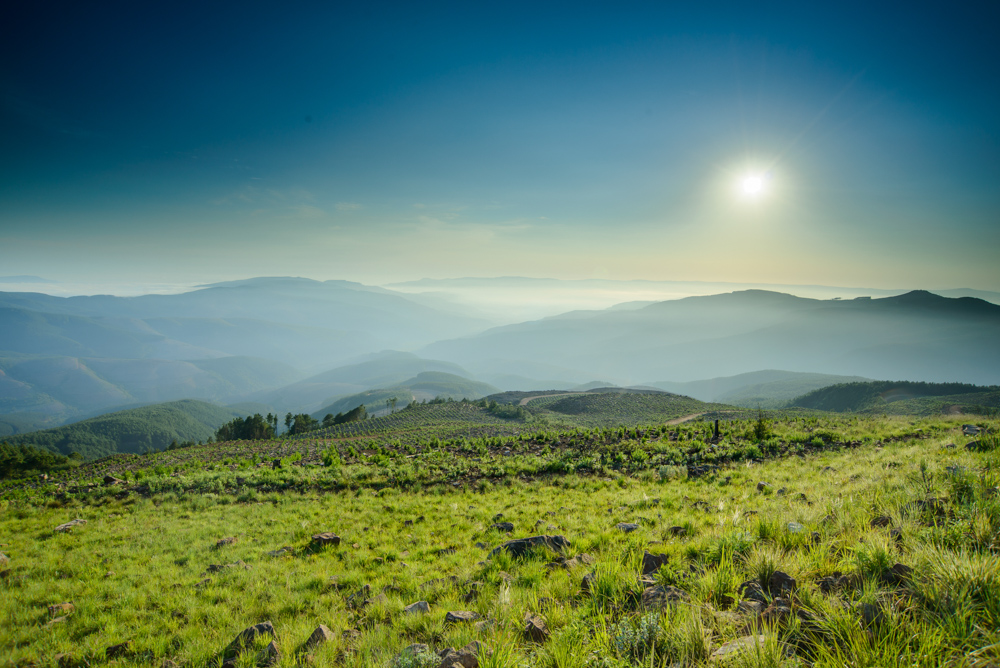
One of his favourite drives is the road to Elandshoek near Ngodwana where you can stop and take a walk through an almost unending forest of clivias and take an all-encompassing look at the rolling hills and valleys.
As Stanger called it, “the scenic Super Bowl”.
Even though nature like this panoramic vista has not changed much, there has been significant change in the industry over the past 25 years. Research and development also form an important part of Sappi’s tree-breeding programmes. This has led to hybrid combinations being developed and planted. These hybrids are resistant to pests and diseases and are more site specific.
“We are creating a combination of species in the labs and nurseries that will work in nature.”
Markets have a dynamic way of creating new demands in terms of wood requirements. But, the basics have stayed the same.
“We understand trees, how to grow them and to see to it that their wood properties are exactly what the market requires,” said Stanger.
Climate change does not have a direct impact from day to day on the plantations.
Stanger points out that ongoing research about developments in weather patterns, is part of his management strategy.
“We need to have things in place when more severe weather events occur.”
Safety and security in the rural environment is important to him. He said forestry work can be dangerous.

Mechanisation, however, will only be instituted where really necessary, as the responsibility to provide jobs is a priority.What has been expanded on is a focus on reaching out to communities. Controlled grazing, honey farming and the picking of mushrooms by bordering communities have always been allowed.
A community has been encouraged to plant peanuts among the eucalyptus trees in Zululand.
A social programme rolled out in Sappi villages and bordering communities in KwaZulu- Natal has recently had huge success. Eighteen “agents of change” were employed to develop skills and become entrepreneurs with an aim to keep assets in communities. This will soon be rolled out in Mpumalanga as well.
“With our community’s involvement we need to move from dependency to co-creation,” explained Stanger, while his eyes rested on the rolling hills of the escarpment clad in Pinus patula.
“Every hour of the day it changes out there in nature and we need to keep up with that.”