Spur video: ‘Racism,’ a social media circus and the law
Social media users stepped onto an online legal minefield.

The video of a man and woman’s Sunday morning brawl has gone viral.
It happened in the Texamo Spur at the Glen Shopping Centre, east of Johannesburg.
The fight was captured on video and distributed on social media. Social media users’ comments range from the defamatory to the downright criminal.
Lowvelder offers some insight into what happened and the legal implications.
- The video
Watch this at your own discretion. It contains foul language.
“Just f*ck off,” she said.
“Ek sal jou ‘n p**s klap gee,” he retorted.
He shoved a table at her. The man has since been banned from Spur.
- Accusations of racism
Both were rude. Although being rude is not the same thing as being a racist, the woman accused the man of being that – and a bully.
A Youtube user called ‘DURBANDANCE’ uploaded the video with the title: “Physical threats made by racist bully at Spur.” Another video, uploaded by DintshangaSA, is titled “Watch shocking Spur racist bully.”
Various individuals and media houses shared the video, highlighting that the man was white and the woman black.
The social implications of Sunday’s brawl and online reactions are far reaching. The legal consequences even more so.
- Criminal claims between the two
From the video, it is clear that both parties may lay countless claims against each other. This includes, crimen iniuria, defamation, intimidation and assault charges. A measure of harassment may have been present.
- Social media users and legal liability
Labelling someone a racist without evidence to prove the accusation is risky. This may lead to accusations of defamation and crimen injuria.
If you are an online user on the receiving end of such allegations, you may apply for a court order in terms of the Protection from Harassment Act. Such an order bars further harassment by the wrongdoer.
- Comments inciting violence?
Ms Ntuthuko M Simelane shared the video.
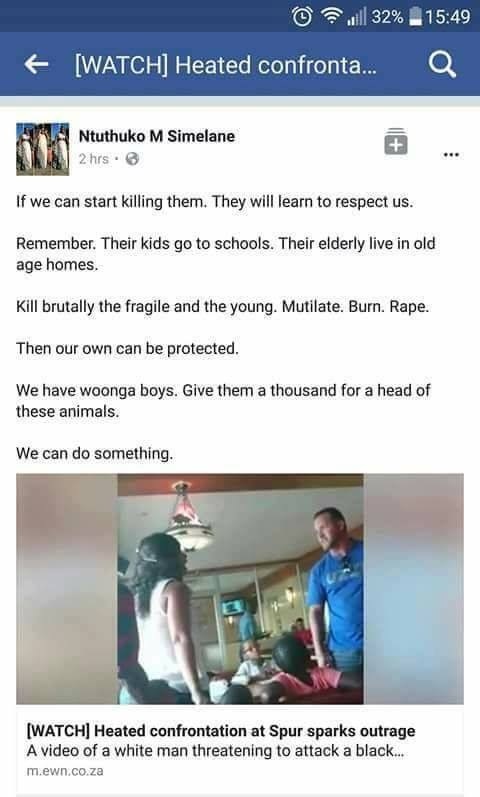
She seemingly encited violence, arson, rape and murder. If found guilty of doing so, she may face jail time.
- Social media users should refrain from creating or sharing content that:
– Defames, entices violence, promotes racism, intimidates, harasses or encroaches upon anyone’s human rights.
A criminal, civil or Human Rights Court may impose fines and/or prison sentences on those who do.
- What exactly constitutes these offences?
Also read: #margaretvanwyk – did you break the law?
Harassment is defined as the unreasonable behaviour by the respondent (wrongdoer) who causes harm (mental, psychological, physical or financial harm) or makes the complainant (victim) believe that harm may be caused by following , communicating with, watching, or bothering the complainant or sending letters, gifts, faxes, or emails to the complainant. Harassment includes sexual harassment. A victim of harassment may obtain a protection order against the wrongdoer.
Defamation occurs when the victim suffers and injury to his or her dignity, good name and reputation as a result of a wrongful act. The defamed party may sue the wrongdoer for damages.
Criminal defamation is defined as the unlawful and intentional publication of a matter concerning another, which tends to seriously injure his or her reputation. It is required that the defamatory statement must have come to the notice of someone other than the victim.
Crimen injuria consists of the unlawful, intentional and serious violation of the dignity or privacy of another person. It must be clear that the victim is aware of the perpetrator’s offending behaviour, and the victim must feel degraded or humiliated by it. The third party need not be aware of the fact that he made the victim feel violated as described above.