Get to know White River’s past through its architecture
Remarkable traces of the colonial past of White River as a predominantly English agricultural settlement in the first quarter of the previous century await the visitor on some of the old country roads outside the town. Of these, the Yaverland Road is the most important, but further afield other architectural gems are to be found. …
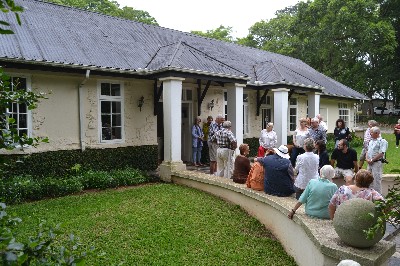
Remarkable traces of the colonial past of White River as a predominantly English agricultural settlement in the first quarter of the previous century await the visitor on some of the old country roads outside the town.
Of these, the Yaverland Road is the most important, but further afield other architectural gems are to be found. Most of these pioneering structures started as modest wattle and daub, or raw clay brick, thatched housing. Over the years more rooms had been added and facades changed into comfortable country homes, of which many remain to be seen.
Where money allowed, a few of these were built right from the start as gracious mansions, of which Uplands of the Webster family and Bedford House of the Turners still remain. Others, such as Carfax of the Glynn family closer to town, have since been demolished. Fortunately most of its content was offered to the old Transvaal Museum services and is today on display at Allenglade, the restored mine manager’s house museum at Pilgrim’s Rest.
Many of these homes still bear the names of the original farms named by the these planters. Most of them used their life savings, demobilisation gratification or inheritance to trade gloomy England after the Great War for a sunny but uncertain farming life in South Africa.
White River Estates, a privately operated land syndicate established in 1916 after the initial Milner settlement plan following the Anglo-Boer War, brought very little success to the initial settlers of 1902. Of the second intake, many were commissioned officers demobilised after the First World War. It is said that the ranks of the members of the Planters’ Club, a social club founded in these early years, rang more like an officers mess evening than a civilian gathering.
Life on the Ridge of years gone by, as the area around the Yaverland Road was known, is beautifully depicted in the book, White River Remembered, compiled by Claire Neville. It paints a vivid picture of the times, characters and lifestyle of the English pioneering families since the 1920s.
This excerpt is from a letter published in the book. It was written by a the young Charles Griffiths to his mother in England shortly after his arrival to start a life as a planter on the Estates. The letter is dated March 29, 1923:
“The scenery is perfectly wonderful, mountains all over the place and lovely grasslands and vegetation. We’ve got 536 acres and it is four miles around the perimeter, so I feel a devil of a lad with all that. Thirty acres are for citrus this year, and these trees will be planted in July. Next year we hope to plant another forty acres citrus. 120 acres for cotton this year, which we hope to extend to 250 acres the following year. The oranges will give their first crop in 1927. At present we are busy ploughing hard. We’ve got 17 labourers and 29 oxen. These Swazis make me shriek with laughter, I don’t quite know why. But to hear them sing as they work is very moving. Some of them work awfully hard, others not quite so good.
Besides ploughing, we are hard at levelling the site for the house. This will be finished in about a fortnight, and then Villers and I will build the house with the aid of a Dutchman foreman. The roof is the only thing we are not going to tackle ourselves, ‘cos it needs a bit of an expert and we don’t need things falling on our heads one night. The house should be ready to live in by September. Then there is the big dam which is being built at the end of the place and the water will be for us and the Bryants, our neighbours.
I’ve have met quite a number of people here so far. The first day I arrived, we all went to the Planters’ Club for tennis. I met some people called the Turners, a Mrs Ross and Digby and Ritchie. The last two are quite nice fellows. Then today we went and visited some people called Macgregor, a brother and a sister, awfully nice people. We went to see their cotton. Saturday and Sunday we are going to the Turners for the weekend. There’s a tennis tournament at the club where they have two topping hard courts. A dance on Saturday night, and heaven knows what else.”
Two more publications which are essential reading on White River’s colonial past are Liz Mackintosh’s The Tale of a School, Uplands Preparatory School 1928 – 2003, as well as Hans Borman’s more recent White River Photo Album. These three books are on sale at the information office of Kruger Lowveld Tourism at Crossings in Mbombela or the book store at Casterbridge outside White River.
Members of Mpumalanga Heritage recently went on a conducted tour of some of these houses. The group was led by Huffy Pott, who grew up on the ridge and still resides in one of the old family dwellings. Huffy was also the last chairman of the Planters’ Club when it closed down in 1973 to merge with the newly established White River Country Club.
Most interesting was the dressed stone house, Nyati, built for the Pott family very much in the Scottish revival style typical of the arts & craft movement of the days around the early 1900s, lasting well into the 1920s and 1930s here in South Africa. Another was Bedford House of the Turner family, later to replace the original pioneering structures of whitewashed rondawels and thatched buildings.