Barényi has ensured our safety from the get-go
An important chapter in the history of vehicle safety started 75 years ago when Béla Barényi joined the former Daimler-Benz AG, as the company was called then. “Pretty well everything,” responded the young engineer Barényi boldly, when asked during his job interview which aspects of the current Mercedes-Benz vehicle range he would improve.
Wilhelm Haspel, at that time a deputy board member of Daimler-Benz AG, was won over by the unconventional thinking of the 32-year-old Austrian and took him on, at the recommendation of the former head of testing in the bodyshell development area, Karl Wilfert. On August 1, 1939 Barényi took charge of the newly established safety-development department. So began an important chapter in the history of vehicle safety.
“Every innovation needs creative engineers who, like Barényi, are bold enough to question the status quo and to break new ground,” emphasised professor Dr Thomas Weber, the Daimler AG board of management member responsible for group research and Mercedes-Benz cars development.
“Our declared aim at Mercedes-Benz is to retain and extend our role as trendsetters in the field of vehicle safety and, by doing so, to continue to improve road safety,” said Prof Rodolfo Schöneburg, head of vehicle safety at Mercedes-Benz Cars. “And we are a long way off running out of ideas in this respect. We are currently, for example, concentrating on reducing the strain on the upper torso in a side-on collision.”
Béla Barényi: The father of safety
Visionary engineer Barényi (1907 – 1997) worked for Daimler from 1939 to 1974. He initiated more than 2 500 registered patents, many of them concerned with the principles of automotive safety. Among his inventions was the safety cell, protected by crumple zones.
Barényi had groundbreaking ideas early on: even as a student in the 1920s, he was working on a design for a state-of-the-art car with a tubular backbone chassis and air-cooled boxer engine. From 1939 the engineer dedicated himself to improving passenger car bodies at Mercedes-Benz. This work resulted in a 1941 patent for an improved platform frame which, owing to its particular resistance against distortion, minimised “booming and shaking”.
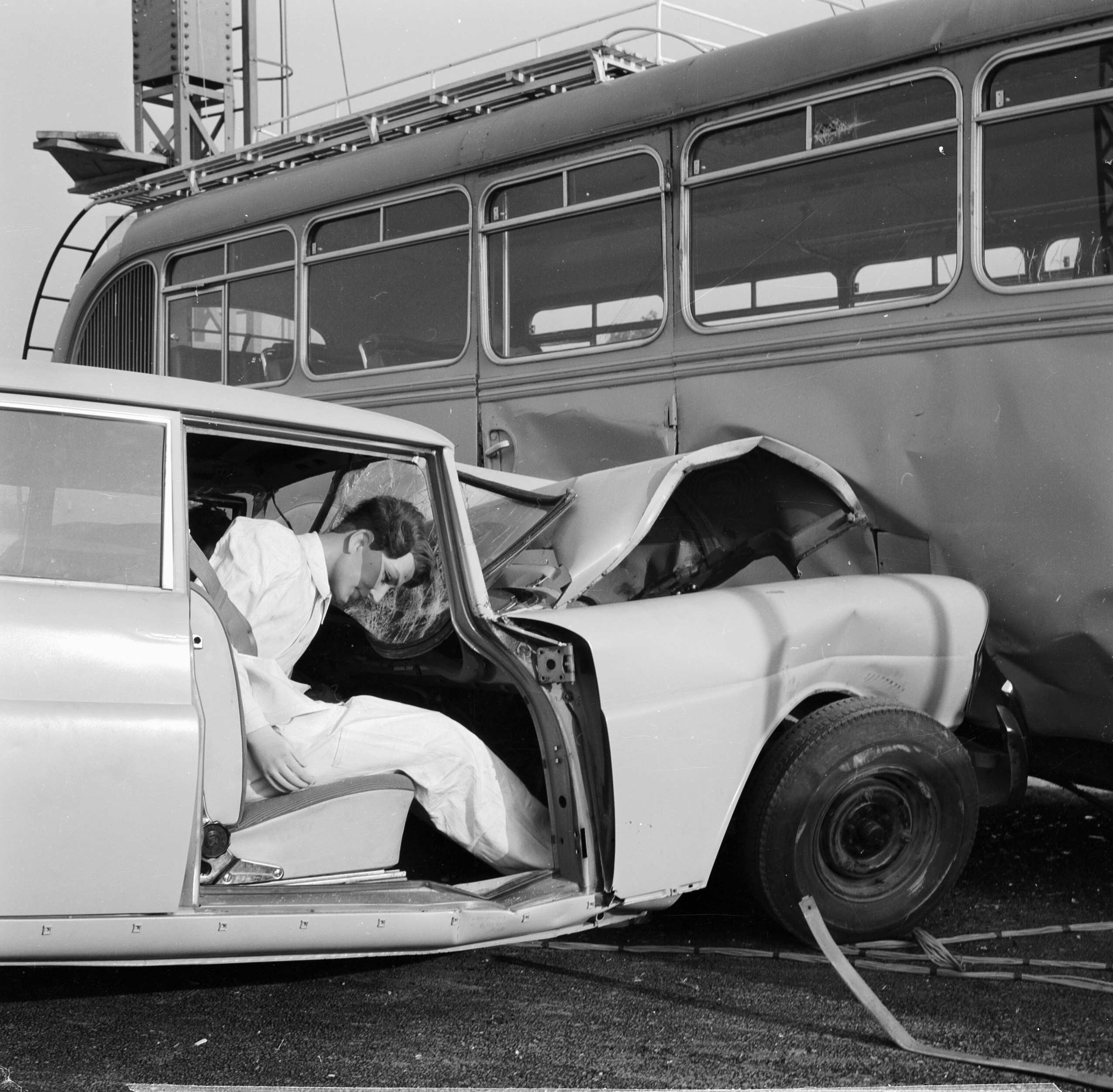
Mercedes-Benz implemented the patent filed in 1951 for the first time on the W111 model series (“Fintail”) of 1959. Crumple zones deform in an accident and absorb the kinetic energy from the collision in a controlled way. At the same time, a sturdy occupant cell protects the vehicle occupants. Since that time, this structure has become an established part of passenger cars worldwide.
Barényi’s “safety steering shaft for motor vehicles” also caught on. This technology was patented in 1963 and premiered as a complete safety steering system in the W 123 series of 1976, the predecessor to the E-Class. It took 28 years before his idea for a recessed windscreen wiper to protect pedestrians made its debut in the
W 126-series S-Class of 1979.
“Always way ahead of his time” : Reminiscences from those who knew Barényi
• Prof Werner Breitschwerdt – “I joined Daimler-Benz AG as an engineer in 1953 – so at a point when Barényi was already celebrating one of the highlights of his working career: the patenting of the principle of the crumple zone. I got to know him as someone whose sheer tenacity, more than anything else, made him stand out from the crowd.
“He had so many ideas and worked ferociously hard to ensure that they were also acted upon. But he was also extremely fortunate in being able to work as freely as he did at Daimler-Benz. He was given a tremendous amount of freedom – and that was right and necessary at that time, in order to drive forward the important issue of safety. Just consider: Barényi was coming up with his inventions in the post-war period. There were far more pressing issues in Germany at that time than automotive safety – these were just the early days of motoring, when people were driving bubble cars or other really small ones. And yet the engineers at Daimler-Benz were already working on improving the safety of future models. Barényi was always way ahead of his time.”
• Prof Guntram – “At the time when Barényi was making his important discoveries about automotive safety, there was no such thing as a crash test. Much of his work was based purely on theoretical principles – and on intuition. He would say how it had to be done, and he was right. That was the amazing thing about the man. Then, when I joined Daimler-Benz in 1959, we built the first test sled to use for safety tests – it was a really basic construction with one seat on it, operated by a pulley system.
“The crash zone in those early days was a pile of great big tins from the canteen kitchen. However, the first proper crash test with a vehicle soon took place, in the autumn of 1959, and we were just so full of admiration that Barényi’s crumple-zone concept worked precisely as he had calculated years earlier on a purely theoretical basis.”
• Dr Falk Zeidler – “I have rarely met an engineer who had such an enquiring mind, or was as dedicated and astute as Barényi. I can still remember very clearly, when we had completed the first analyses of real-life accidents and established in the process that, in a collision, the way the steering wheel moved back into the interior was often quite different from what we had seen in crash tests, Barényi spoke to me and got me to explain in great detail what we had discovered in the accident analysis.
“The outcome of this conversation was ultimately a new patent from Barényi for further improvements to the safety steering system – a technology that then went into series production at Mercedes-Benz in 1979.”
Ever since the invention of the motor car in 1886, Mercedes-Benz, with its precursor brands, has been instrumental in the development of active and passive safety, setting one new benchmark after another in the process.