


Despite being lowered in severity for the media, the various tasks tested patience, physicality, brains, teamwork and trust to the limit.
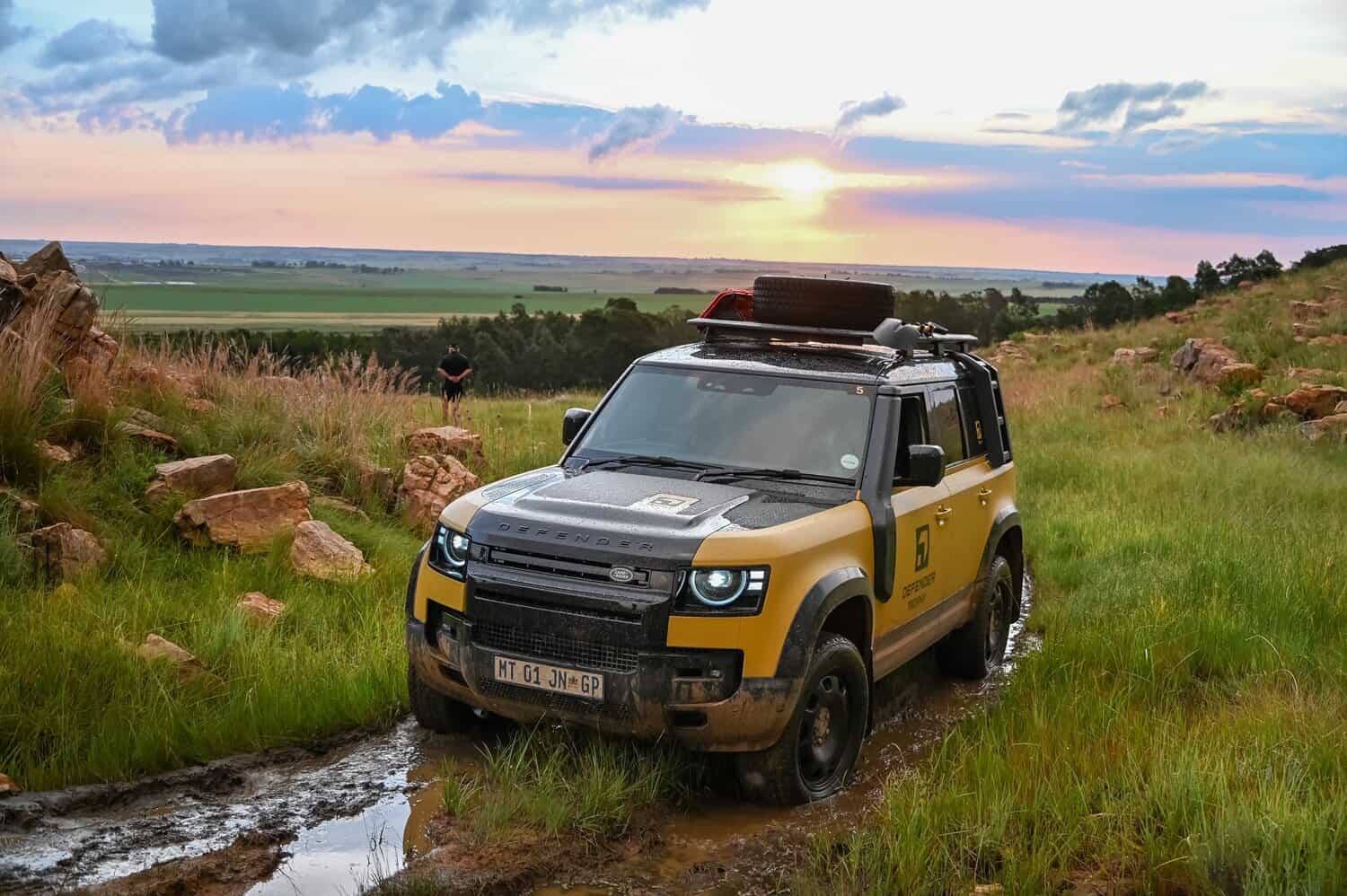
Defender Trophy takes the same spirit, but with a modernised feel, as the iconic Camel Trophy. Image: Rob Till


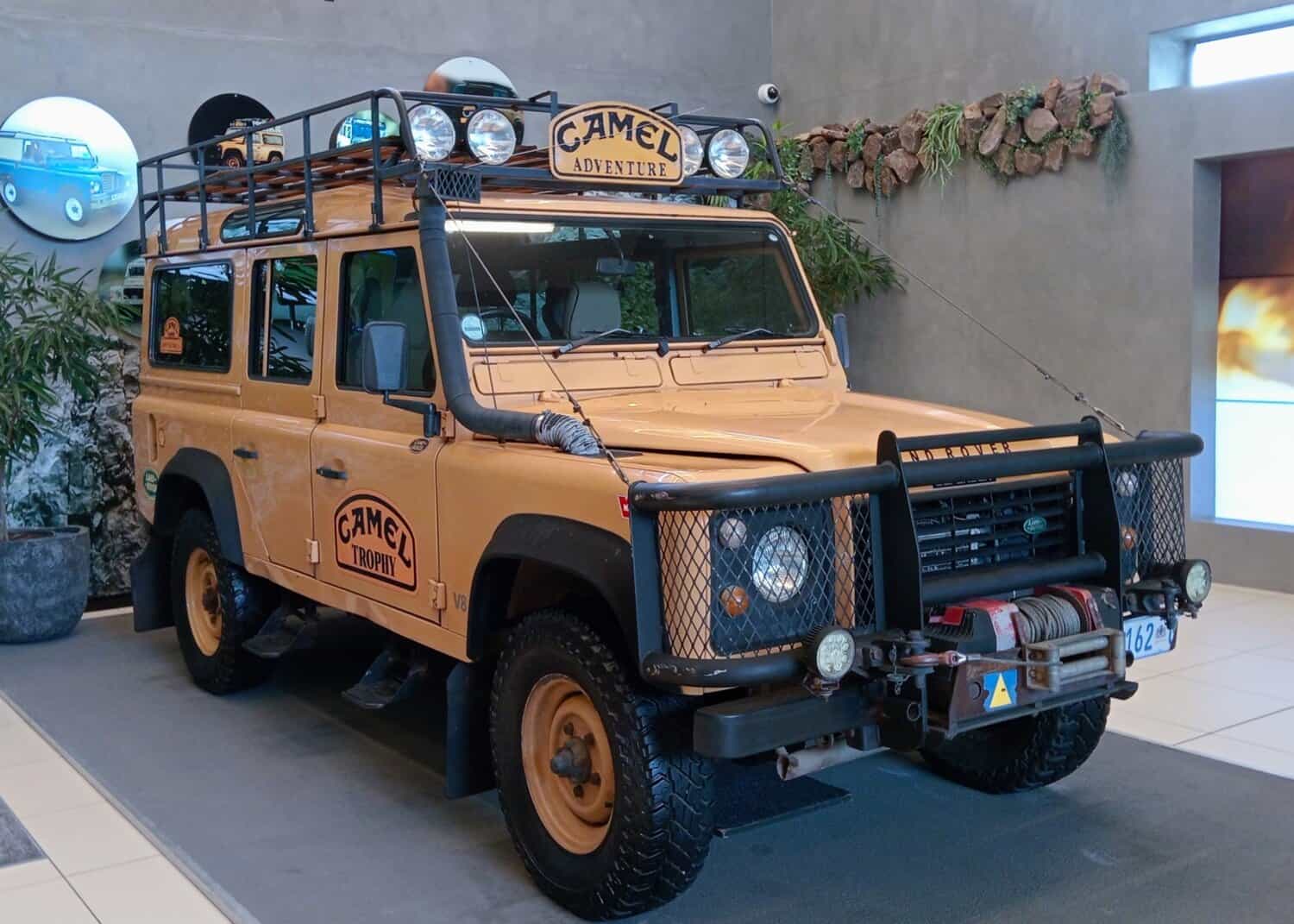
The Camel Trophy was renowned for its toughness and stamina in the 20 years it took place from 1980 to 2000.
The past refined
Famous, though not from the first edition, for its use of Land Rovers, the event crisscrossed countries and continents as the ultimate adventure rush key later sponsors Land Rover and Camel cigarettes wanted to portray.
The eventual outlawing of tobacco advertising led to Camel stubbing out its sponsorship in 2000.
Watch video below
Later rebooted as the Land Rover G4 Challenge, the event, arguably, had lost some of its magic and quietly disappeared soon after.
Since last year though, it has seen a revival, but retitled and now known as the Defender Trophy using Defender 110s.
ALSO READ: JLR returns Defender to competition past with new Trophy Edition
Despite similarities with the original, it is more physical and not as reliant on driving.
While activities such as orienteering is still present, cycling has been removed and water-based activities no longer restricted to rowing from one end of a river or lake to another.
Process of elimination
As before, the event is split into regional segments campaigned in 75 countries by over 600 participants.
Of these, 12 will go into the semi-finals before being whittled down to two for the global finals in October.
South Africa, which has always had a strong Camel Trophy presence, is no exception as our semi-finals kick-off next month.
Oh boy…
Before getting underway, though, JLR South Africa, as a way of also launching the limited run Defender 110 Trophy Edition, opened the event to the media for the first time.
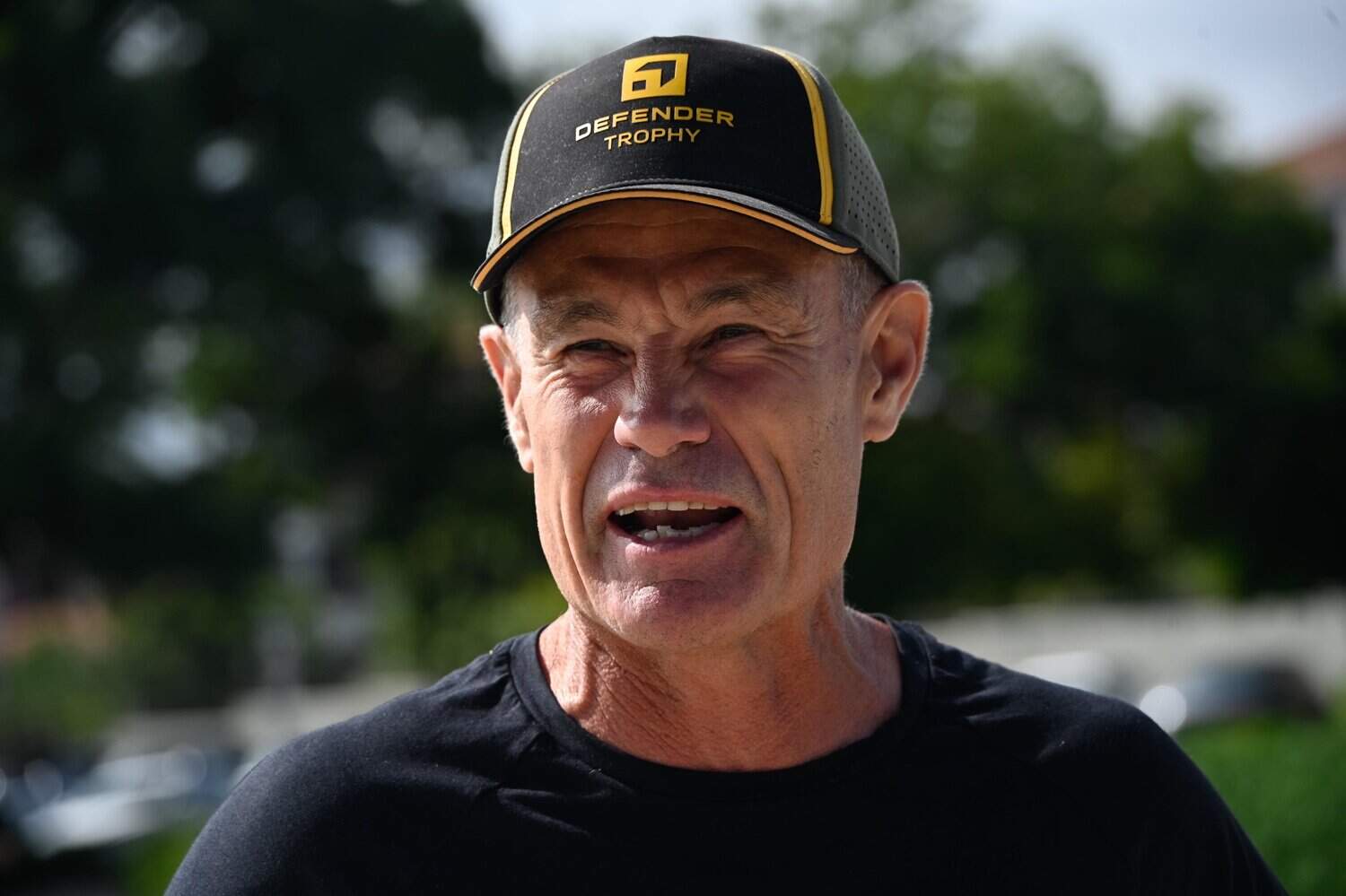
Lead by Mark Collins, who finished second in the 1998 Camel Trophy with his brother John, the tasks had been made a bit easier to compensate for our lack of physical prowess, supposed skill and muscle.
This involves yours truly who, having spent many years watching the Camel Trophy on television, isn’t the most physically adept or worth much in the muscle department.
Turning up at the JLR Experience Centre in Lonehill last week was, therefore, a literal plunge into the unknown.
What was certain was that this would be no traditional vehicle launch despite the Camel Trophy tribute coloured Defender 110s parked in front of us.
Defender 110 Trophy Edition
Unveiled last year as a precursor to the event, the Trophy Edition only comes in five-door 110 bodystyle based on the X-Dynamic SE trim.
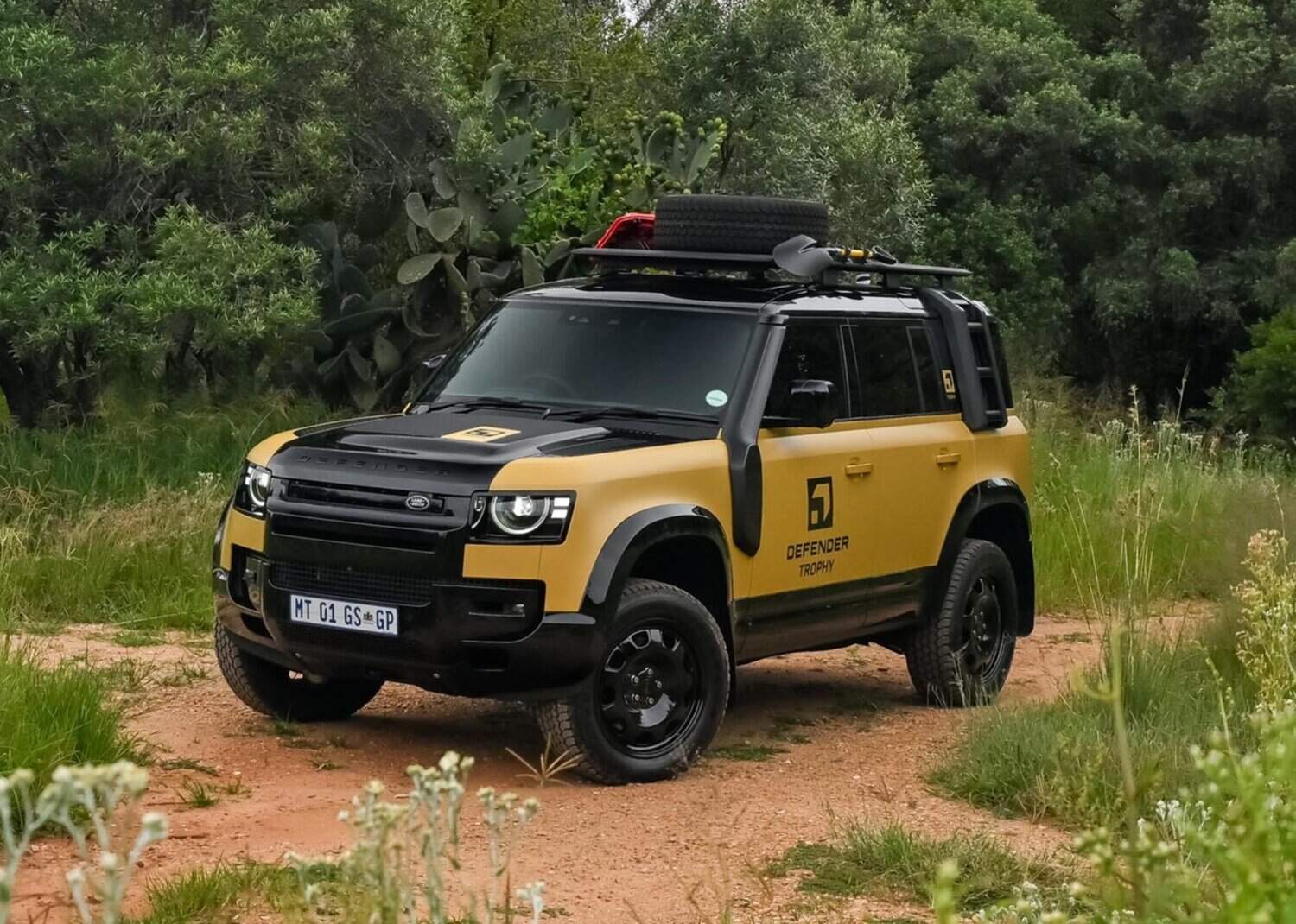
Limited to 60 units priced at R2 227 800, its exterior add-ons consist of 20-inch alloy wheels styled to resemble steel covers, all-terrain tyres, darkened front and rear scuffplates, a black bonnet and brake calipers, black side moulds and gloss black wheel arch cladding.
Black recovery hooks and special Trophy badges round the exterior off, together with otherwise optional accessories comprising a side ladder, a single side-mounted storage box, roof rack, snorkel and heavy-duty mud flaps.
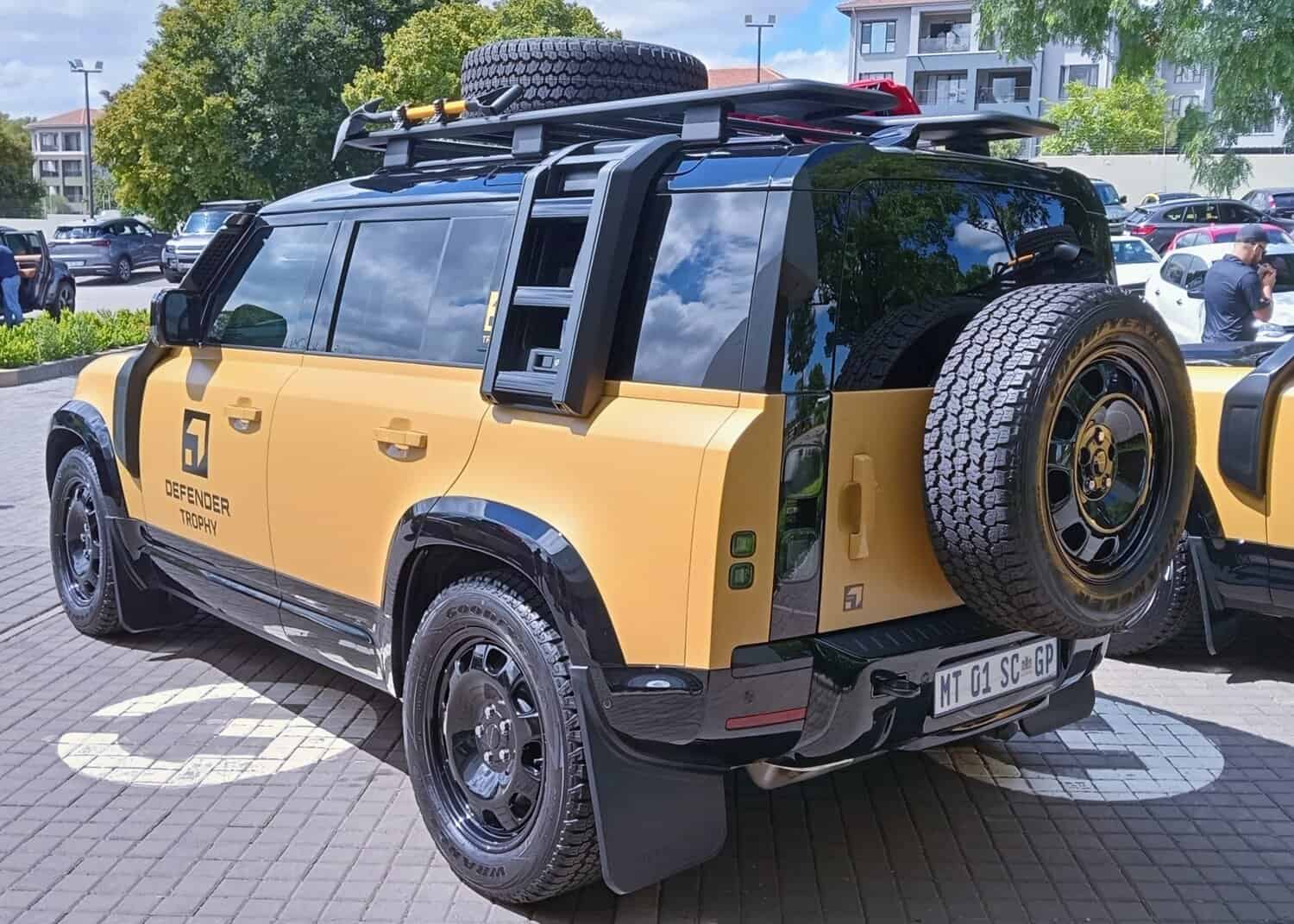
Finally, two colours can be selected from; the mentioned Camel-inspired Deep Sandglow Yellow or Keswick Green.
Inside, the more minimal additions include the updated 13.3-inch Pivi Pro infotainment system, a body-coloured dashboard “crossbeam”, Ebony Windsor leather upholstery and illuminated Trophy branded treadplates.
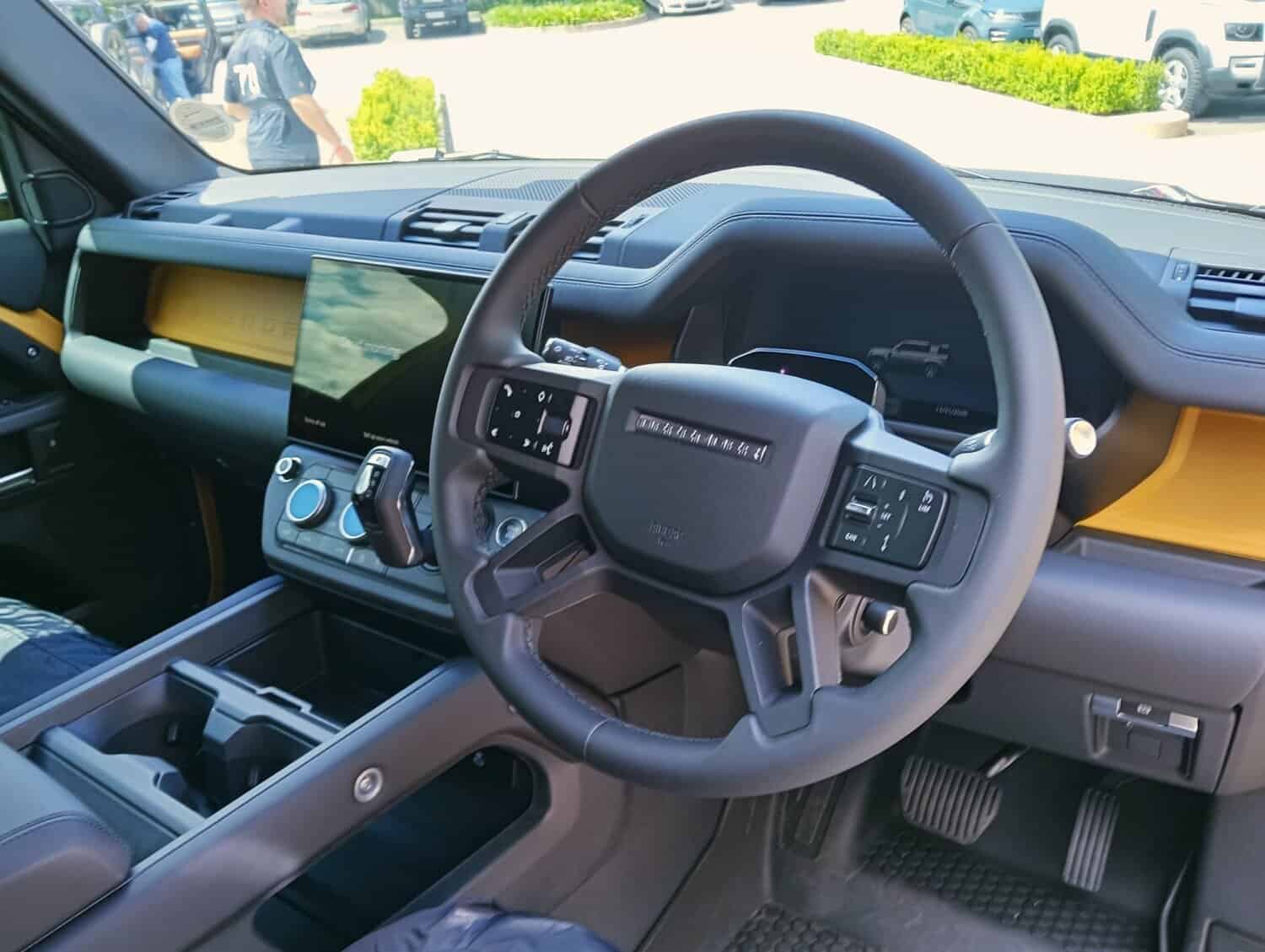
For motivation, the Trophy sticks with the 3.0-litre Ingenium straight-six turbodiesel engine that sends 257kW/700Nm to all four wheels through the ZF-sourced eight-speed automatic gearbox.
How to do it?
Before any driving or activities commenced, there was the matter of learning what we were going to do by “practising” some of the tasks at JLR HQ.
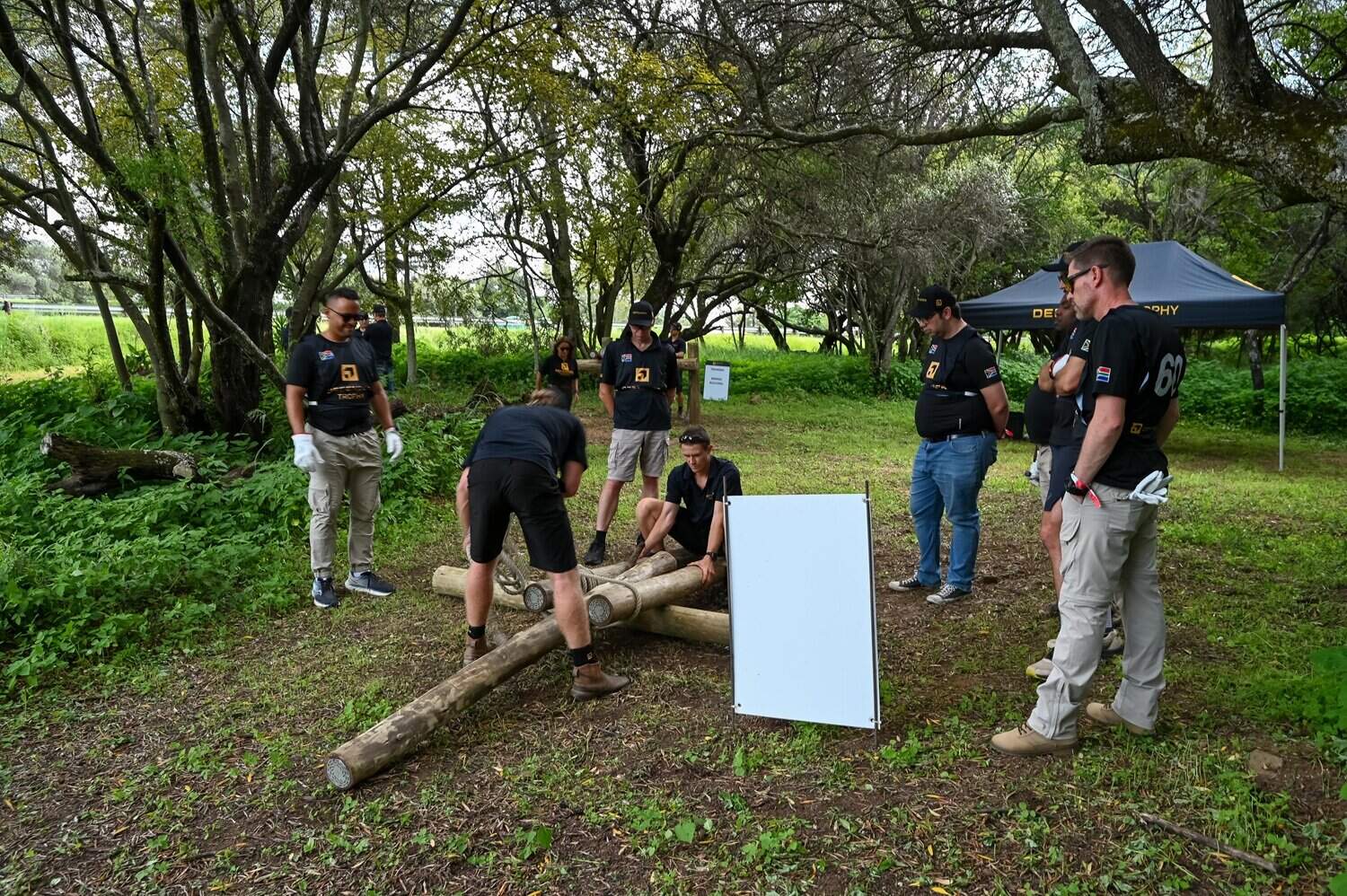
While traversing the off-road course proved easy, the complexity of tying two specific knot patterns to poles in creating, amongst others, a tripod, left me fumbling.
Devising the system for the orienteering leg also proved tricky and not as easy as it looked on television.
Here we go
Setting off for a farm outside Bronkhorstspruit in cloudy to ultimately pouring rains proved the easiest bit. But not for long.
Nearing a water crossing, we had to re-route as a tractor had, perhaps deliberately, blocked the only way across.
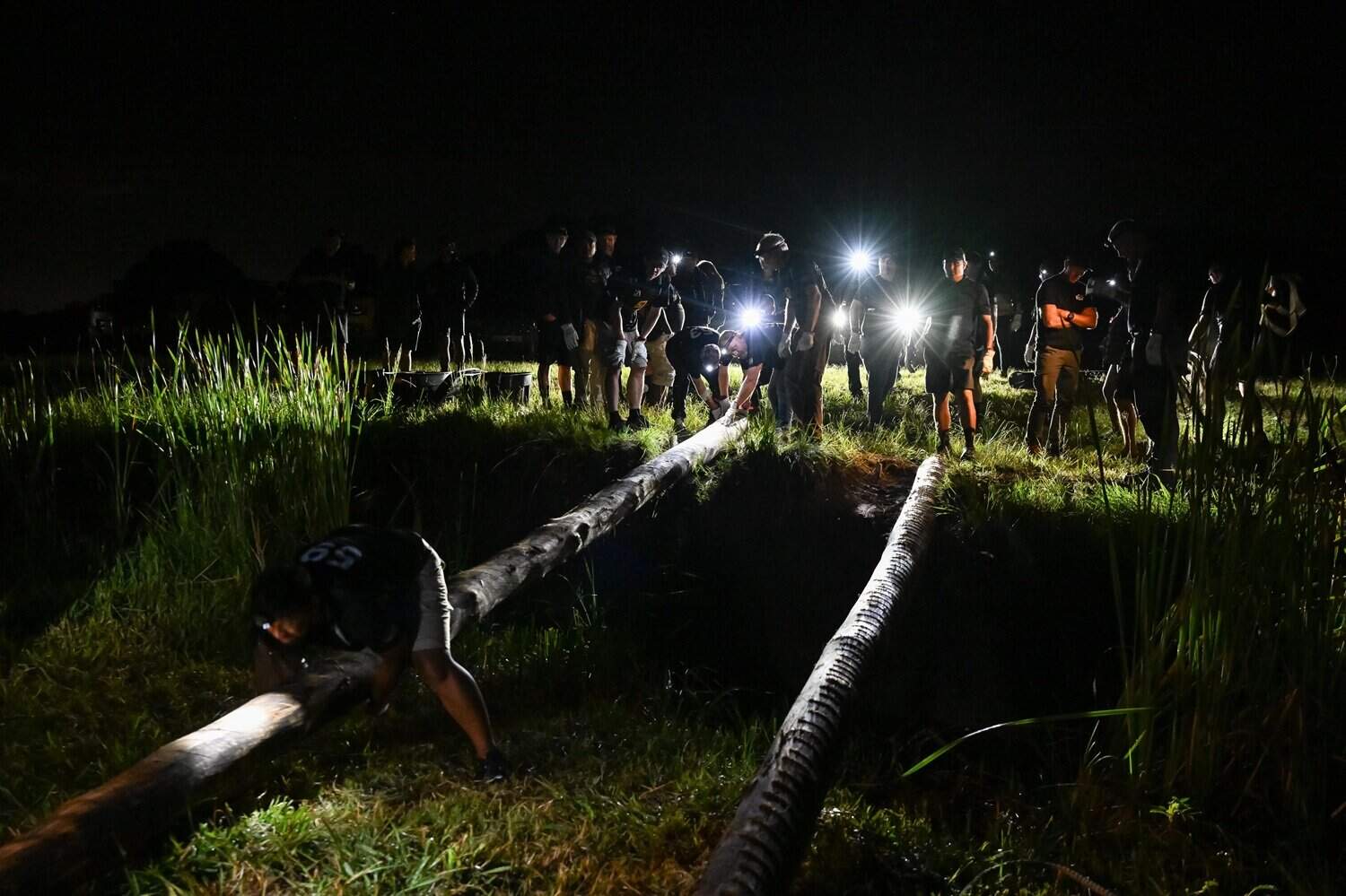
The figure of Collins then appeared, alongside four poles and rope adjacent to two neatly cut grooves in the ground.
The message was clear; we had to use our knot tying learnings to build a bridge strong enough for all six Defenders to cross.
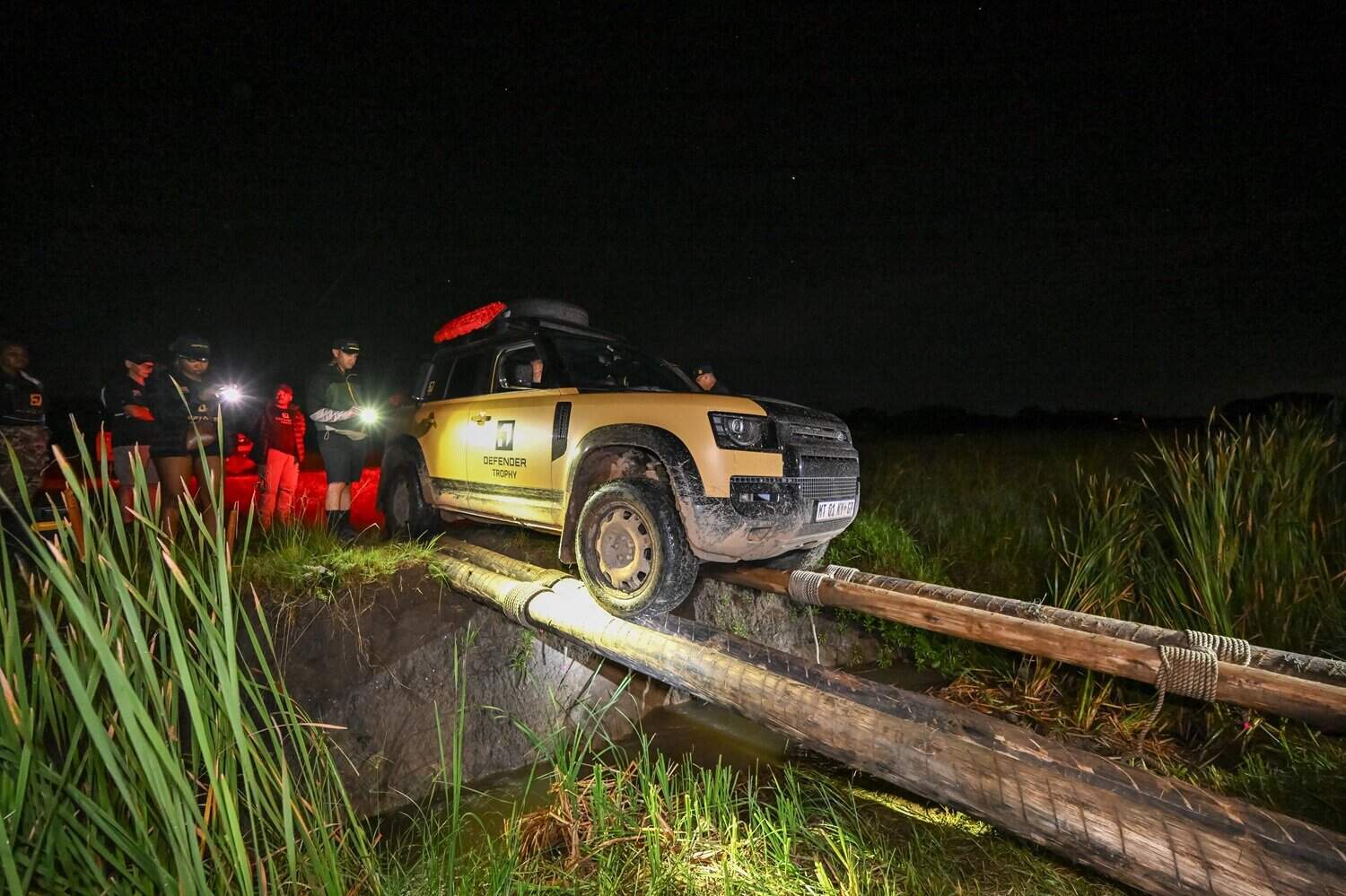
Dark and wet, the bridge building, thankfully, proved a success and without any hairy moments, all six made it over without the poles shifting or the ropes coming undone.
Bedraggled and tired as we found our way to our tents well after 23h00, we knew that this had only been the start as a full day of extremes laid ahead, starting with a 05h00 wake-up call.
Straight into battle
Rising to rain-free conditions, we were split into teams of four and handed the challenges that had to be completed in between 25 and 30 minutes.
The claw
Spread across the farm, the first was the aptly named Claw, which involved a rope and pulley to manoeuvre a hook.
This would then clip on to handles integrated into tree stumps, which had to be placed on spray painted tree stump cutaways representing different point values without falling off.
A task that tests communication, it proved fun but difficult.
Wide Load
Task 2, Wide Load, involved a horizontal beam strapped to the bumper of the Defender.
Measuring differently at both ends, slaloming through marker beacons on the outside of the course without the beam touching also proved complicated.
While time got the better of us, only one pole got grazed.
Photobomb
The next task, Photobomb, involved the orienteering leg, but with a twist.
Unlike in training, we were not given a map with the various checkpoints. Instead, we had to memorise them by running back to the start line where a map had been placed.
Tedious and time consuming, it, nonetheless proved enjoyable even though I didn’t fully succeed in crunching all of the checkpoint’s markers onto my score card.
Auto Test
The next two tasks were by far the most frustrating.
In the Auto Test, we had to drive the Defenders through gates marked A to F, but from a directional entry i.e. North, South, East and West.
Making this difficult was that the co-ordinates had to be remembered from the provided piece of paper, and relayed via radio to the team in the car.
As it turned out, memorising ‘A West’ and ‘F North’ became difficult for our tired brains, with my failure to remember one set of instructions being especially costly.
Ring Fence
More was to follow at Ring Fence. Here, poles were stacked in a ring and involved the Defender being driven in nose first, and then manoeuvred around inside without touching a single one.
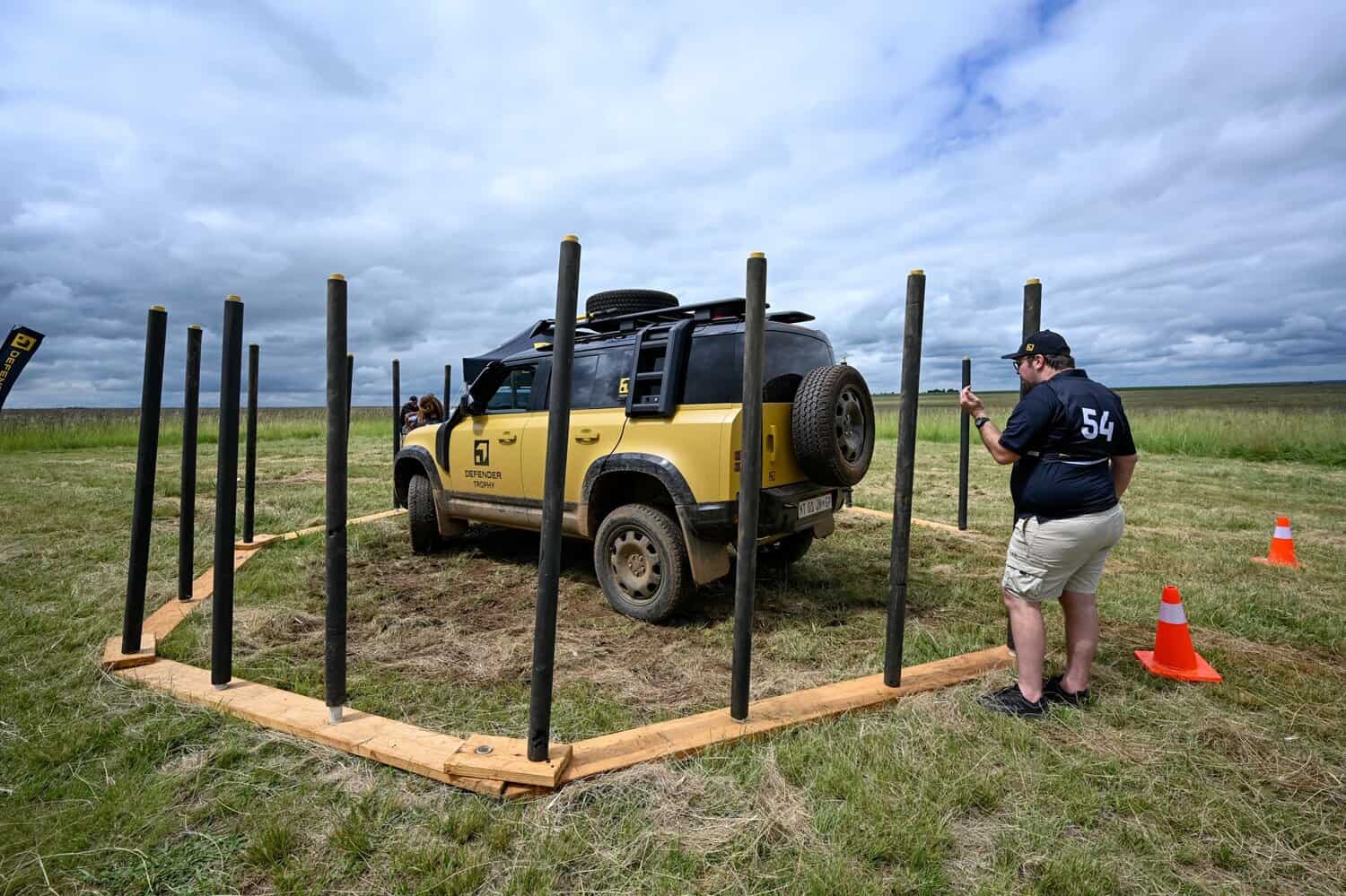
As it turned out, the clock-like “forwards then backwards” technique didn’t work as, no matter how we entered the pen or adjusted the wheels, we ended up in the same position over and over.
It was only when our time expired did the instructors show us the correct way in and out.
Invisible Maze
For the next task before launch, the Invisible Maze, we had to perch ourself on a canoe and search for buoys marked on a map.
Although similar to Photobomb, trying to stay upright with a paddle that constantly found the underwater vegetation, plus trying to understand the map, proved challenging.
Launch over, the number of tasks dropped but the level of physicality didn’t.
Part 2
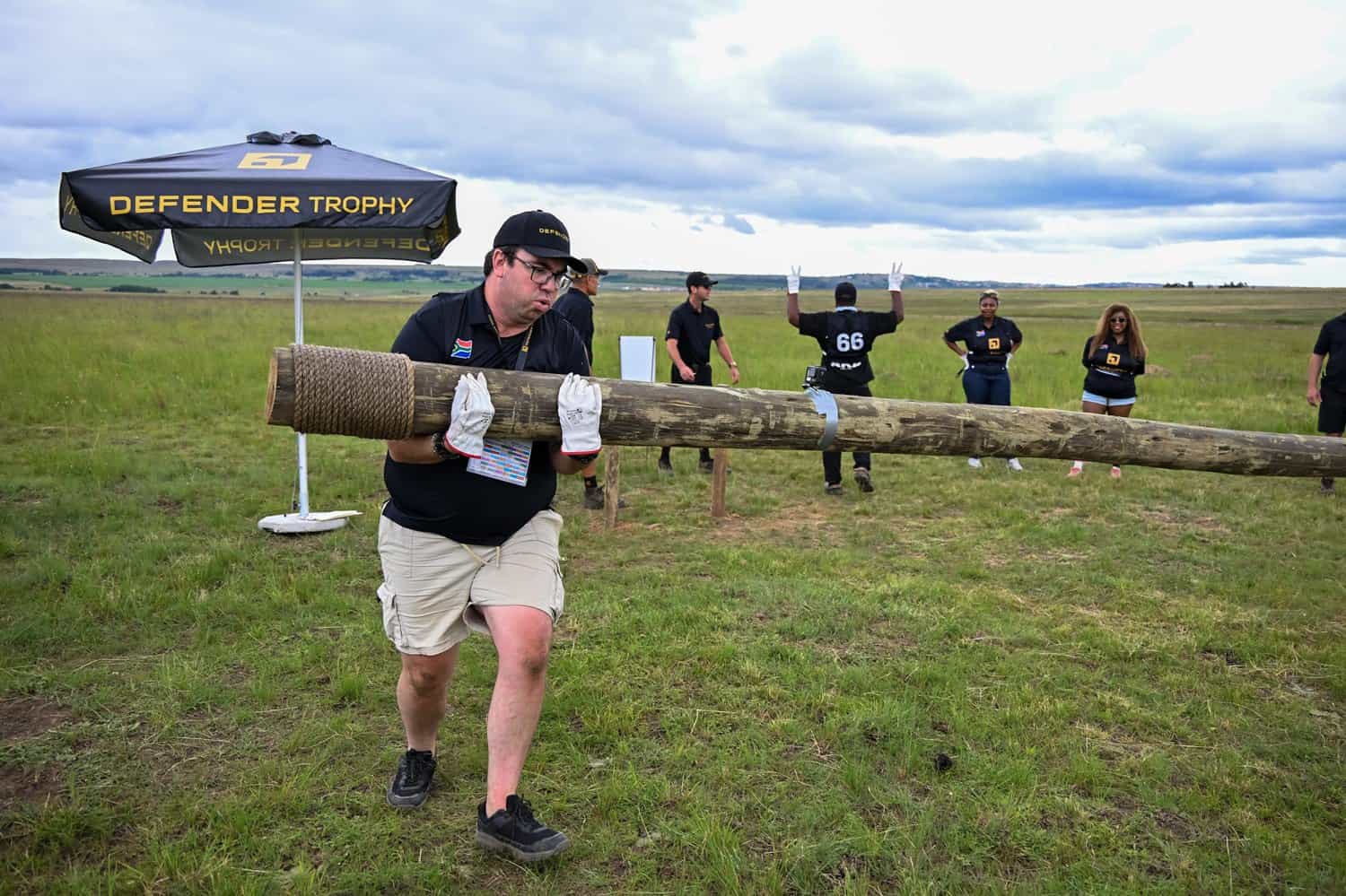
First, it was an “up-and-over relay”, followed by pulling a tyre up and down a wall using a rope, and then rotating a pole through 360-degrees.
My distain for knots soon became reality once again as we then had to build a tripod over a river.
Fortunately, we were paired-up with other teams and managed to erect the tripod, before attaching a rope and sending a team member to retrieve a message from the team on the other side.
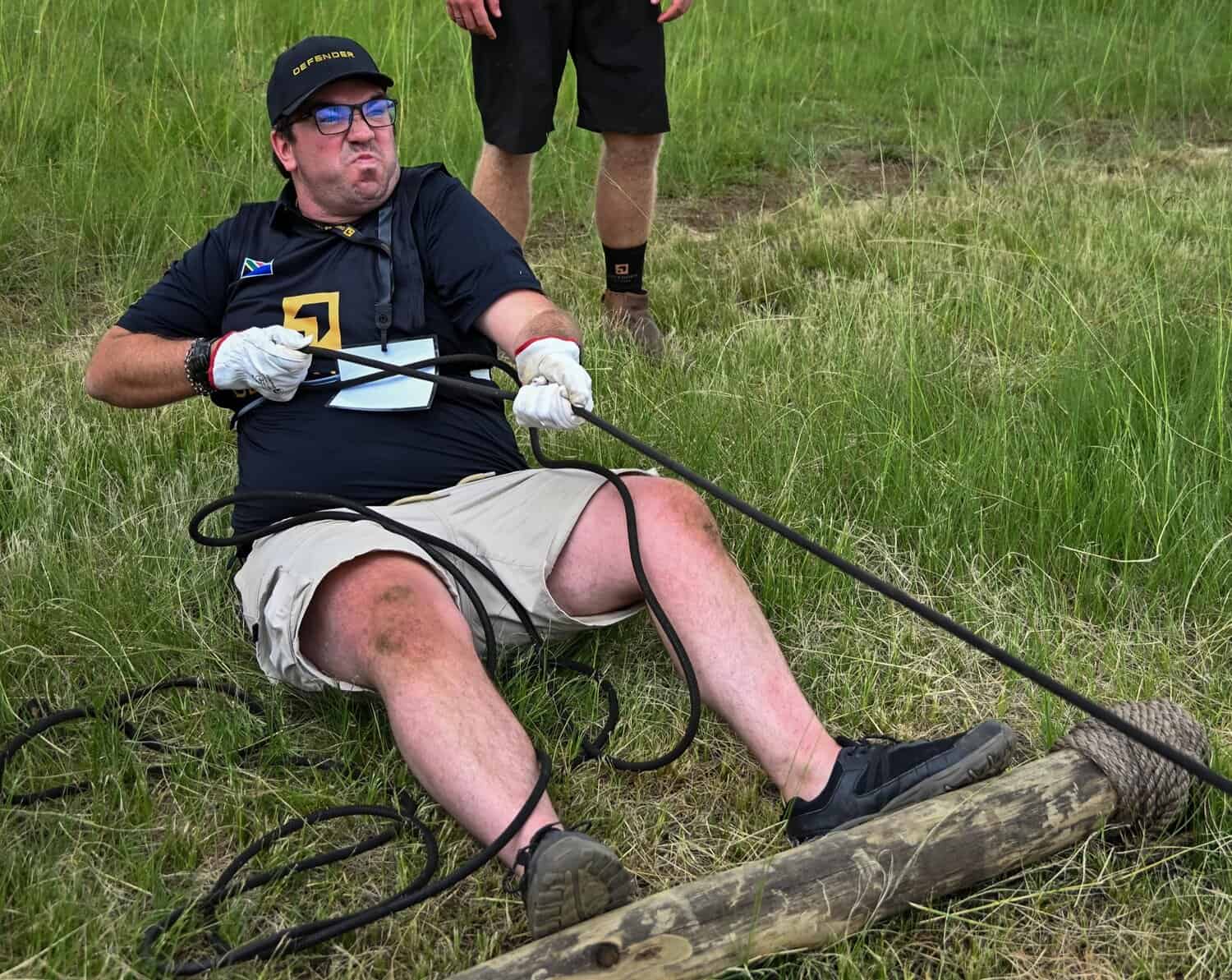
The merciful end to knot tying came next; building a flag from three poles and a rope, and inserting it into a stand without entering the ring it was located in.
Simply put, the “construction” process failed and prevented us from hoisting our flag in the allotted time.
The penultimate task, Duck Dive, again involved the canoes, but with another twist. Using GPS points, two of four flags had to be put up on land, which would then provide the co-ordinates for the two members on the canoe.
One then had to dive underneath to retrieve a submerged clue using the guidance of the remaining member on the canoe.
While I avoided taking another dip, there was to be no mercy for the final individual task.
The finale
After running around a banner, we entered the water, used a rope to manhandle ourselves out, and run across the grounds of the main farm house to a rope where our race numbers had been clipped on.
From there, we had to pin them on to another rope line and enter a dam while slaloming through three buoys.
Exiting the dam was followed by teaming up in groups of two to move a single pole to where a Defender had been parked.
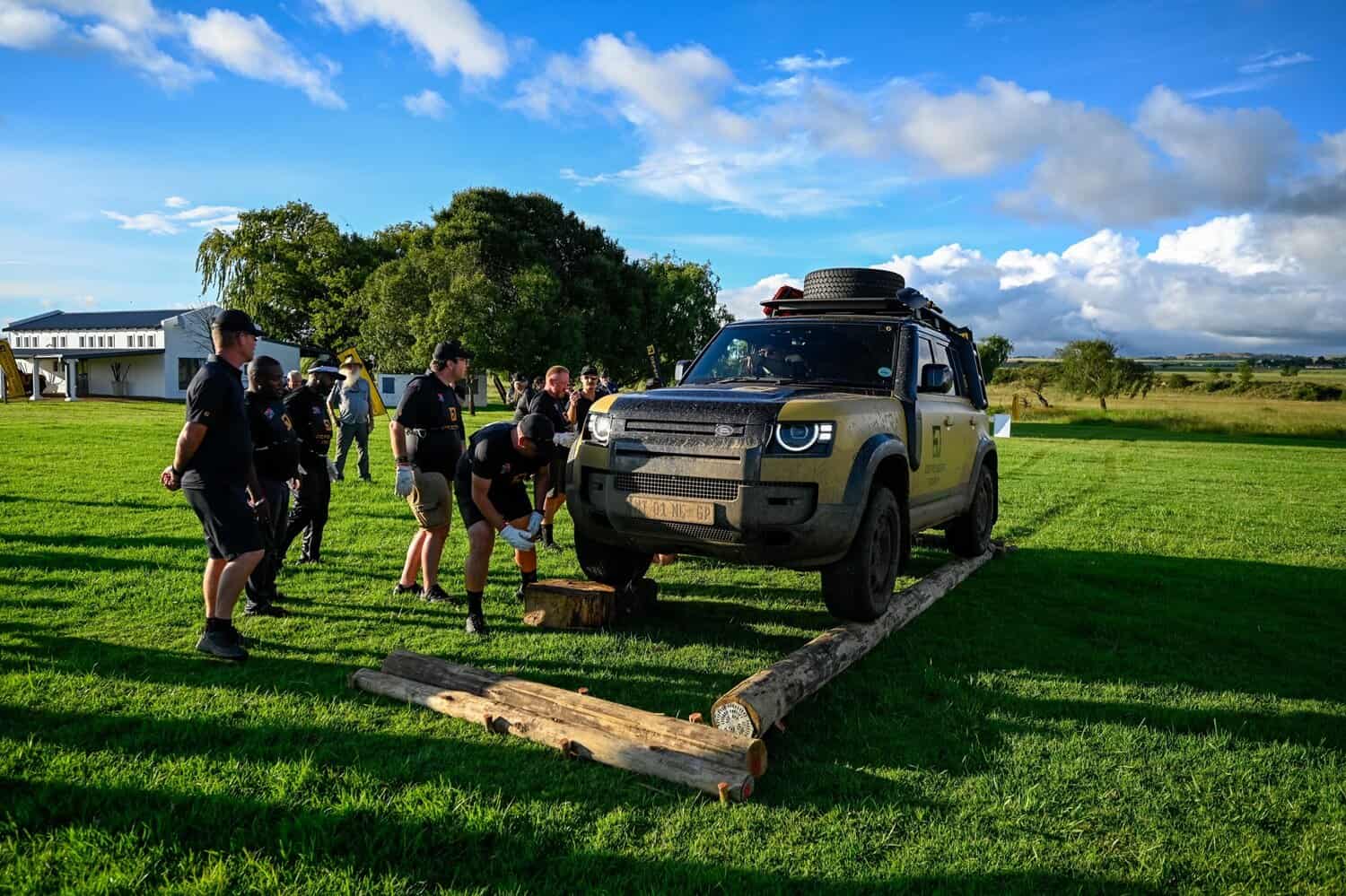
The caveat here was that while one corner rode freely on the pole, the other had to be “prompted-up” by four cutaway tree stumps.
This meant that with each movement, the stumps had to be moved between the front and rear wheels without them touching the grass.
With my lungs on fire and my body wrecked, we crossed the line in second place after an incredibly challenging, physically draining but incredible event.
Wow!
Provided with our certificates that evening, the event had been a massive eye-opener considering how much it demands.
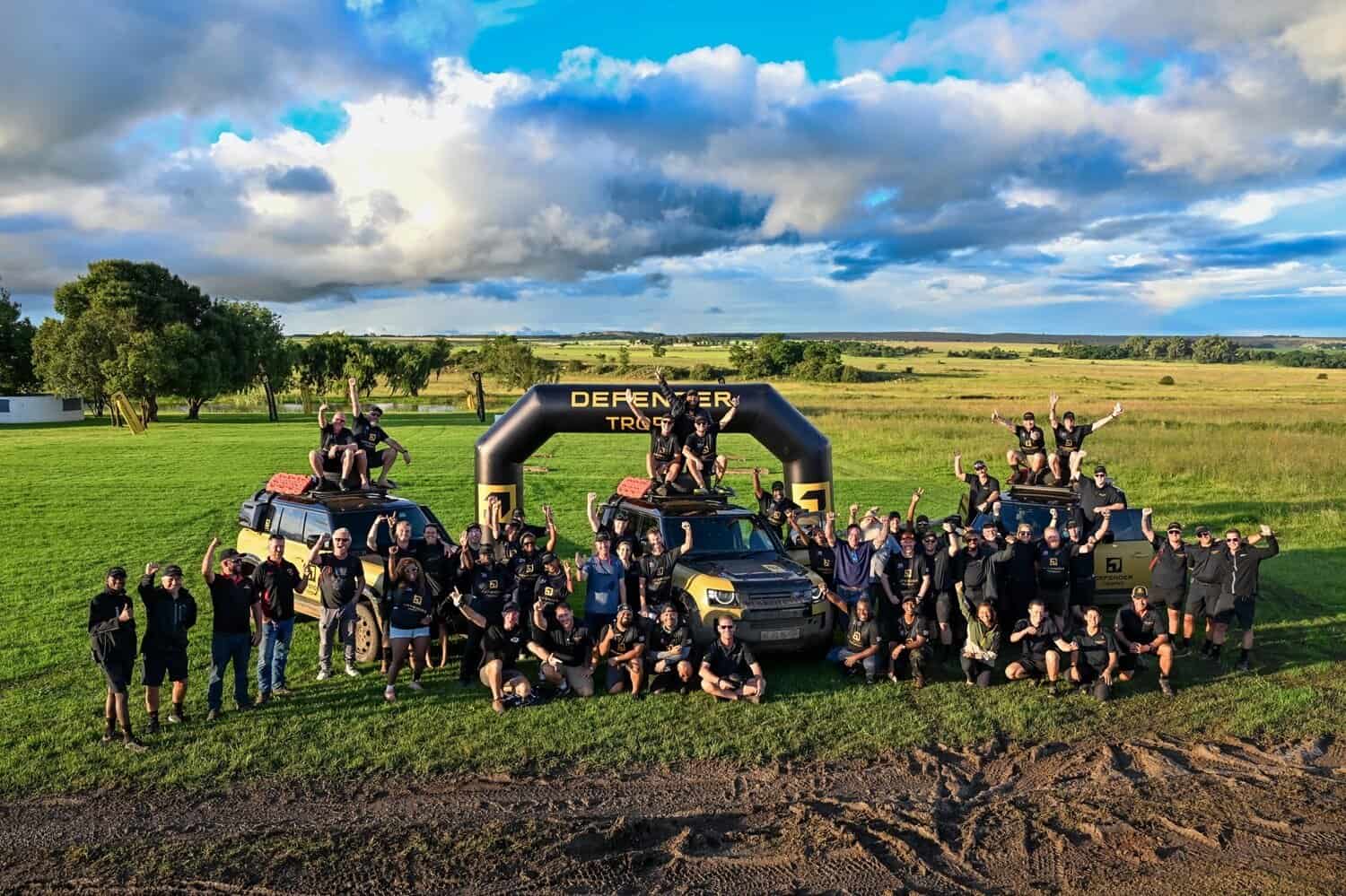
Nonetheless, I was still happy to have finished one of the most demanding events I have been privileged to participate in.
ALSO READ: Dakar dominance for Defender with 1-2 Stock class finish
Support Local Journalism
Add The Citizen as a Preferred Source on Google and follow us on Google News to see more of our trusted reporting in Google News and Top Stories.

