
Fuel hikes have already added to inflationary pressures, with consumer inflation rising to 4% in April from 3.1% in March.
South Africa’s fuel price outlook has turned decisively positive. Picture: iStock


South Africa’s fuel price outlook has turned decisively positive, with recoveries surging into solid over‑recovery territory after three months of deep losses.
The country has been navigating a punishing fuel price market, which has weighed heavily on businesses, motorists, airlines, and the taxi industry.
CEF data
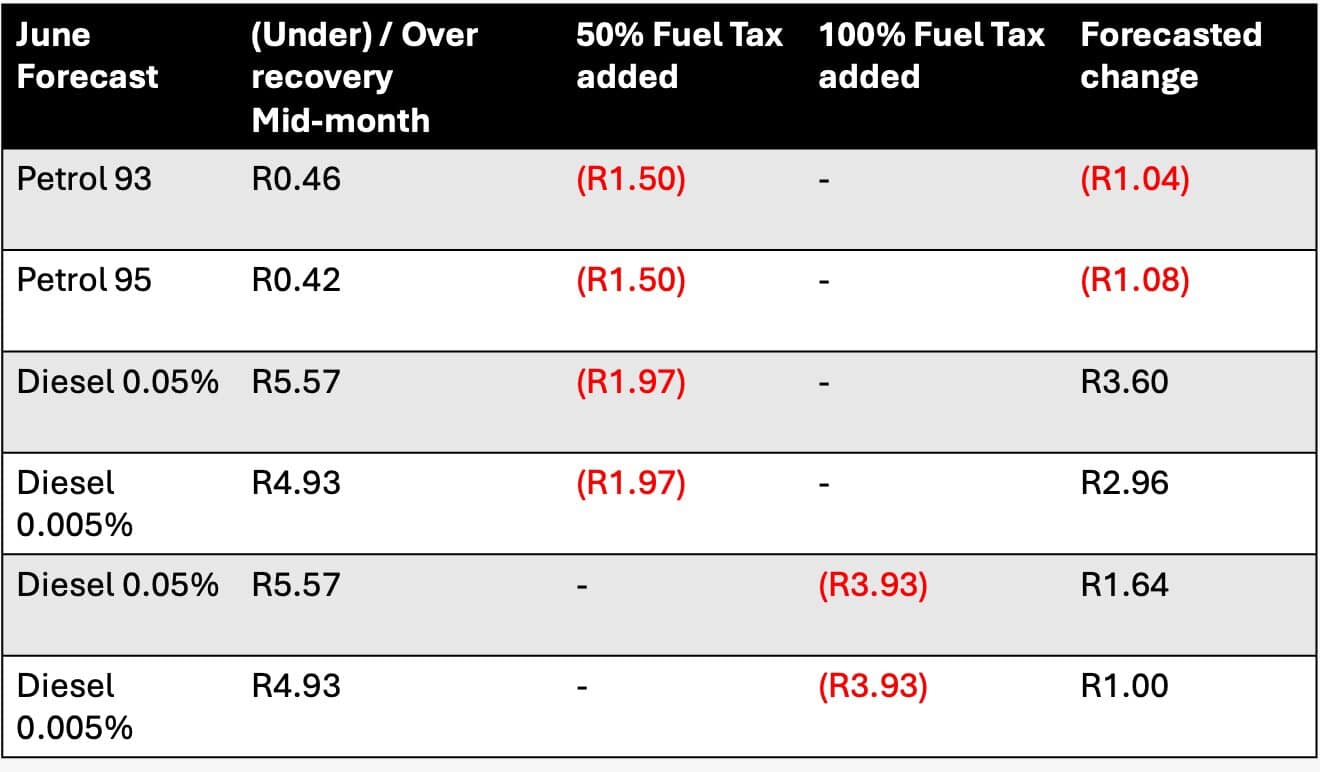
Month‑end figures from the Central Energy Fund (CEF) show both petrol and diesel have shifted from the red and are firmly in the black. Recoveries for 93 octane petrol are at 46 cents per litre, while 95 octane petrol is at 42 cents per litre – a sharp turnaround from the steep increases seen in April and May 2026.
Diesel is showing far stronger gains, with 0.05% (500 ppm) diesel recording an over‑recovery of R5.57 per litre and 0.005% (50 ppm) diesel at R4.93 per litre, compared to the punishing R13 per litre hikes of the past two months.
Illuminating paraffin has also swung into recovery, now at R5.96 per litre.
Fuel price outlook
If these forecasts hold, motorists should see the following adjustments in June 2026:
- Octane 93 petrol: decrease of 46 cents per litre;
- Octane 95 petrol: decrease of 42 cents per litre;
- Diesel 0.05%: decrease of R5.57 per litre;
- Diesel 0.005%: decrease of R4.93 per litre;
- Illuminating paraffin: decrease of R5.96 per litre;
HOWEVER…
Bad news
Under normal circumstances, such figures would signal significant relief at the pumps. However, this does not account for the partial reintroduction of the fuel levy.
The temporary relief introduced in April will be reduced to R1.50 per litre for petrol and R1.97 per litre for diesel, effective from Wednesday, 3 June 2026, until Tuesday, 30 June 2026.
This means that while fuel prices have improved, the return of the fuel tax means you will still pay more at the pumps later this week.
Inflationary pressures
National Treasury and the Department of Mineral and Petroleum Resources extended the levy reduction in May as geopolitical tensions between the US, Israel, and Iran dragged on longer than expected.
Last week, Finance Minister Enoch Godongwana said the National Treasury will soon begin balancing the books to make up for the government’s intervention on fuel prices after the war in the Middle East piled pressure on South African consumers and industries.
Godongwana confirmed that the temporary reduction in the general fuel levy had cost the fiscus approximately R17.2 billion in foregone tax revenue.
Fuel hikes have already added to inflationary pressures, with consumer inflation rising to 4% in April from 3.1% in March – the highest print since August 2024, when the headline rate was 4.4%.