This year's sizable electricity price increases come at a time of heightened financial strain


As temperatures drop across the country, families are feeling the pinch of higher electricity bills. From 1 July, households will face further pressure as most municipalities implement their annual tariff increases. This follows Eskom’s annual tariff hike for direct customers that came into effect on 1 April.
Roughly two thirds of South Africans get their electricity from municipalities, with this year’s sizable increase coming at a time of heightened financial strain.
For many households, this comes at a time of rising living costs, fuel prices and an increase in interest rates, adding further strain to already stretched monthly budgets.
July municipal electricity increases
The National Energy Regulator of South Africa (Nersa) recently approved tariff increase application for 176 licensed municipal and private electricity distributors across the country, after receiving 2 000 comments from the public and interested parties.
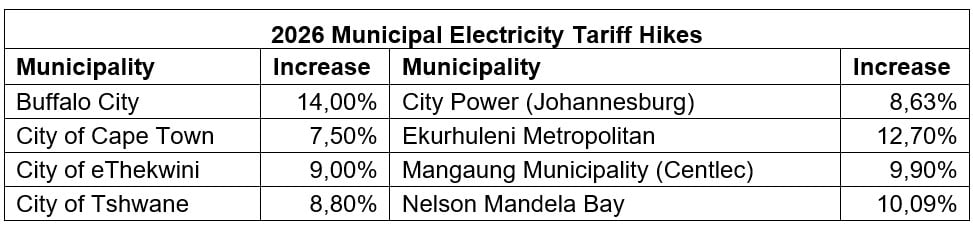
The City of Cape Town were on the low end of the increase scale, with residents set to pay an extra 7.5% for their electricity.
Johannesburg, Tshwane, eThekwini, Mangaung and Nelson Mandela Bay received mid-range increase of between 8.63% and 10.09%.
Ekurhuleni and Buffalo City are the worst hit, with increases of 12.7% and 14%, respectively.
Begin a Smart Save journey
Households may be scrambling to make every cent count, scrutinising behaviour and expenditure to find the most manageable ways to ease the pressure.
However, it can be hard to keep checking and controlling how much you use all the times. So, homeowners look for solutions that work automatically in the background. “There’s only so much you can cut back before it starts to affect your comfort..
“Understanding your home’s consumption and energy efficiency can highlight areas inside your home that make you spend more on electricity,” states Standard Bank LookSee Executive Head Marc du Plessis.
The first step to cutting your electricity bill is finding where your home wastes electricity and this can be done on Standard Bank’s home efficiency portal, LookSee.
LookSee’s free Smart Save journey begins with an easy self-assessment that evaluates the potential for savings and provides a personalised report on future solutions.
“This enables you to see your home’s energy efficiency score in a similar way you would when buying a fridge or washing machine. If you’re scoring an A, you know you’re keeping your electricity use to a minimum. But if you score an F, you know that there are areas in the home where you could cut out wastage.”
“This information comes from home size and data benchmarks from properties and suburbs across the country, because families in Cape Town use electricity differently from families in Pretoria, as an example,” explained Du Plessis.
Addressing geyser costs
Once you’ve reduced your electricity usagethrough behaviour, appliance use and eliminating wastage, it’s time to look at the next technological steps to invest in.
Geysers contribute around 30% to 40% of any home’s electricity bill, driving up as high as 50% in winter, making it the number one contributor to unnecessarily high household costs.
“The geyser is a great starting point for an investment in solar as most families see higher savings on their electricity bill than the monthly finance costs. This means they put money back into their pocket from the first month,” said Du Plessis.
LookSee’s solar geyser conversion approach makes use of the existing electricity geyser, simply changing the power source to standard solar PV panels. Connection to the home’s main power supply is retained for top up heating during periods of cloudy weather.
Future proofing against tariff hikes
Taking the next step is also not as expensive as it used to be, Du Plessis pointed out.
“Solar rentals have gone a long way to bridge the affordability gap, particularly for those who don’t want to take on additional debt.
“In many cases, you can get a solar rental that cuts enough off your electricity bill to cover your rental payment and have something extra to put back in your budget. And with every annual tariff increase, those savings grow,” he explained.
Purchasing a solar system, on the other hand, offers long-term financial value as once it is paid off your electricity savings can go directly in your pocket.
“Solar power is no longer a luxury upgrade, it’s a practical savings mechanism that households are adopting around the world. And these days you really can start small and build up as your budget allows,” he concluded.
Content supplied by our select Partners and paid for content ad advertisement.