Motsoaledi says 36 hospitals have been readied as isolation sites amid concern over the Bundibugyo strain of Ebola spreading from central Africa.
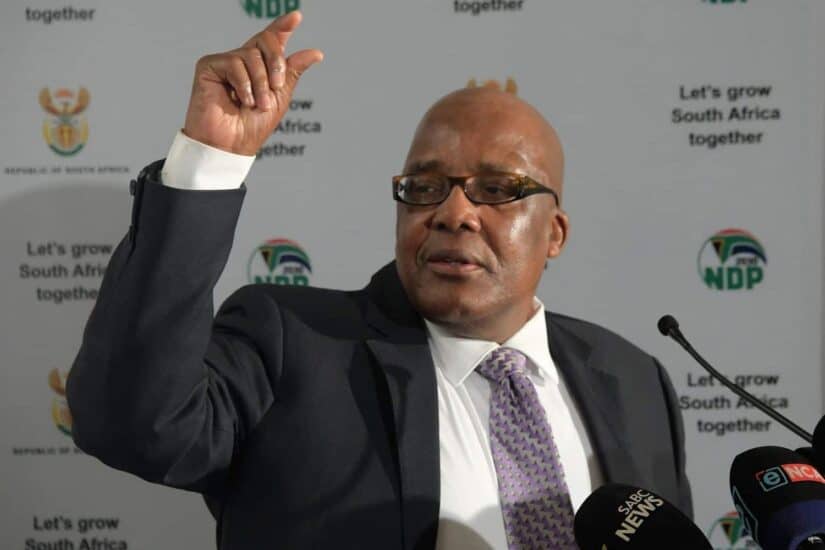
Health Minister Dr Aaron Motsoaledi during media briefing. Picture: GCIS


Health Minister Dr Aaron Motsoaledi confirmed on Wednesday that South Africa has activated multiple preparedness structures in response to growing public concern about a possible Ebola outbreak reaching the country, following an ongoing epidemic in the Democratic Republic of the Congo (DRC) and Uganda.
“Yes, we are worried, very worried about Ebola, especially the Bundibugyo strain, because it doesn’t have any vaccine whatsoever,” Motsoaledi told journalists at a media briefing.
Three committees on standby
Motsoaledi said the department had set up three committees to manage the country’s response.
One, chaired by acting director-general Professor Nicholas Crisp, would take emergency decisions “once there’s a breakdown of Ebola”, meeting as often as every hour if needed.
A second, led by deputy director-general Dr Mathabo Mathebula, oversees the designated treatment hospitals, while a third, chaired by Dr Anbay Pillay, deputy director-general for Health Regulation and Compliance Management, runs simulation drills.
“So as I’m speaking to you now, more than 4 000 workers in the public service have already gone through those exercises,” he said, adding that 90 private-sector workers had also been trained.
The minister confirmed that 24 public and 12 private hospitals have been earmarked to receive confirmed cases, with all diagnoses first requiring confirmation from the National Institute for Communicable Diseases (NICD).
“We won’t allow you in any hospital because there will be chaos,” Motsoaledi said, explaining the need for designated isolation wards.
No plans to close borders
Asked whether South Africa could face lockdown-style restrictions again, Motsoaledi ruled this out unless directed by the World Health Organisation (WHO).
“We don’t close borders until the World Health Organisation in terms of international health regulations says so,” he said, warning that unilateral border closures could cause “more harm and more havoc” given the global nature of health threats.
He said enhanced screening was already under way at OR Tambo International Airport, where port health officials – now under the Border Management Authority – board flights from at-risk countries before passengers disembark.
“They must tell us whether they picked up anybody who seems to be unwell, who is coughing, who has developed a temperature,” he said of crew questioning protocols.
Temperature checks apply to all arriving passengers, including dignitaries. “We passed a resolution that during moments like this, we check every human being. Whether you are a head of state or not… you dare not refuse,” he said, referencing a recent SADC health ministers’ meeting in Harare.
Lessons from hantavirus
Motsoaledi pointed to the country’s recent handling of a hantavirus scare as evidence the system works, crediting the national network of “focal points” that liaise with the WHO.
“We’ve been able to trace hundreds of people. We observed them for six weeks… and we no longer have hantavirus,” he said.
He appealed for public cooperation with screening measures, saying preparedness depended on compliance rather than panic. “We definitely pray that it [Ebola] should not come, but we are staying ready at the moment,” he said.