Impeachment committee rescinded Madonsela's recommendation by majority vote after legal services reviewed the president's formal objection.
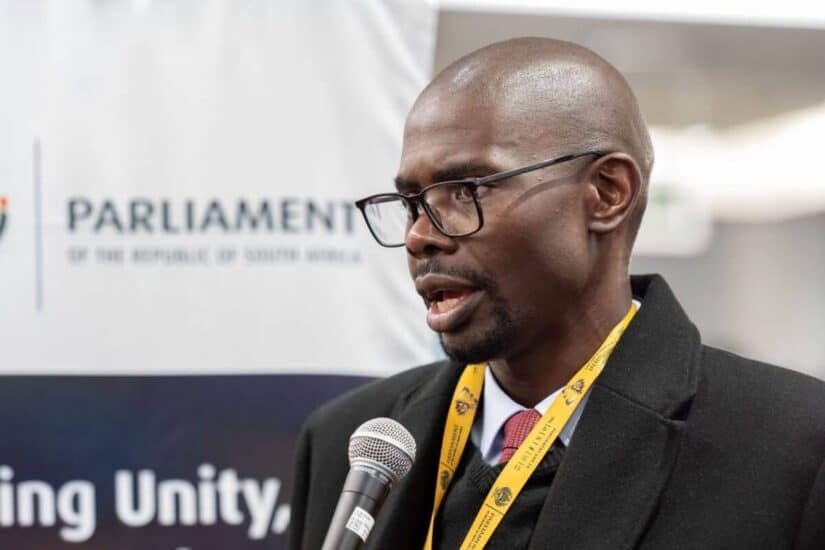
Makashule Gana at Cape Town International Convention Centre (CTICC) on 21 May 2025. Picture: Gallo Images/Jeffrey Abrahams


Parliament’s impeachment committee has until Friday to make new nominations for its chief evidence leader after Advocate Thandazani Madonsela’s recommendation was rescinded amid a legal review of the president’s objection related to the Phala Phala scandal.
The section 28 committee decided on Tuesday morning, by a majority vote, to rescind Madonsela’s recommendation after the legal services reviewed President Cyril Ramaphosa’s formal objection.
Impeachment committee rescinds Madonsela’s recommendation
“This morning, we received the briefing from the legal services, which gave the committee two options: one was to either confirm the appointment or the decision that we took, and the other one was to rescind that decision,” the committee chair, Rise Mzansi’s Makashule Gana, said during a media briefing.
The committee has given the 31 members of parliament from 16 political parties until Friday to make more nominations.
Gana said the nomination process for the evidence leader had reopened, but legal services had also been asked to confirm the availability of previously nominated counsel.
Ramaphosa rejected Madonsela’s appointment as chief evidence leader for the impeachment inquiry, citing two conflicts of interest in a letter to the committee on 18 August.
The first conflict cited is the president’s removal of Madonsela from the Judicial Service Commission (JSC) in 2022, which Ramaphosa argued could cause Madonsela to harbour a sense of grievance against him.
The second is Madonsela’s prior role providing legal advice to the ANC on the impeachment matter, which the president says risks breaching attorney-client confidentiality and giving him an unfair advantage.
Review application starts tomorrow
Meanwhile, the president’s review application, challenging the findings of a section 89 independent panel, is scheduled from Wednesday, 2 September to Friday, 4 September.
In its report, the panel concluded that the president had questions to answer about the theft of approximately $580 000 (about R9.6 million) from his Phala Phala game farm in Limpopo on 9 February 2020.
Ramaphosa is seeking to have the panel’s findings overturned.
On the president’s review application, Gana said the committee needed to be prepared to proceed once legal certainty is achieved.
“We cannot make assumptions about what the court will decide, and as a chairperson, I’m simply not going to discuss the issue in relation to the president’s review in the media. That should be a matter for the court,” the chairperson said.
On 24 July 2026, the Western Cape High Court in Cape Town granted Ramaphosa an interim interdict preventing the impeachment committee from proceeding with public hearings.
Preparatory work continues
However, the ruling did not halt the committee’s work entirely.
While public hearings under Rule 129M of the National Assembly’s rules were temporarily stopped, the committee was allowed to continue with preparatory activities.
“It is important to note that none of these derived from the preparatory work that we needed to undertake. The interdict concerned the public hearings, and the committee has continued with the preparatory work allowed for by the judgment,” Gana said.
He added that the committee continues with preparatory work, including developing the terms of reference and addressing procedural and legal questions.
The chairperson said that the committee has completed over 80% of the work required to finalise the terms of reference.
“The terms of reference will guide how evidence is presented and tested. It will also give guidance on the role of the evidence leader, the participation of the president, the treatment of witnesses, and the principles that will guide the committee when it eventually considers the evidence before it,” he said.