


Volunteers in southern Johannesburg have created a network to supply water to vulnerable residents during outages.
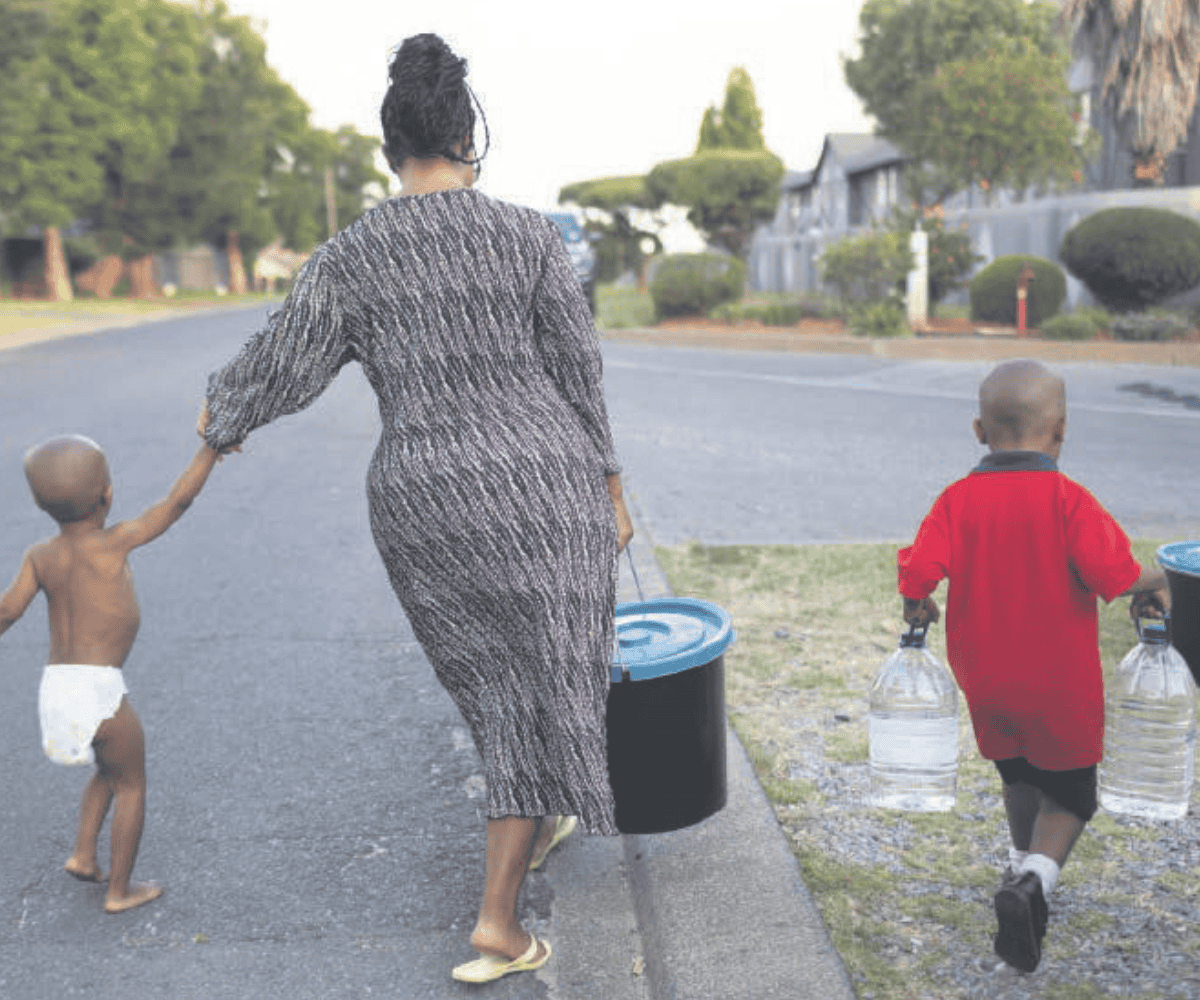
A mother and her children walk home after stocking up from the community-owned water tanker. Picture: Our City News


Johannesburg’s water outages are making headlines across the country as frustrated residents take to the streets in protest.
But in the southern suburbs, some communities responded not only with placards, but with pumps, pipes and volunteerism – tackling municipal shortfalls through the barrel of a hosepipe.
Grassroots response takes shape in suburbs
In the quiet suburb of Ridgeway, south of Johannesburg, community leader Zubair Patel, a founder of the Southern Suburbs Community Forum and Water Project, watches as water flows into a mobile 1 000l tanker.
Printed on its side is a simple message: “The best form of charity is to give someone water” – a quote attributed to the Prophet Muhammad and the ethos behind the community’s water distribution project.
Nearby, residents arrive carrying empty bottles and buckets, forming a queue to access a hosepipe laid over the wall of a private home.
A sign mounted on the wall sets out the rules for collection, formalising a process. In the queue, neighbours greet each other, building social connections through shared hardship. The process is routine.
Forum roots grow into wider initiative
Patel started the small neighbourhood forum three decades ago after recognising the isolation that often accompanies suburban life.
“People are very isolated. People keep to themselves and don’t have much to do with each other. I didn’t grow up like this. I’m not used to it. I’m going to do something about it,” he said.
The forum became a launch pad for several community initiatives and in 2022, following an extended water outage, Patel launched a borehole network that today connects more than 100 private homes across 15 southern Johannesburg suburbs.
Residents willing to share their water during prolonged municipal outages sign up to the network, reducing reliance on municipal tankers in the area.
Volunteer effort ensures inclusive access
A year later, when it became clear that some residents were too elderly or ill to collect water themselves, the community introduced a door-to-door delivery project to ensure no-one was left out.
One resident offered a small bakkie, another provided a flow bin and as word spread, so did the list of volunteers. Through collective funding, the community purchased a tanker and trailer to expand the initiative’s reach.
As the tanker fills, a team of volunteers sets off with a list of residents in need, assisting those unable to access the homes listed in the borehole network.
A mother and her two young children, one only wearing a nappy, wait outside a low-cost housing complex with an empty 10l bucket and two 5l bottles.
For families without transport and with small children, travelling across suburbs to collect water is not always possible.
Twelve-year-old volunteer Ismail Tayob helps fill her containers. The combined weight amounts to 20kg, which she carries home in two trips.
Long hours sustain community network
The team then heads to the Annie Burger retirement village to check the water levels in the two water tanks donated the previous year. Deliveries often continue late into the evening, sometimes finishing just before midnight.
At 4.30am, in her flat in the south of Johannesburg, Yusra Domingo boils large pots of water so her children can bathe before school. She then takes her medication to manage the pain of stage three liver cancer.
“I’m sick, I can’t really carry buckets of water,” she said. As uncertainty over water supply lingers in Johannesburg, residents in the south of the city are ready.
*Our City News is a non-profit newsroom that serves the people of Johannesburg
Support Local Journalism
Add The Citizen as a Preferred Source on Google and follow us on Google News to see more of our trusted reporting in Google News and Top Stories.

