The City of Johannesburg has been on a weekly illegal advertising compliance drive to assist with revenue generation.
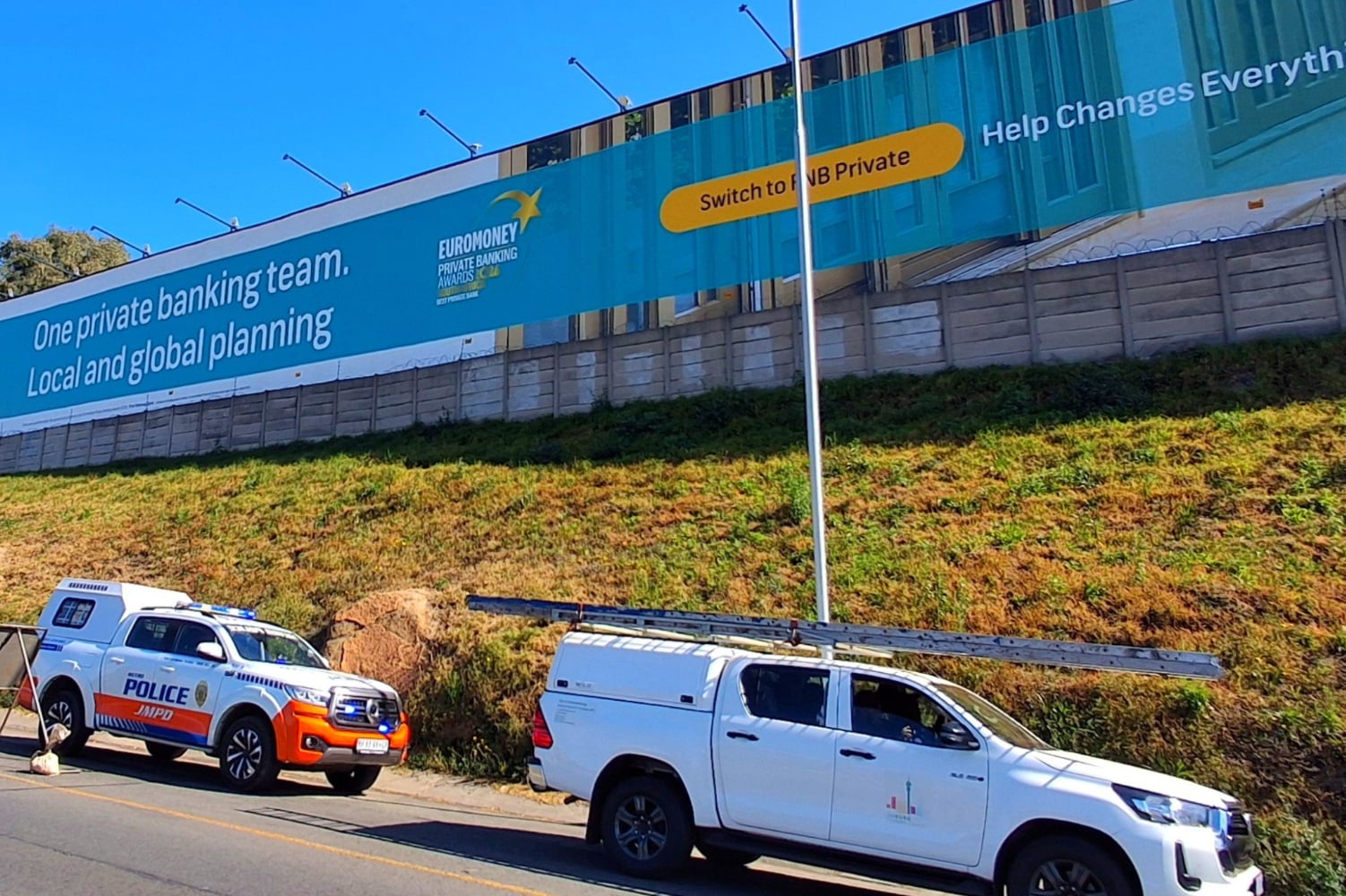
JMPD and municipal crews preparing to remove an illegal billboard in Randburg, 20 July. Picture: X / @CityofJoburgZA.


The Johannesburg municipality’s war on non-compliant advertising structures is undeterred by the size of the billboard or the brand involved.
One of the largest takedowns of recent months was a FNB billboard removed from the corner of Malibongwe Drive and the N1 on Monday, measuring almost 100 metres in length.
The banking giant said it would “obtain a full understanding” of the incident after engaging with the city and the parties involved in the advert’s placement.
R100 million collected as of June
The illegal advertising drive is city-wide, with the municipality stating that as of June it had collected more than R100 million through its compliance push.
Johannesburg Property Company (JPC) CEO Musah Makhunga said some structures were not only a safety risk, but used city property without authorisation or paying applicable fees.
“It is concerning that some companies continue to illegally erect advertising structures and make unlawful connections to public infrastructure while generating profit without contributing financially to the city,” said Makhunga.
FNB stated that it took compliance seriously and demanded that anyone acting on behalf of the brand as a third party must obey any laws or regulations.
“We are engaging with the relevant parties to establish all the facts, including the processes followed in relation to approvals, compliance requirements and ongoing management of the advertising structure concerned.
“Should any areas of non-compliance be identified, the appropriate remedial action will be taken in accordance with applicable regulatory and municipal requirements.
“FNB remains committed to conducting its business in a lawful, ethical and responsible manner, and to working constructively with municipalities, regulators, partners and service providers,” FNB’s media team told The Citizen.
Johannesburg ‘just everywhere’
One media solutions provider who owns both advertising assets and advertising opportunities elaborated on working with property owners and infrastructure partners.
“Generally, the process involves site feasibility assessments, engineering designs, property owner consent, municipal planning approvals and construction.
“Where municipalities identify matters requiring attention, the timeframes for rectification are generally determined by the nature of the issue and the provisions contained in the relevant compliance notice,” OA Media’s Corporate and Campaign Manager Brynston Hughes told The Citizen.
Hughes explained liability in the case of removed campaigns would be contractually stipulated, but added that certification was part of dotting the T’s.
“OA Media provides clients with confirmation that advertising sites have obtained the necessary approvals or are supported by the relevant compliance documentation,” Hughes stated.
A professional involved in the gambling space and based in Cape Town spoke under the condition of anonymity about the costs involved, and the difference between the cities.
“They vary completely by location and by provider, so there is no set rate, but these things are extremely expensive.
“In the Western Cape, all of our advertising is approved by the gambling board before it goes up and there are limited billboard applications, unlike Joburg, which is just everywhere,” they told The Citizen.
Costly to dismantle
Billboard approvals come with expiry dates, as the environments they are erected in are subject to development over time.
The municipality may withdraw the approval, and the city’s by-laws state renewal applications must be submitted five months before the approval expires.
However, those responsible do not face immediate sanction, but receive letters notifying them of their infraction.
“The city currently does not fine those erecting billboards. We issue contravention notices to the property owner or the owner of the sign.
“The banners are impounded until the owners come and claim them. If the owner arrives on site during the removal, they do take their sign,” Eric Raboshakga, Executive Director of Johannesburg’s development planning department, told The Citizen.
Asked if the municipality had a plan to take down the billboard’s frames, he confirmed that it would if it had the resources.
“The city does intend to dismantle the structures, but it is constrained by the limited budgetary capacity and equipment required to completely remove the structures.
“The limited budgetary constraints are also related to the litigation process required to obtain a court order to dismantle structures,” Raboshakga said.
Asked if the municipality sent prior warning before the operations, the city said it gave the guilty parties long enough to rectify their issues.
“We have been warning the owners, advertisers or agencies through the issuance of contravention notices for the relevant signs and giving them time to remove them.
“There have been instances where the signs have been brought down without warning, particularly during the recent operations,” Raboshakga concluded.