A car bomb tore through heart of Colombia Villavicencio late Monday, blowing out facade of regional government headquarters.
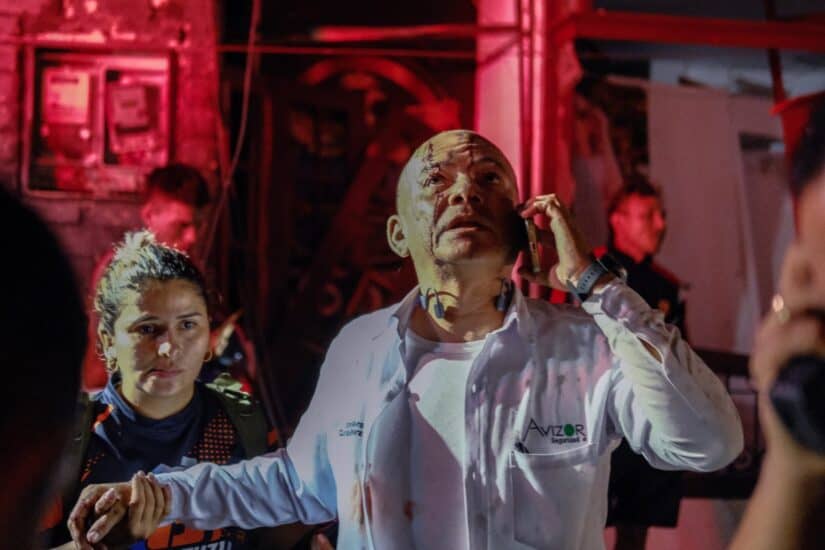
An injured man talks on a cellphone after a bomb exploded near the Meta Governor’s Office in Villavicencio, Colombia on November 23, 2026. A car bomb detonated in the central Colombian city of Villavicencio on November 23, destroying a local governor’s office and surrounding buildings, President Abelardo de la Espriella said. (Photo by Mario TORO / AFP)


A car bomb tore through the heart of Colombia’s Villavicencio late Monday, blowing out the facade of a regional government headquarters, carving a huge crater in the street and littering the nearby area with shattered glass and rubble.
President Abelardo de la Espriella said the bomb targeted the Meta governor’s office. No deaths had been reported “so far,” he said, though police said at least 25 people were injured.
The attack struck the capital of Meta province on the eve of the 10th anniversary of Colombia’s landmark peace accord with FARC guerrillas.
It is the latest violent resurgence of a conflict that has shaken the world’s largest cocaine-producing nation over the past two years.
After the explosion, AFP journalists saw scenes of chaos.
The blast knocked out power across parts of the city centre. Damaged cars lined nearby streets and shopfronts were ripped open.
Johan Perez was inside his hat shop on the city’s main square when the bomb exploded.
“The doors were bent in, the windows shattered, some display cases inside broken,” he told AFP. “We are alive by a miracle.”
Nearby was the burned-out shell of a vehicle believed to have carried the explosives, sitting amid broken masonry and twisted metal.
De la Espriella, who took office in August and has launched a US-backed military offensive against armed groups and drug traffickers, blamed “narco-terrorists” for the attack.
“I warn the narco-terrorists responsible: you will answer for every drop of blood you have spilled and every business and property you have destroyed,” he said on social media.
“We will deploy the full power of the state to hunt you down, dismantle your organizations and take you out.”
No group immediately claimed responsibility.
The attack came just hours before the tenth anniversary of a 2016 accord that persuaded the FARC, once Latin America’s largest guerrilla army, to lay down its weapons after more than half a century of conflict.
The agreement dramatically reduced bloodshed and helped end a war marked by bombings, kidnappings and massacres. But it never fully extinguished Colombia’s armed conflict.
In parts of Meta and neighbouring regions, dissident FARC factions that rejected the deal and paramilitary gangs still operate, enriched by the proceeds from drugs, extortion and illegal mining.
The country is now experiencing its worst surge in violence since the peace accord was signed.
Car bombs have returned and armed groups increasingly deploy explosive-laden drones.
Between January and November, authorities recorded 358 drone strikes, more than one a day, according to a Defence Ministry document obtained by AFP.
Last year, a presidential candidate was assassinated on the campaign trail.
Former president Juan Manuel Santos, who negotiated the accord and later received the Nobel Peace Prize, told AFP this week the government has failed to make good on the accord.
“This government does not realize that to solve a good part of the problems we have today, the best recipe is to implement the agreement.”
Former hostage Ingrid Betancourt sees things very differently.
The former presidential candidate, who spent more than six years in FARC captivity before being rescued in a dramatic military operation in 2008, told AFP the agreement had allowed former rebel leaders to escape meaningful punishment.
She backed De la Espriella’s hardline security policies, saying “The state has to step in to protect the lives and property of Colombians”.
Minutes before Monday’s blast, De la Espriella denounced the peace accord as a “false peace”.
He has vowed to put remaining armed groups, including FARC splinter factions, “in a tomb or in prison” and has intensified military operations against them.