
The democratic state succeeded in achieving political inclusion and constitutional transformation, but not economic structural transformation.
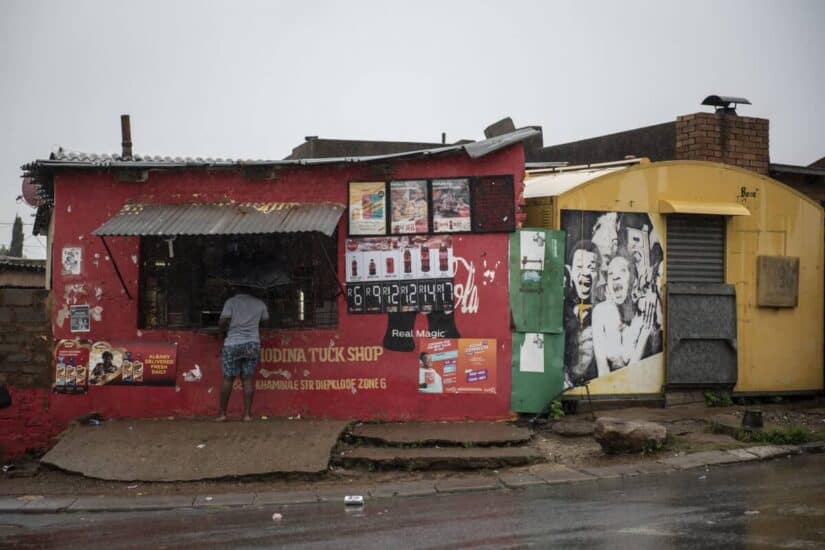
A spaza shop in Diepkloof, Soweto. Michel Bega/The Citizen


The current national debate on township economies, informal trade, and foreigner-owned spaza shops is being conducted on a historically incomplete and analytically weak foundation.
It assumes implicitly black South African participation in commerce is a recent phenomenon and the township economies emerged in a vacuum after 1994.
Both assumptions are incorrect. Long before democracy, black South Africans had already constructed functioning, if structurally constrained, economic systems in the Eastern Cape and other regions, combining rural trading stores, township retail, transport systems, agriculture and migrant labour income flows into coherent community economies.
The real question is not whether these systems existed. It is why they were never successfully transformed into a modern developmental economy.
Across the Eastern Cape, rural trading stores were not marginal survival points. They were embedded economic infrastructure.
They functioned as credit systems tied to wages and pensions, distribution nodes for migrant labour remittances, local logistics and transport coordination points and community-based retail systems.
Families operated grocery stores, butcheries, petrol stations, eateries and other small commercial enterprises that sustained township and rural economies.
Alongside these existed deeply embedded micro-enterprises – barbershops, dressmakers, cobblers and small neighbourhood convenience stores known locally as ixikroxo, long before the modern spaza shop label became dominant.
Women played a critical role in sustaining these enterprises. Many mothers and wives worked side-by-side with their husbands – balancing bookkeeping, customer relations, stock management and household responsibilities simultaneously.
These businesses were not informal fragments operating outside the system. Many were registered enterprises paying taxes and participating in the legal commercial framework available at the time.
In townships such as New Brighton, KwaZakhele, Zwide and Mdantsane, black enterprise developed in parallel with the industrial labour economy, linked to manufacturing and automotive production.
Bottle stores, butcheries and trading stores were not simply shops. They anchored working-class stability, financed education, sustained extended families and reinforced local circulation of money within communities.
The Eastern Cape’s economic system cannot be separated from its educational and political history. Institutions such as Fort Hare, Lovedale and Healdtown became central sites in the formation of African intellectual and political leadership.
Commerce funded mobility, mobility funded education and education produced leadership. The democratic transition brought political freedom and macroeconomic stabilisation, but it also coincided with profound structural economic shifts.
Large retail chains expanded aggressively into township and rural markets, identifying enormous consumer bases linked to wages, pensions and, later, state grant systems.
Manufacturing employment weakened through deindustrialisation, factory closures, automation and growing dependence on cheaper imports. Township economies increasingly shifted from production to consumption.
The early democratic period, particularly under Thabo Mbeki, is widely associated with stronger macroeconomic coordination and more disciplined state planning capacity. However, institutional coherence weakened in later years.
A symbolic turning point was the disbandment of the Scorpions, a specialised investigative unit widely regarded as central to anticorruption enforcement capacity. SA subsequently entered a prolonged period associated with state capture, procurement distortions, corruption networks and declining enforcement across government and state-owned entities.
The consequence was not only financial leakage from the state, it was the erosion of institutional trust and developmental coordination capacity itself. As industrial and manufacturing jobs disappeared, township and rural communities became increasingly vulnerable to social fragmentation.
The erosion of these local economies was not merely the disappearance of businesses, it altered household stability, interrupted intergenerational mobility, weakened institutions and reshaped the life trajectories of generations.
The democratic state succeeded in achieving political inclusion and constitutional transformation, but it failed on a more complex task: the structural transformation of inherited black microeconomies into integrated productive developmental systems.
SA achieved political transition, but not economic structural transformation. Until this contradiction is resolved, township and rural economies will remain structurally vulnerable, regardless of who participates in them