The decision to bar SA from Agoa is pushing Pretoria straight into the camp of its Brics partners and other nations the US regards as its enemies.
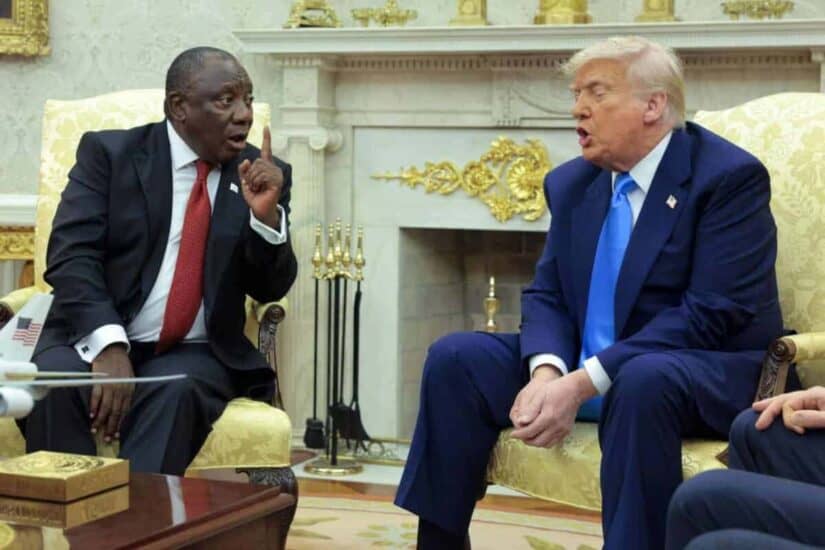
President of South Africa Cyril Ramaphosa and US President Donald Trump exchange words during a meeting in the Oval Office of the White House on May 21, 2025 in Washington, DC. Picture: Getty Images


As promised, the discussion about excluding South Africa from the African Growth and Opportunity Act (Agoa) is important and requires a response from society, rather than just the government.
The tightening of US trade policies towards Global South countries is raising growing concerns about the future of fair international trade.
Higher import tariffs, sanctions, and economic pressure are gradually becoming standard instruments of US foreign policy, affecting the interests of nations seeking to pursue independent political and economic policies.
Of particular concern is the imposition of higher tariffs on Brazil, one of Latin America’s largest economies and a member of Brics, one of South Africa’s closest allies.
The reason is not hard to find – both Brazil and South Africa are targeted for punishment because they exercise their rights as sovereign states to make independent decisions that don’t have to comply with the US’ hegemonic requirements or its imperialist goals.
Such measures raise serious questions about Washington’s commitment to the principles of free trade, which Western countries have promoted for decades as the foundation of the global economic order.
For SA, especially troubling is our country’s exclusion from Agoa, a US trade preference programme that provides African countries with duty-free access to the American market for a wide range of products.
Despite the programme’s extension until the end of 2028, Pretoria was excluded not for any wrongdoing, but simply for not being a US lapdog.
It’s about Pretoria’s stance on Israel and its support for Palestine.
We know of the consequences, even President Cyril Ramaphosa has already spoken about the serious damage this will cause to the country’s economy and employment.
Agricultural exporters, automotive manufacturers and other industrial enterprises could see their interests threatened.
They have to live with it, as it increasingly appears that access to the American market is being weaponised, not merely as a matter of trade, but also as a means of influencing the foreign policy choices of sovereign nations.
This raises a legitimate question: is the US attempting to preserve its dominant position in a world where an increasing number of countries are seeking greater independence in their foreign policy decisions?
The use of trade barriers as instruments of political pressure undermines national sovereignty, disrupts international supply chains and slows economic growth for the targeted countries, this time SA and Brazil.
Developing economies are particularly vulnerable to such decisions, as stable access to international markets is essential to their economic development.
Ultimately, ordinary citizens may bear the brunt of tariff disputes through rising prices, job losses and declining investment activity.
Against this backdrop, Brics and other global south nations are becoming increasingly important as they seek to expand mutual trade, diversify economic partnerships and reduce dependence on decisions made by individual global powers.
Strengthening such cooperation mechanisms could give developing countries greater opportunities to protect their economic interests.
The decision to bar SA from Agoa is pushing Pretoria straight into the hands of its partners, China and Russia, and other nations that the US regards as its enemies.
This will hurt President Donald Trump.