South Africa has demarched Nigeria's high commissioner for bypassing diplomatic channels with social media remarks
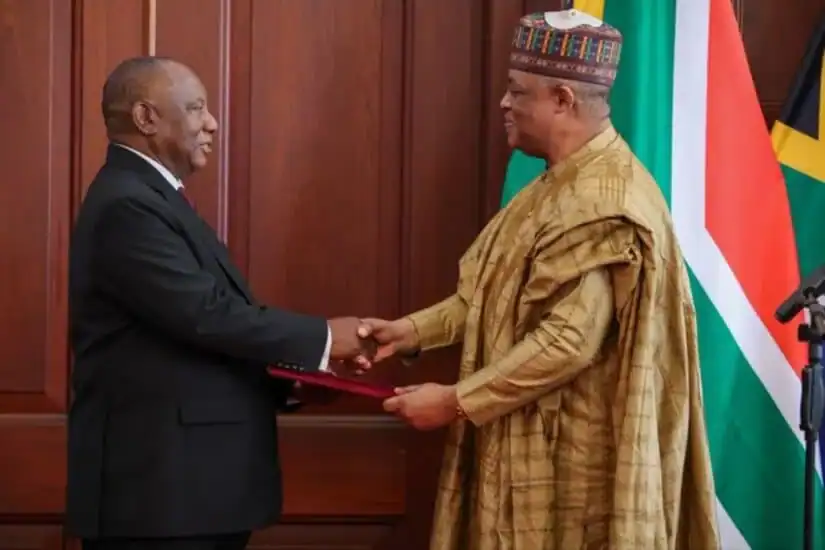
President Cyril Ramaphosa receives Letters of Credence and Letters of Recall from Olufemi Adewumi Fani-Kayode during the Credentials Ceremony in Tshwane. Picture: The Presidency/X


South Africa has demarched Nigeria’s High Commissioner to South Africa, Femi Fani-Kayode, for bypassing established diplomatic channels with his social media remarks after last week’s credentials ceremony.
The Director-General of the Department of International Relations and Cooperation (Dirco), Zane Dangor, met with Fani-Kayode on Tuesday, 17 November, to convey South Africa’s concern over his conduct.
SA demarches Nigeria’s High Commissioner
On Friday, heads of mission-designate attended the credentials ceremony, where President Cyril Ramaphosa received their letters of credence and letters of recall.
After the ceremony, Fani-Koyode accused the Presidency of refusing to air his introduction and cutting him out of the SABC News livestream “completely”.
“Of all the 15 introductions and speeches that were made and delivered this morning, only Nigeria’s was cut out,” he said in a social media post.
“I raised the issue with President Ramaphosa directly during the course of the photo session, and whilst we were still on the premises, and, in fairness to him, he took me to the relevant officials and acted with dispatch.”
Fani-Koyode drew criticism from both Presidency spokesperson Vincent Magwenya and South Africa’s head of public diplomacy Clayson Monyela.
Magwenya criticised the Nigerian official for “misrepresenting facts” on social media, instead of following proper diplomatic channels.
Dangor met with Fani-Kayode to convey SA’s concern
Following this, Dirco called Fani-Koyode in for a meeting with the director general.
The department said that during Dangor’s meeting with Fani-Koyode, he reiterated the importance of maintaining the historic and long-standing bilateral relationships between Nigeria and South Africa.
The director general said that the relationship is founded on mutual respect, friendship and cooperation.
“Mr Dangor further recalled the provisions of Article 41 of the Vienna Convention on Diplomatic Relations (1961), which require diplomatic agents to conduct official business with the receiving state through the Ministry of Foreign Affairs,” Dirco said.
The department said it emphasised that all official communication should go through established diplomatic channels, including Dirco.
“South Africa remains committed to the continued strengthening of its strategic partnership with Nigeria and to maintaining constructive diplomatic engagement in the spirit of African solidarity and mutual respect,” the department said.
SABC responds to Fani-Koyode
Meanwhile, the SABC responded to Fani-Koyode’s criticism over its coverage of the diplomatic ceremony.
In his post, he said he declined an interview with SABC News over what he described as the “deplorable” treatment of the Nigerian delegation and warned that he would not tolerate any disrespect towards Nigeria or its government.
In response, the SABC said it regretted the high commissioner’s decision not to grant an interview.
The public broadcaster also sought to clarify what it described as misconceptions about its role.
“Two points need clarifying. First, the SABC is a public service media, not a state broadcaster. Our mandate is to serve the public interest through independent, impartial and credible journalism. The Presidency’s livestream arrangements and SABC News’ editorial coverage are separate matters.”
The broadcaster said it remained committed to the principles of “fairness, impartiality, and editorial independence” and valued its longstanding relationship with Nigeria.
Additional reporting by Vhahangwele Nemakonde and Faizel Patel