



Allies and rivals alike are hedging as US foreign policy grows more unpredictable.
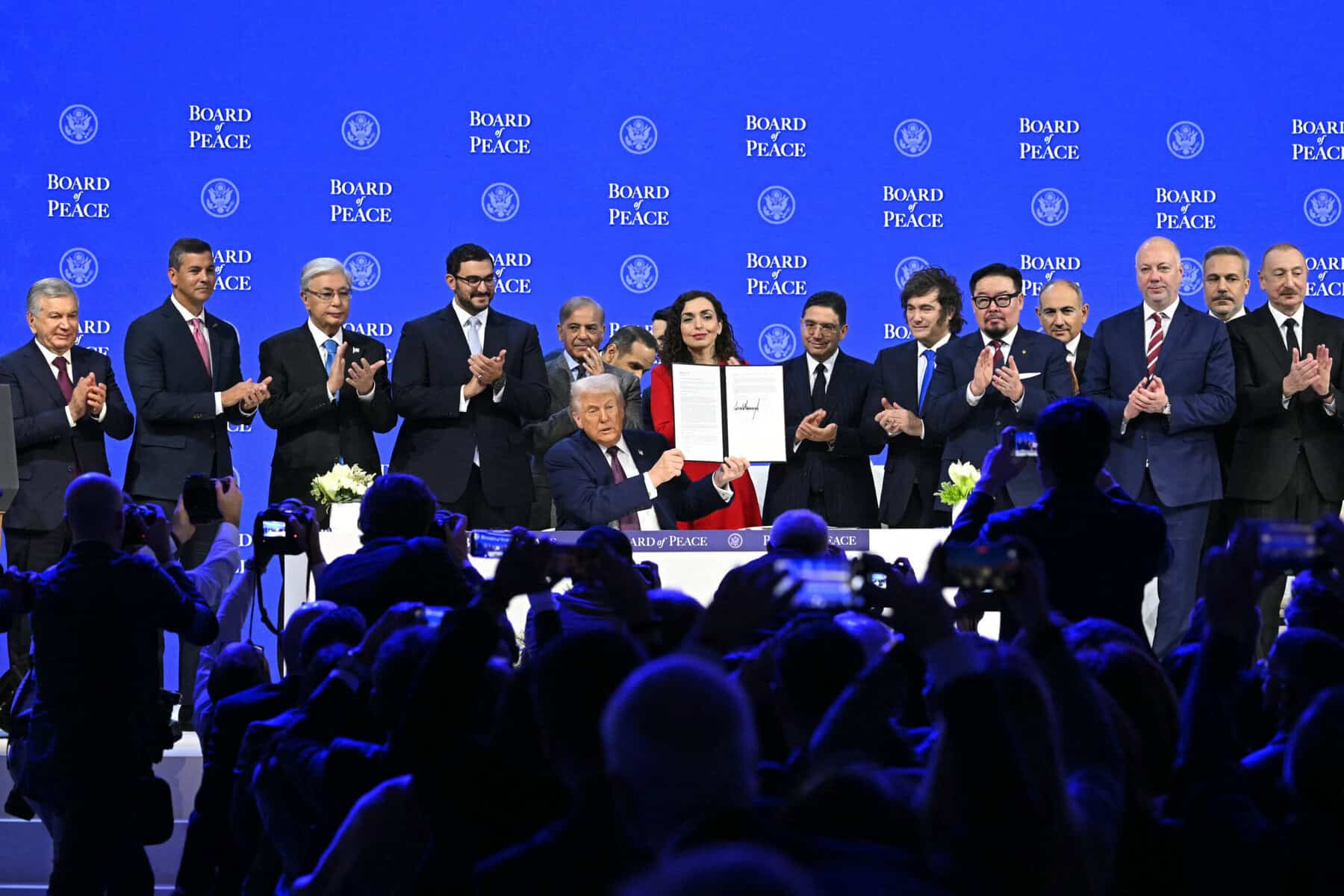
US President Donald Trump (C) holds a signed founding charter surrounded by leaders of various countries at the “Board of Peace” meeting during the World Economic Forum (WEF) annual meeting in Davos on January 22, 2026. Picture: Fabrice Coffrini / AFP


US President Donald Trump’s announcement of a self-styled Board of Peace is being hailed by some as an audacious effort to reorder international diplomacy.
Yet, beneath the spectacle lies a stark illustration of how unpredictability in US foreign policy is recalibrating alliances, emboldening rivals, and testing the coherence of the global order.
At first glance, the Peace Board appears ambitious: a forum designed to tackle protracted conflicts, from Ukraine to the Middle East, bypassing traditional institutions like the United Nations.
Trump extended invitations to global leaders, including Russian President Vladimir Putin. But the Russian response was measured and revealing.
The Kremlin emphasised that any engagement would be channelled through its foreign affairs apparatus and subject to consultation with strategic partners – a subtle but unmistakable signal that Moscow will neither be hurried, nor subordinated, to a US-centric framework.
Putin effectively transformed a public US initiative into a bureaucratic consultation, preserving leverage, while managing expectations.
China, for its part, adopted a similarly calibrated stance. Xi Jinping acknowledged the invitation without committing to participation, reiterating Beijing’s priority of safeguarding strategic autonomy and maintaining stable bilateral relations with Washington.
ALSO READ: What is Trump’s ‘Board of Peace’?
This careful hedging exemplifies China’s broader approach: engage where it advances national interest, avoid symbolic alignment that could compromise independence.
In effect, Trump’s peace gambit is being reframed by global powers to suit their own strategic calculus. Even US allies are navigating uncertainty.
South African President Cyril Ramaphosa’s absence from Davos raises questions about both strategy and perception.
Some interpret it as solidarity with the global south’s preference for multilateralism; others suggest it signals irritation at Washington’s exclusion of South Africa from the 2026 G20 summit in Miami.
Either reading underscores the diplomatic ripple effects of a unilateral American initiative: when trust in predictability erodes, allies recalibrate, hedge, or withhold engagement.
Canada’s actions illustrate another dimension of this volatility-driven realignment. By pursuing pragmatic engagement with China, Ottawa signals that medium powers can and will diversify partnerships in response to US unpredictability.
Trump’s Peace Board, like his broader foreign policy – from Greenland to Iran to Venezuela – reinforces the lesson: allies cannot assume stability; they must strategically hedge while the United States experiments with transactional or performative diplomacy.
ALSO READ: Trump launches ‘Board of Peace’ at Davos
The Peace Board, therefore, is less a mechanism for resolving global conflicts than a diagnostic tool exposing the frailty of the traditional Western-led order.
Putin’s cautious response, Xi’s measured engagement, South Africa’s diplomatic discretion and Canada’s recalibration all demonstrate a world in which predictability and consistency are increasingly valued commodities.
Where US leadership wavers, influence migrates to actors willing to navigate complexity with disciplined foresight.
In the end, the Peace Board reveals the paradox of power in the modern era: influence is no longer determined by unilateral initiative or spectacle.
It accrues to those who understand, adapt and negotiate within the structural realities of a multipolar world.
Trump may launch forums, gestures, and headlines, but the real work of shaping outcomes is now being done elsewhere – quietly, deliberately and on terms that the United States cannot dictate.
NOW READ: The world must stand up to bully Trump
Support Local Journalism
Add The Citizen as a Preferred Source on Google and follow us on Google News to see more of our trusted reporting in Google News and Top Stories.

