



Eskom warns of supply cuts as City Power owes R5.2 billion in arrears while crackdowns target theft in Kya Sands, Randburg.
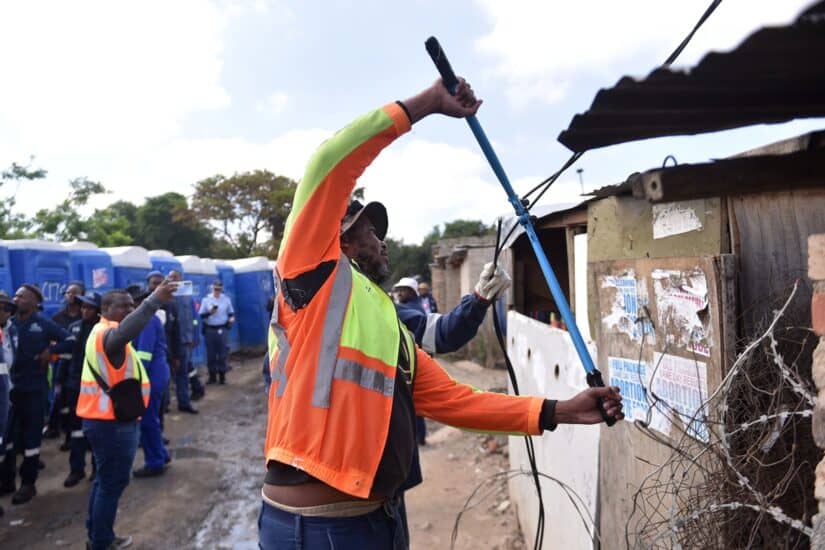
City Power employees and contractors remove illegal connections at Kya Sands in Randburg. Picture: Nigel Sibanda


Johannesburg’s electricity debt problem extends far beyond poor areas, with new figures from City Power showing some of the utility’s largest unpaid bills are concentrated in affluent suburbs, businesses and commercial hubs.
Service delivery areas such as Randburg, Roodepoort and Hurst Hill each owe well over R1 billion, with the inner city alone accounting for a staggering R3.67 billion of the utility’s R13.3 billion debt book, City Power spokesperson Isaac Mangena said.
Randburg, Roodepoort and inner city owe billions
While Alexandra township remains one of the city’s most troubled areas from a revenue collection perspective, its total outstanding debt of R718.7 million is significantly lower than several other City Power supply areas.
Its debt is made up of R364.8 million owed by residents, R129.9 million by businesses and R223.9 million by large power users.
City Power’s debt is spread across residential customers, businesses and large power users. The utility’s latest breakdown shows the inner city owing R3.67 billion, comprising R1.63 billion in residential debt, R1.09 billion owed by businesses and R938.8 million by large power users.
The suburb, Reuven, follows with R2.37 billion in total debt, while Hurst Hill owes R2.2 billion. Other major debt hotspots include Roodepoort at R1.28 billion, Randburg at R1.23 billion and Lenasia at R1.2 billion.
Midrand records the lowest debt at R634.7 million.
Inner city, Reuven and Hurst Hill each top R2 billion
“Debt reporting is based on service delivery centre boundaries and not township classifications,” Mangena said. “These areas include a mixture of residential neighbourhoods, businesses and industrial customers.
Electricity theft continues to have a significant impact on City Power’s finances and infrastructure across Johannesburg, he said.
The utility estimates its overall electricity losses at 29.87%, made up of technical and non-technical losses.
City Power buys its electricity from Eskom and sells it on to its customers. Effectively, this means City Power still pays Eskom for the 29.87% of total electricity it loses.
Technical losses are linked to ageing infrastructure, overloaded feeders and network inefficiencies, while non-technical losses are largely caused by illegal connections, electricity theft, meter bypassing and unmetered consumption.
Illegal connections drain revenue and infrastructure
City Power said these activities cost the utility billions of rand annually, while placing severe strain on infrastructure.
The Auditor-General’s 2023/24 findings recorded R4.9 billion in electricity losses, caused mainly by illegal connections, damaged and bypassed meters, technical losses, and billing failures.
The utility also reported a R2.8 billion net loss.
This crisis is now affecting the wider city. In May, Eskom announced that City Power owed R5.2 billion in arrears, excluding a further R1.5 billion current account. Eskom has warned that supply interruptions could follow if the issue was not resolved.
In one of the latest crackdowns, City Power dismantled 10 illegally installed transformers in Kya Sands, Randburg, on 9 June. The operation resulted in the arrest of one suspect allegedly linked to the illegal electricity network.
10 illegally installed transformers
Mangena said the operation targeted infrastructure used to facilitate large-scale electricity theft and follows a similar intervention about a year ago, when 13 illegal transformers were removed from the same area.
To curb losses and improve revenue collection, Mangena said the utility has intensified intelligence-led operations with the South African Police Service, the Joburg Metropolitan Police Department and private security companies.
“City Power is also implementing a normalisation programme aimed at removing illegal connections, installing legal meters and ensuring all customers pay for the electricity they consume.
“Areas including Mayibuye, Kanana, Rabie Ridge, Freedom Park, Tshepisong and parts of Alexandra have already undergone aspects of the programme,” Mangena said.
City Power believed reducing non-payment and electricity theft would allow it to recover significant revenue, strengthen infrastructure maintenance, accelerate upgrades and improve the reliability of Johannesburg’s electricity network, he added.



