The Section 89 panel's report on Phala Phala must to be referred to an impeachment committee.
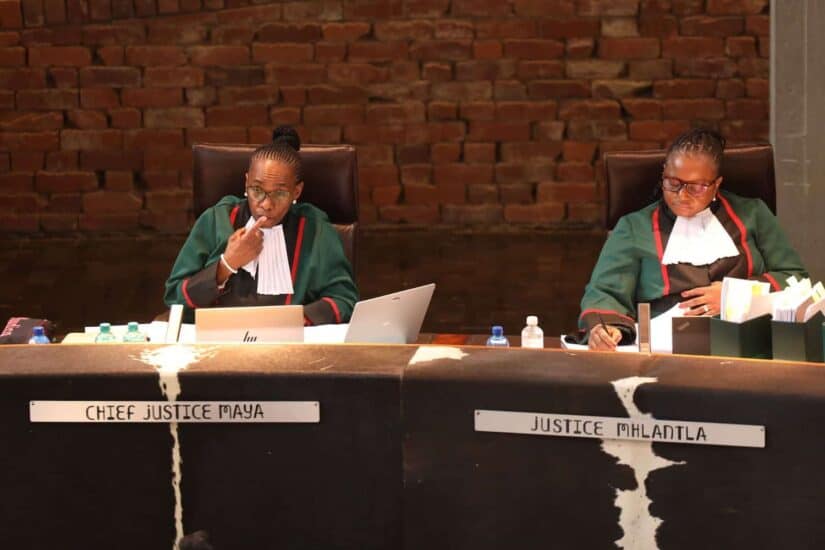
Chief Justice Mandisa Maya and Justice Nonkosi Mhlantla during the hearing of the National Health Insurance (NHI) case at the Constitutional Court (ConCourt) on 5 May 2026. Picture: Gallo Images/Sharon Seretlo


The Constitutional Court (ConCourt) has sent the Section 89 panel’s report on the Phala Phala scandal back to parliament, paving the way for an impeachment process against President Cyril Ramaphosa to proceed.
The ConCourt delivered its much-anticipated judgment at Constitutional Hill in Braamfontein, Johannesburg, on Friday, 8 May 2026.
Why did EFF and ATM approach the ConCourt?
The Economic Freedom Fighters (EFF) and the African Transformation Movement (ATM) turned to the apex court after parliament declined to adopt the Section 89 independent panel’s report, which could have triggered an impeachment inquiry against the president.
The panel concluded that there was prima facie evidence for Ramaphosa to answer questions about the theft of approximately $580 000 (about R9.6 million) stolen from his Phala Phala game farm in Limpopo in February 2020.
However, in December 2022, the National Assembly voted against referring the report to an impeachment committee.
The ANC used its majority at the time, with MPs following the party’s instruction to reject the findings.
Chief Justice apologises for delay
During Friday’s proceedings, Chief Justice Mandisa Maya apologised for the delay, which had drawn heavy criticism after more than 500 days had passed since the case was heard in November 2024.
“I start by taking full responsibility for the delay in producing this judgment concerning an extremely difficult matter of national importance, and I tender my sincere apology to the parties, my colleagues and fellow South Africans for the inconvenience it has caused,” she said.
Watch the proceedings below:
Delivering the first judgment, Maya noted that the EFF and ATM were seeking an order declaring parliament’s vote unlawful and irrational.
The applicants went further, she highlighted, challenging the constitutionality of Rule 129I of the National Assembly’s rules, which governs the process for removing a president from office under Section 89 of the constitution.
The chief justice explained that while the application was filed more than a year after the parliamentary vote took place, this didn’t stop the apex court from hearing the matter.
“The first judgment finds that the substantial delay, which was not explained, is unreasonable; however, it finds that several factors favour overlooking the delay,” Maya said.

ConCourt judgment on Phala Phala
The relief sought by the applicants, Maya pointed out, was not “moot”, as the ConCourt was not precluded from entertaining a challenge to the National Assembly’s rules.
The chief justice added that an impeachment inquiry could take many months.
The first judgment concluded that Rule 129I effectively blocked an impeachment process without meaningful engagement on a motion during a parliamentary vote.
According to Maya, this undermined the values of accountability and transparency.
The rule was therefore declared inconsistent with the Constitution and invalid.
As a result, the National Assembly must amend the rule.
In addition, the Section 89 panel’s report must be referred to an impeachment committee.
“The first judgment finds that the EFF has been successful.”
Other judgments
The second judgment, however, took a different view.
Judge Jody Kollapen, in a minority ruling, found that even if Rule 129I was unconstitutional, this did not mean that the National Assembly’s vote was invalid.
The last judgment, penned by three judges, found that once the rule is set aside, “the vote taken cannot stand”.
“The third judgment concludes that Rule 129I is unconstitutional and must be set aside.
“It further holds that the National Assembly’s vote must, likewise, be set aside because it was taken under an invalid rule that prevented the National Assembly from properly determining whether a ground for impeachment existed.
“The vote, therefore, lacked a lawful foundation,” Maya said.
Consequently, the National Assembly’s decision to reject the panel’s report was declared irrational and unconstitutional.
Watch the video below:
Rule 129I changes
The Chief Justice indicated that, until it is amended, Rule 129I is to be applied in the following terms:
- Once the panel has reported, the speaker must inform the National Assembly of the report.
- The president must be provided with a copy of the report forthwith.
- If the panel concludes that sufficient evidence exists, as contemplated in Rule 129G, the matter must be referred to the impeachment committee established by this rule or by the National Assembly rules for that purpose.
- If the panel concludes that sufficient evidence does not exist, as contemplated in Rule 129G, the speaker must schedule the report for consideration by the Assembly. If the Assembly nonetheless resolves that a Section 89(1) inquiry proceed, the matter must be referred to the impeachment committee established by this rule or by the National Assembly Rules for that purpose.
The Section 89 report will now proceed to an impeachment committee.