


The Namibian national also described the personal toll of his conviction.
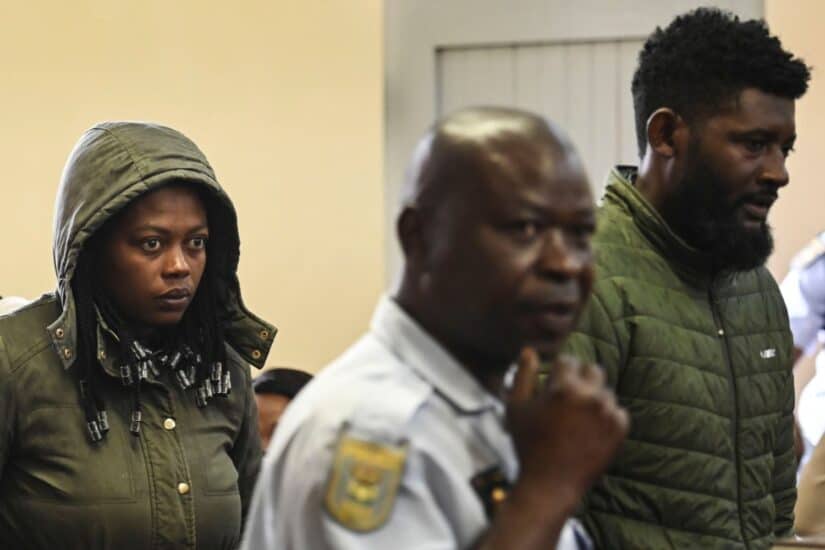
Froliana Joseph (L) and Imanuwela David (R) appear at Bela-Bela Magistrate’s Court on 7 November 2023. Picture: Gallo Images/Deaan Vivier


Imanuwela David has asked the Modimolle Regional Court to consider his personal circumstances when determining his sentence for his role in the theft at President Cyril Ramaphosa’s Phala Phala farm.
However, despite his conviction, the 42-year-old continues to distance himself from the crime, maintaining that he knows nothing about the break-in.
David appeared in court alongside his co-accused, Froliana Joseph, as the sentencing proceedings in the high-profile case continued in Limpopo.
The two were convicted on 2 November of housebreaking, conspiracy to commit housebreaking with intent to steal, and theft.
David was further found guilty of money laundering.
Joseph’s brother, Ndilinasho David Joseph, walked free after being acquitted.
Sentencing proceedings in Phala Phala farm theft trial
Giving evidence in mitigation of sentence on Friday, 13 November 2026, David told the court that his detention had placed considerable strain on his family.
He explained that he had been financially supporting his mother and four children before his arrest in November 2023, leaving them without their main source of income.
“Since the day of my arrest, I can say that it has affected me a lot more, especially because I was a breadwinner to my family, starting from my mother, my siblings [and] my kids.
“So now I’m here in prison and people who were depending on me, they are stranded,” the Namibian national testified through the court’s Oshiwambo interpreter.
David also described the personal toll of the conviction, telling the court that he was “emotionally, physically and mentally drained” by his conviction.
“I am not happy, but I will accept whatever the court has decided,” he continued.
Despite being found guilty, David continued to deny having any knowledge of the incident at the president’s farm.
“I have no idea, and I don’t know anything concerning the break-in. Therefore, if I comment now or say something, it will look as if I am defending myself.”
He nevertheless urged the court to show him leniency when considering an appropriate sentence.
The court also questioned David about his ability to pay a R1 million fine.
In response, he indicated that he could raise R500 000.
Meanwhile, Joseph’s legal representative requested additional time to secure a correctional supervision report from a Correctional Services officer.
The request suggests that the defence may be considering correctional supervision as a possible sentencing option for Joseph, who has been out on bail since November 2023.
Magistrate Peter Manthata postponed the matter to 26 November.
US dollars stolen at game farm
The criminal proceedings centred on the theft of 580 000 in US dollars, estimated to have been worth approximately R9.2 million at the time.
The money was stolen from a couch at Ramaphosa’s game farm in Bela-Bela, Limpopo, on 9 February 2020.
It was alleged that David went on a spending spree after the incident, acquiring expensive vehicles, properties and other luxury items.
Froliana, who had worked as a temporary cleaner at the farm, was suspected of providing information about the cash hidden inside the couch.
David and the Joseph siblings, who are originally from Namibia but hold South African citizenship, had earlier applied for a discharge in terms of section 174 of the Criminal Procedure Act (CPA), seeking to have the charges against them dismissed after the prosecution concluded presenting its evidence.
However, their application was unsuccessful, with the court rejecting the bid in April this year.
Alleged cover-up and investigations
The Phala Phala scandal only became public in June 2022, when former State Security Agency boss Arthur Fraser laid criminal charges against Ramaphosa and the head of the Presidential Protection Service, Wally Rhoode, with the South African Police Service, alleging that the pair had concealed the theft of $4 million (around R65.5 million).
Ramaphosa later confirmed that a burglary took place, but maintained that the $580 000 cash was payment for the sale of Ankole cattle to Sudanese businessperson Hazim Mustafa, who had not yet collected the livestock.
Further allegations by Fraser suggested that Rhoode improperly used state resources to investigate the theft and manage its fallout.
Subsequent investigations by the Public Protector, the South African Reserve Bank and the South African Revenue Service cleared the president of wrongdoing.
However, the Independent Police Investigative Directorate concluded in its report that Rhoode deliberately covered up the break-in at Phala Phala farm, in addition to kidnapping the suspects and interrogating them.


