


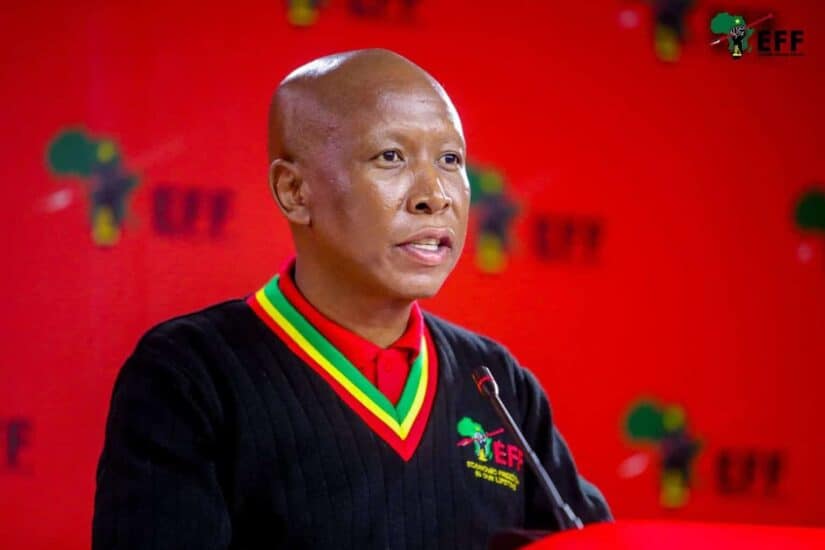
EFF leader says social grant recipients receive little money.


With South Africa’s elections often serving as a stage for political parties to put their best foot forward, promises to win voters’ support are taking centre stage.
With the upcoming local government elections set for 4 November, parties are already rolling out their pitches to South Africans, with EFF leader Julius Malema putting the country’s youth firmly in his sights.
Malema, on Saturday at the party’s provincial manifesto launch in the North West, promised a raft of measures to tackle the challenges facing young South Africans, including support for unemployed graduates, while arguing that the current social grants, particularly the R370 Social Relief of Distress (SRD) grant, are not enough.

LIVE interactive map, latest news, multimedia and more!
View MapSocial grant for the unemployed is too little
The SRD grant was introduced during the Covid pandemic as emergency support for unemployed and vulnerable South Africans. What was initially intended as a temporary lifeline has endured well beyond the pandemic, becoming an important source of income for millions of people amid persistent unemployment and economic hardship.
The SRD grant started at R350 in May 2020, but now pays R370. Malema said this amount is too little for anyone to survive given the cost of living.
“We do not want the SRD grant just to be permanent, but we want it to increase, because what can one buy with R350? We want the money to increase, but it must only be given to people who have no income.”
Social grants for unemployed graduates
Malema told voters that no party has the legal right to take Sassa away, and the EFF will ensure the source of income for millions of households remains in place.
“We want graduates to be employed; if they are not given jobs, they must be given a graduate allowance,” he said.
“They [ANC] played with us; they said education pays, their education does not pay; it is only EFF education that will pay – if we do not give you a job, we give you a graduate allowance. This will also motivate others to go to school because they will see that indeed education pays.”
Free electricity
On the same day, he addressed EFF supporters in Mpumalanga, where he also took a moment to slam the amount of social grants, citing that elders in the country are responsible for raising many grandchildren. Therefore, the R2 400 and R2 420 old age recipients receive per month is too little. He wants the grants to start at R4 500.
Malema touched on Free Basic Electricity (FBE), saying that Sassa recipients must automatically receive free electricity, instead of having to register with municipalities because they have already been recognised as indigent.
“Old age pensioners must not pay for electricity; everyone who is a Sassa recipient must not pay for electricity, because when they give you social grants, it is because you are struggling, but then they come back and steal it with water and electricity. You cannot be poor when it’s time to receive Sassa, but rich when it’s time to pay for electricity and water,” he said.
“When we win Mbombela, we are going to scrap the debt of the poor, no one will owe the municipality.”
FBE needs to reworked
Malema is not the first to slam the FBE’s registration. Organisation Undoing Tax Abuse (Outa) has previously warned that the process of getting households to receive free electricity needs review.
“The policy intention is good, but implementation has been poor and inconsistent across municipalities. Government itself has previously acknowledged that millions of households who should benefit from FBE are not receiving it,” said Julius Kleynhans, executive manager for local government at Outa.
“The Auditor-General has also repeatedly highlighted that nearly half of our municipalities did not have adequate internal controls to manage indigent households.”
Simply put, the amount of free units households receive is not the only issue; the biggest challenge lies in identification, registration, administration, outdated indigent registers and municipal capacity.